Spotlight: The Forgotten Ones by Andrea Bills

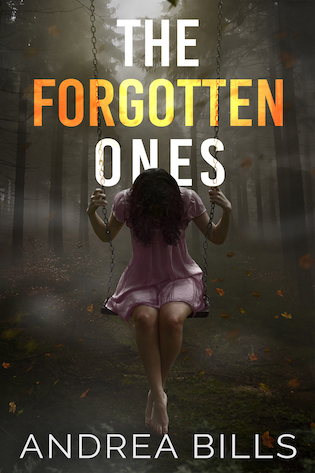
The Forgotten Ones
Andrea Bills
Publication date: May 6th 2019
Genres: Adult, Mystery, Romance, Thriller

From the iBooks Bestselling Author of Hardwired comes
One small town.
One lost love.
One killer.
Agent Caitlin Cade is called back to her hometown by a serial killer. She’s avoided the town for six years, trying to create a new life away from the painful memories of the sudden passing of her father and a love lost.
Dean Campbell was given a mission that forced him to walk away from the only woman he had ever loved. Just as his mission is over and he can return to her news reaches him that a serial killer has Caitlin caught in a deadly game.
Can Dean handle not being the one in control in order to show Caitlin he’s back for good? Can Caitlin not only face her past but also a killer who always seems two steps ahead of her? As a game of chess plays out using human bodies, secrets and lies come to see the light of day for the first time.

Goodreads / Amazon / Barnes & Noble / iBooks / Kobo

EXCERPT:

All the Gods, all the heavens, all the hells, are within you. —Joseph Campbell

“Have you ever heard the saying; ‘only the forgotten are dead’?”

The young girl shook her head. Tears welled up in her eyes, but they hadn’t fallen yet. This one was tough. She was fighting the terror that was undoubtedly coursing through her body. There was no point in fighting it; her death was inevitable.

“See, I will kill you, but if I remember you, then it’s like you’re not even dead.”

A whimper escaped from the girl. She wasn’t the first one to die, and she wouldn’t be the last. She would be the first to send a message, so her body would be the first one to be discovered unlike the others; the forgotten ones. Their bodies had been left to decay in their shallow graves never to be found. There was an added excitement knowing someone — Agent Caitlin Cade more precisely— would be staring at this girl’s dead body in just a matter of hours.

“Don’t worry baby girl, you won’t be one of them; one of the forgotten ones. You’re going to be found.”

A scream ripped through the room.

“I always like to talk during this next part. I don’t know why. The first few times I thought maybe it was just what was left of my humanity reaching out to offer comfort in the final minutes of their lives, but that’s not it. I haven’t had humanity in years.”

The knife sliced through the air, and the first cut into flesh vibrated to the depths of the killer’s soul. The feeling was orgasmic. Another cut and then another. The smell of fresh blood wafted through the room permeating every single crack and crevice. The beautiful scream that ripped from the girl’s throat was the icing on the cake. Over and over the knife cut into her flesh.

“I saw a therapist once, and she told me that my mind was like a disease. Can you believe that? Someone who went into the business of helping people told me that.”

The girl’s body was lifeless now. There was no point in checking for a pulse. Still, the desire to feel the knife tear through her flesh was uncontrollable. That was the problem with the urges. They were impossible to control. Blood sang a song like the sirens from the old tales, and there was no refusing the call.

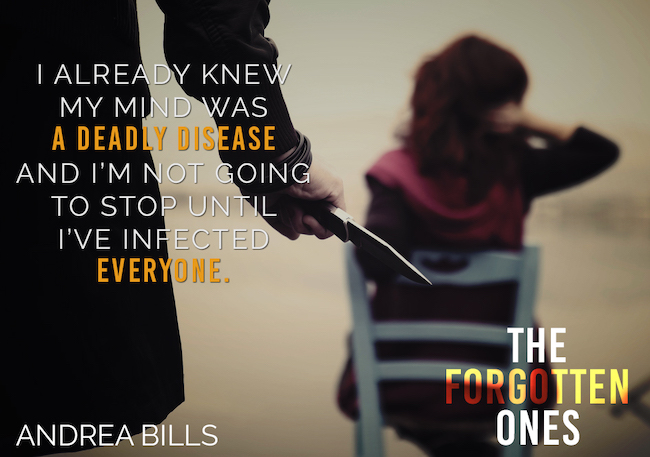
“I already knew my mind was diseased, and I’m not going to stop until I’ve infected everyone.”

If only walls could talk, these walls would tell some very horrific stories. Stories that were filled with screams, begging and pleading, but never salvation. This room had never seen salvation.


Author Bio:

Andrea is a wife, mother and writer from small town West Virginia. She spends her time while she's not dreaming up lovers and villains alike chasing after her two kids and husband.
Her overactive imagination and her husband's wacky dreams attribute to her love of the written word. Guilty pleasures include reading all night and Reese Cups.

Goodreads / Facebook / Instagram


GIVEAWAY!
a Rafflecopter giveaway

XBTBanner1

Spotlight: Nobody’s Fool by Ophelia Bell

Nobody’s Fool
Ophelia Bell
(Fate’s Fools #5)
Publication date: May 7th 2019
Genres: Adult, Paranormal, Romance

Deva Rainsong has a mission to take revenge on a god, but all she really wants is to understand why one mortal man doesn’t love her. Once upon a time, Ozzie West was her first love, her savior, and the man she always believed she could count on no matter what. But to him it’s as if she never existed.

Unfortunately Deva’s mission won’t wait, and she needs Ozzie’s love to fulfill her promise to Fate or their entire world could come crashing down around them. Because when you piss off a god, you’d better have the power to strike back.

Goodreads / Amazon / Barnes & Noble / iBooks / Kobo / Google Play

EXCERPT:

I plucked at the strings again, restarting the song and finding my voice. Despite a tongue clumsy from drink, I had no trouble singing clearly. Call it my superpower; I may not have been able to walk a straight line, but I could still make flawless music while wasted.

Her eyelids fluttered closed and some of the tension in her expression eased. Her spine became less rigid and she seemed to flow across the room toward me. The way she moved may have been the most graceful thing I’d ever seen. She was just walking, but it felt like a dance, each step matching the beat of my song. My pulse raced, my body heated, and I could hear my heartbeat in my ears, thrumming to the same tempo.

My mouth had gone dry by the time she climbed up on the bed. She crawled across the covers, her movements seductive though her eyes were closed now. She only paused for a second to listen before continuing toward me, straddling my legs.

I pushed back against the pillows, the notes faltering, then stopped entirely when her breasts grazed my hand.

“Uh, I can’t play if you’re going to climb all over me. You understand that, right?”

“Sing,” she demanded.

I got the impression her vocabulary must have been limited to singular syllables in this form, and I doubted the wisdom of allowing her to just crawl on top of me the way she was doing. I clutched the guitar, deciding it was probably better to keep some barrier between us, considering she was looking at me as if she wanted to eat me.

“Why don’t you just sit next to me here, and I’ll sing you all the songs you want?” I patted the bed beside me and then started in on a different song—one I knew all the words to.

Her face twisted with displeasure. “No!” She tore the guitar from me with surprising strength and sent it crashing to the floor in a dissonant clatter. She surged up close, her breath hot against my ear, her full breasts warm through the thin fabric of my shirt.

“Sing,” she rasped.

I cleared my throat and hummed a bar of the unfinished song, then stopped. “You mean that one?”

“Mmm,” she said, a small smile gracing her lips and her eyelids fluttering closed again.

“All right, but I need you to—ah—move off me.”

I grasped her by the shoulders and attempted to twist around to position her beside me. The next thing I knew, I was pinned flat to the bed, her wild eyes staring down at me as vines snaked down and coiled around my wrists.

“Sing.”

“Fucking hell,” I muttered, staring at the vines. I tugged hard, but they held tight.

Her lovely, dark face hovered over me, eyes a maelstrom of need, but a flicker of deeper awareness made me think Deva was still in there, perhaps along for the ride while her instincts had control. Up close, her lips were a deep blue, as was her tongue as it swept across her lower lip.

Fuck, now she did look like she was going to eat me, and I was only more convinced of that when she grasped the sides of my shirt and wrenched it open, leaving me absently relieved it had snaps instead of buttons.

She raked her blunt nails down my chest, the sensation more arousing than painful. My body came alive under her touch despite the fact that I knew she was off-limits. But holy fuck, was this hot. If she went any further, all bets were off.

Author Bio:

Ophelia Bell loves a good bad-boy and especially strong women in her stories. Women who aren't apologetic about enjoying sex and bad boys who don't mind being with a woman who's in charge, at least on the surface, because pretty much anything goes in the bedroom.

Ophelia grew up on a rural farm in North Carolina and now lives in Los Angeles with her own tattooed bad-boy husband and four attention-whoring cats.

If you'd like to receive regular updates on Ophelia's publications, freebies, and discounts, please subscribe to her mailing list: http://opheliabell.com/subscribe/

Website / Goodreads / Facebook / Twitter


GIVEAWAY!
a Rafflecopter giveaway

XBTBanner1

Spotlight: The Orphan's Song by Lauren Kate

The historical adult debut novel by # 1 New York Times bestselling author Lauren Kate, The Orphan’s Song is a sweeping love story about family and music–and the secrets each hold–that follows the intertwined fates of two Venetian orphans.

A song brought them together.
A secret will tear them apart.

Venice, 1736. When fate brings Violetta and Mino together on the roof of the Hospital of the Incurables, they form a connection that will change their lives forever. Both are orphans at the Incurables, dreaming of escape. But when the resident Maestro notices Violetta’s voice, she is selected for the Incurables’ world famous coro, and must sign an oath never to sing beyond its church doors. 

After a declaration of love ends in heartbreak, Mino flees the Incurables in search of his family. Known as the “city of masks,” Venice is full of secrets, and Mino is certain one will lead to his long-lost mother. Without him, the walls close in on Violetta and she begins a dangerous and forbidden nightlife, hoping her voice can secure her freedom. But neither finds what they are looking for, until a haunting memory Violetta has suppressed since childhood leads them to a shocking confrontation.

Vibrant with the glamour and beauty of Venice at its zenith, The Orphan’s Songtakes us on a breathtaking journey of passion, heartbreak, and betrayal before it crescendos to an unforgettable ending, a celebration of the enduring nature and transformative power of love.

Excerpt

One

Violetta!"

She spun from her bedroom window, from the seagull roosting on the terra-cotta rooftop next door. She'd been willing its wings to take flight and abandon this shadowy alley. If Violetta were a bird, she would be gliding over the ocean. She would never land on the same ship twice.

Outside, the September morning was so bright, and her sliver of sky so blue, that when she turned from the window it took a moment for her eyes to adjust to the heaving form in her doorway.

"What is it, Laura?" she asked, making room on the bed for her friend. Both girls were sixteen. They had been neighbors, sharing a wall between their single bedrooms on the second floor since they graduated from the nursery at ten. "Come, catch your breath. Take a lesson from a lazy seagull."

But it wasn't Laura's nature to catch her breath. She could worry over anything, from rain dampening a feast day to what happened to sparrow eggs when a mother bird swallowed a pebble of glass. She worried over the moisture from her palms when she played a difficult piece on the violin, drying the wood fastidiously with linen so it wouldn't warp. She worried over how to distinguish her playing from the other violinists in the music school. She worried deeply over being promoted to the coro, and she worried that Violetta didn't worry enough about being promoted with her. She never missed an opportunity to remind Violetta that the coro had space for only thirty-three women at a time, less than half the number presently training in the music school. There were only a few openings each year, as the older girls married or retired to nunneries.

Laura worried over Violetta's voice exercises and the sheet music for Violetta's librettos-too often left scattered on the floor. Over the years, Laura had gotten better at making up excuses for the prioress when Violetta was late for a lesson, but she never stopped worrying that Violetta would be caned. Their relationship was a duet: the more Laura worried, the more Violetta gave her cause to.

It wasn't that Violetta was carefree; she only seemed that way to Laura, who turned toward her worries as much as Violetta tried to escape them. It was why she spent so much time at her window, imagining herself beyond it.

Laura stuffed a loose curl back into the great brown bun of her hair. "Of course, you didn't hear."

"Hear what?" Violetta didn't know how long she'd been at the window. This happened on days when she'd had the dream.

The wheel, the woman. That song. Eleven years had passed since that night, but she remembered the dark race downstairs as if it were yesterday. She'd been the only one who knew he was there, stuck. The only one who could help. She'd never been so near a boy's alien body. He'd still been sleeping when she pulled him from the wheel.

Years later she had realized that his mother must have drugged him. That he hadn't even heard the woman's song.

Whenever Violetta dreamed that song, it rendered her waking life muted and pale. She struggled to go about her responsibilities as usual: rising at sunrise, praying aloud by rote-first the Angelus, then a prayer for suppression of heresy, one for their most pious republic, one for the benefactors and the governati of the Incurables, and on and on-just as all the other murmuring voices did in the rooms to the left and right of hers.

Before mass she had taken her breakfast of porridge and cream as the prioress's wide hips moved between the rough wood tables, spouting sacred readings in her corrosive whisper, daring any of them to gossip or to giggle. And then the morning had passed with three hours of music lessons-first with the full music school, second with a smaller coterie of singers, and finally with her private tutor, Giustina.

Giustina was beautiful, twenty-four, and the lead soprano in the coro. She was known as bella voce throughout the city, and even beyond the republic of Venice. Tourists traveled from across Europe, paying dearly to hear her perform. Last summer, she astonished Violetta, selecting her as one of two apprentices. Violetta still could not be sure what Giustina saw in her, but her sottomaestra's patient generosity inspired her to try her best.

At the moment, she was meant to be reading the latest corrections to her sheet music, practicing her trills and passaggios. Giustina would test her on them later, before compline, the prayer at end of day. But Violetta hadn't even looked at the pages. The moment she'd been free to close herself in her room, she'd drawn near the window, felt the warmth beyond it, and let her mind fly away.

The dream song haunted her, those words she could never sing aloud.

I am yours, you are mine . . . 

It had become her song. But who or what was she addressing? Sometimes she still thought of the boy she had pulled from the wheel that night. Before Violetta had left him near the embers of the kitchen hearth, tucked beneath a folded tablecloth, she had discovered the small painting clutched in his hand.

It was half a painting, really, a thin piece of wood, splintered from being shorn diagonally in half. It hung from a broken chain, as if it had once been a pendant. It featured a naked woman. Half a woman. Face and breasts and a belly covered by waves of flowing blond hair, the same shade as the boy's. Dark eyes cast into the distance, her mouth open in song against a blue sky.

The boy's mother must have kept the other half. Most orphans at the Incurables had some such token-part of a painting or a swath of patterned fabric-proof of a bond, should destiny ever reunite mother and child.

Violetta had none. She didn't believe in such fantasies.

She'd never seen that boy again, so separate were the lives of boys and girls at the Incurables. She didn't want to see him, though he was always with her. The song meant for him haunted her, gave words to the part of herself she most wanted to deny-that someone had done the same thing to her. She hoped he had no memory of his abandonment, that he never had to think upon that night. Likely by now he had moved on from the orphanage to an apprenticeship somewhere in the city.

"Violetta!" Laura took her arm. "Porpora is back."

Violetta jumped to her feet. "Why didn't you say so?"

That year, the Incurables had commissioned the famous Neapolitan composer Nicola Porpora to lead the coro. He was the final authority, determining which girls advanced and which did not. Even the youngest students, tiny children six years of age, straightened their shoulders and hushed their gossip at the mention of his name.

Those Porpora chose for the coro could look forward to years of intense collaboration with the brilliant, tightly wound composer and to regular performances before admiring crowds. The women of the coro enjoyed leisure time, more frequent outings, better food, and wine. Some of them received letters from important Venetians or European tourists who traveled just to see them perform. A portion of the sizeable earnings from their concerts was saved in a special dowry.

The girls not chosen for the coro became figlie di commun, the ordinary women of the orphanage. They served as nurses to the syphilitics on the first floor, or toiled in menial tasks like laundry and lace making, sewing and dyeing the thick wool cloaks that inimitable shade of midnight blue. Some became zie and cared for foundling babies. Figlie di commun worked for the orphanage until they were forty, and then they were sent to a nunnery. The only possibility of escape was to be sold off as a servant. But worst of all, the music simply stopped. There were no more opportunities to practice or perform if you were a figlia di commun.

This horrified Violetta. All they knew of life was music, and to have it taken away? She and Laura had pledged to each other that they would not accept this fate. Deep down, Violetta suspected that both of them knew Laura would be fine, but that Violetta, with her tendency toward daydreams, might not make the cut.

The maestro had been abroad for all of August and half of September. Lessons relaxed in his absence, but no longer. Porpora would stay on through the fall, through the festival of carnevale, as the coro prepared for their most important season of performances, Advent. For Violetta and Laura, and each of the sixty-two younger girls in the music school, Porpora's arrival meant a trial by fire.

"He wasn't meant to return until next week," Violetta said.

"He's early," Laura said. "And he wants to hear us. In the gallery."

"The gallery?" That was where the coro girls performed. Violetta had been in its anteroom many times, fetching sheet music for Giustina, but she'd never set foot in the special enclave that looked down over the entire church through a gilded grille. The music school girls practiced in a stifling, windowless chamber above the apothecary. It stank of the holywood tea brewing for the syphilitics downstairs.

"You're already late," Laura said, "and you're not leaving this room with your hair like that."

"What's wrong with my hair?" Violetta tugged the thick, dark rope that hung to her waist. There was no mirror in her chamber. She couldn't remember the last time she'd brushed her impossible hair.

"Leave it to me," Laura said, moving behind her, standing astride Violetta on the creaking bed, her toes nudging Violetta's thighs through her slippers. "You start warming up. Scales. And, Madonna, stockings!"

Violetta worked the scratchy wool stockings up her legs, fastening them with a ribbon just above her knee. She grumbled when Laura undid her days-old braid and pulled dense knots from her hair.

While Laura's fingers gathered and combed, Violetta straightened her back and breathed through a fibrous wall of nerves. She pulled on her tongue, flattening it between her fingers as she moved through three octaves of scales, as Giustina had taught her to do.

"When you sing," the sottomaestra had said, "you must think of what you want to say to the world."

When Violetta sang, she was barely confident enough to want to be heard, let alone to convey a message. She found it hard to imagine the world might be listening to her.

She turned the question back on Giustina. "What do you want to say to the world?"

Giustina pressed both hands to her breast and sighed. "Love is here."

Violetta's eyes had pricked with tears, for she felt there was nothing higher any musician could aspire to. And she felt hopeless. She would never be able to sing something so brave and essential to the world. She wanted to see and hear the world and be inspired by it. She couldn't imagine returning the favor.

Giustina had squeezed Violetta's shoulder and said softly, "Don't worry, you'll find it."

Would she? Violetta was a soprano, but a faint one, and despite her years of practice and prayer, her voice still stretched to reach the highest notes of the complicated arias she loved best. Sometimes she felt fear holding her back. If she could only make the coro and relieve herself of this anxiety, her voice might come into its own. She wondered what it felt like to perfect an aria, to sing as Porpora intended-or better. But when she thought of asking Giustina, she knew this was not something one could express, much like the buried root of Violetta's own longing.

The best moments were those when she felt her voice blend with the other singers'. When she felt a part of the music instead of alone. Then Violetta longed to be nowhere else, caught in the joyful embrace of a song.

But today the dream had its grip on her, and she felt unworthy of the music. Why did the maestro have to arrive now?

At least Laura's presence was a comfort. Soon she and Violetta synchronized-as Violetta moved toward the upper registers of her scales, Laura spun her hair into a neater, tighter braid. Music was in all the girls so deeply that they made it out of everything they did: the syncopated clanks of their spoons against their bowls at dinner, the soft percussion of their footsteps to nightly confession, the tenor whistle of their piss into porcelain pots.

"Hold your notes. What's wrong with you?" Laura said as she secured Violetta's hair. She came around to stand before Violetta, smoothed a wild cowlick, nodded at her work. She touched one finger under Violetta's chin, raised it, looked into her eyes.

"You had the dream?"

Violetta nodded, quiet but not ashamed. From the years she'd slept in the nursery she knew that nightmares were common. Laura knew Violetta dreamed of one thing again and again, and that when she did, it brought great sorrow, but she had never asked Violetta for details. And Violetta had never clarified; she had never asked about Laura's own painful dreams. What would have been the point? Each girl here had so little from her time before, when she had been figlia di mamma-the daughter of a mother-not just figlia degli incurabili-a daughter of the Incurables.

For Laura, it was enough to know Violetta had the dream and that the day would be shaped by its ghost. And so Laura's hand found Violetta's, a reassuring secret music in the pressure of their palms, in the sound of their slippers as they ran for the bridge.

The bridge was a short, windowless passageway, no longer than a gondola, accessed through the third floor of the dormitory. It arced over the courtyard and connected to the church in the center, opening onto a small anteroom where the coro girls warmed their voices, tuned their violins, and broke in new oboe reeds before performances.

Beyond a white door at the far end of the anteroom was the treasured performance space of the coro: the singing gallery. A chest-high marble parapet enclosed the gallery, and, above the parapet, the famous brass grille of sculpted orange blossoms was the object of widespread fascination. The grille was intended to obscure the performers from the eyes of the church below-and vice versa-but when Violetta sat in her pew downstairs with the other music school girls and gazed up, she could discern which girl was which.

How powerful and mysterious they had looked behind those gilded orange blossoms. How she always wanted to be one of them. She suspected most parishioners spent the full mass straining to see the angels making music on the other side.
Excerpted from The Orphan's Song by Lauren Kate. Copyright © 2019 by Lauren Kate. All rights reserved. No part of this excerpt may be reproduced or reprinted without permission in writing from the publisher.

Buy on Amazon | Barnes and Noble

About the Author

Lauren Kate is the internationally bestselling author of The Betrayal of Natalie Hargrove and the Fallen novels: Fallen, Torment, Passion, Rapture, and Fallen in Love. Her books have been translated into more than 30 languages. She lives in Los Angeles with her husband.

Spotlight: Recursion by Blake Crouch

From the New York Times bestselling author of Dark Matter and the Wayward Pines trilogy comes a relentless thriller about time, identity, and memory—his most ambitious, mind-boggling, irresistible work to date.

Memory makes reality. That’s what New York City cop Barry Sutton is learning as he investigates the devastating phenomenon the media has dubbed False Memory Syndrome—a mysterious affliction that drives its victims mad with memories of a life they never lived.

Neuroscientist Helena Smith already understands the power of memory. It’s why she’s dedicated her life to creating a technology that will let us preserve our most precious moments of our pasts. If she succeeds, anyone will be able to re-experience a first kiss, the birth of a child, the final moment with a dying parent. 

As Barry searches for the truth, he comes face-to-face with an opponent more terrifying than any disease—a force that attacks not just our minds but the very fabric of the past. And as its effects begin to unmake the world as we know it, only he and Helena, working together, will stand a chance at defeating it.

But how can they make a stand when reality itself is shifting and crumbling all around them? 

Excerpt

Barry

November 2, 2018

Barry Sutton pulls over into the fire lane at the main entrance of the Poe Building, an Art Deco tower glowing white in the illumination of its exterior sconces. He climbs out of his Crown Vic, rushes across the sidewalk, and pushes through the revolving door into the lobby.

The night watchman is standing by the bank of elevators, holding one open as Barry hurries toward him, his shoes echoing off the marble.

“What floor?” Barry asks as he steps into the elevator car.

“Forty-one. When you get up there, take a right and go all the way down the hall.”

“More cops will be here in a minute. Tell them I said to hang back until I give a signal.”

The elevator races upward, belying the age of the building around it, and Barry’s ears pop after a few seconds. When the doors finally part, he moves past a sign for a law firm. There’s a light on here and there, but the floor stands mostly dark. He runs along the carpet, passing silent offices, a conference room, a break room, a library. The hallway finally opens into a reception area that’s paired with the largest office.

In the dim light, the details are all in shades of gray. A sprawling mahogany desk buried under files and paperwork. A circular table covered in notepads and mugs of cold, bitter-smelling coffee. A wet bar stocked with expensive-looking bottles of scotch. A glowing aquarium that hums on the far side of the room and contains a small shark and several tropical fish.

As Barry approaches the French doors, he silences his phone and removes his shoes. Taking the handle, he eases the door open and slips out onto the terrace.

The surrounding skyscrapers of the Upper West Side look mystical in their luminous shrouds of fog. The noise of the city is loud and close--car horns ricocheting between the buildings and distant ambulances racing toward some other tragedy. The pinnacle of the Poe Building is less than fifty feet above—a crown of glass and steel and gothic masonry.

The woman sits fifteen feet away beside an eroding gargoyle, her back to Barry, her legs dangling over the edge.

He inches closer, the wet flagstones soaking through his socks. If he can get close enough without detection, he’ll drag her off the edge before she knows what--

“I smell your cologne,” she says without looking back.

He stops.

She looks back at him, says, “Another step and I’m gone.”

It’s difficult to tell in the ambient light, but she appears to be in the vicinity of forty. She wears a dark blazer and matching skirt, and she must have been sitting out here for a while, because her hair has been flattened by the mist.

“Who are you?” she asks.

“Barry Sutton. I’m a detective in the Central Robbery Division of NYPD.”

“They sent someone from the Robbery—?”

“I happened to be closest. What’s your name?”

“Ann Voss Peters.”

“May I call you Ann?”

“Sure.”

“Is there anyone I can call for you?”

She shakes her head.

“I’m going to step over here so you don’t have to keep straining your neck to look at me.”

Barry moves away from her at an angle that also brings him to the parapet, eight feet down from where she’s sitting. He glances once over the edge, his insides contracting.

“All right, let’s hear it,” she says.

“I’m sorry?”

“Aren’t you here to talk me off? Give it your best shot.”

He decided what he would say riding up in the elevator, recalling his suicide training. Now, squarely in the moment, he feels less confident. The only thing he’s sure of is that his feet are freezing.

“I know everything feels hopeless to you in this moment, but this is just a moment, and moments pass.”

Ann stares straight down the side of the building, four hundred feet to the street below, her palms flat against the stone that has been weathered by decades of acid rain. All she would have to do is push off. He suspects she’s walking herself through the motions, tiptoeing up to the thought of doing it. Amassing that final head of steam.

He notices she’s shivering.

“May I give you my jacket?” he asks.

“I’m pretty sure you don’t want to come any closer, Detective.”

“Why is that?”

“I have FMS.”

Barry resists the urge to run. Of course he’s heard of False Memory Syndrome, but he’s never known or met someone with the affliction. Never breathed the same air. He isn’t sure he should attempt to grab her now. Doesn’t even want to be this close. No, f*** that. If she moves to jump, he’ll try to save her, and if he contracts FMS in the process, so be it. That’s the risk you take becoming a cop.

“How long have you had it?” he asks.

“One morning, about a month ago, instead of my home in Middlebury, Vermont, I was suddenly in an apartment here in the city, with a stabbing pain in my head and a terrible nosebleed. At first, I had no idea where I was. Then I remembered . . . this life too. Here and now, I’m single, an investment banker, I live under my maiden name. But I have . . .”—she visibly braces herself against the emotion—“memories of my other life in Vermont. I was a mother to a nine-year-old boy named Sam. I ran a landscaping business with my husband, Joe Behrman. I was Ann Behrman. We were as happy as anyone has a right to be.”

“What does it feel like?” Barry asks, taking a clandestine step closer.

“What does what feel like?”

“Your false memories of this Vermont life.”

“I don’t just remember my wedding. I remember the fight over the design for the cake. I remember the smallest details of our home. Our son. Every moment of his birth. His laugh. The birthmark on his left cheek. His first day of school and how he didn’t want me to leave him. But when I try to picture Sam, he’s in black and white. There’s no color in his eyes. I tell myself they were blue. I only see black.

“All my memories from that life are in shades of gray, like film noir stills. They feel real, but they’re haunted, phantom memories.” She breaks down. “Everyone thinks FMS is just false memories of the big moments of your life, but what hurts so much more are the small ones. I don’t just remember my husband. I remember the smell of his breath in the morning when he rolled over and faced me in bed. How every time he got up before I did to brush his teeth, I knew he’d come back to bed and try to have sex. That’s the stuff that kills me. The tiniest, perfect details that make me know it happened.”

“What about this life?” Barry asks. “Isn’t it worth something to you?”

“Maybe some people get FMS and prefer their current memories to their false ones, but there’s nothing about this life I want. I’ve tried, for four long weeks. I can’t fake it anymore.” Tears carve trails through her eyeliner. “My son never existed. Do you get that? He’s just a beautiful misfire in my brain.”

Barry ventures another step toward her, but she catches him this time.

“Don’t come any closer.”

“You are not alone.”

“I am very f***ing alone.”

“I’ve only known you a few minutes, and I will be devastated if you do this. Think about the people in your life who love you. Think how they’ll feel.”

“I tracked Joe down,” Ann says.

“Who?”

“My husband. He was living in a mansion out on Long Island. He acted like he didn’t recognize me, but I know he did. He had a whole other life. He was married--I don’t know to who. I don’t know if he had kids. He acted like I was crazy.”

“I’m sorry, Ann.”

“This hurts too much.”

“Look, I’ve been where you are. I’ve wanted to end everything. And I’m standing here right now telling you I’m glad I didn’t. I’m glad I had the strength to ride it out. This low point isn’t the book of your life. It’s just a chapter.”

“What happened to you?”

“I lost my daughter. Life has broken my heart too.”

Ann looks at the incandescent skyline. “Do you have photos of her? Do you still talk with people about her?”

“Yes.”

“At least she once existed.”

There is simply nothing he can say to that.

Ann looks down through her legs again. She kicks off one of her pumps.

Watches it fall.

Then sends the other one plummeting after it.

“Ann, please.”

“In my previous life, my false life, Joe’s first wife, Franny, jumped from this building, from this ledge actually, fifteen years ago. She had clinical depression. I know he blamed himself. Before I left his house on Long Island, I told Joe I was going to jump from the Poe Building tonight, just like Franny. It sounds silly and desperate, but I hoped he’d show up here tonight and save me. Like he failed to do for her. At first, I thought you might be him, but he never wore cologne.” She smiles—wistful—then adds, “I’m thirsty.”

Barry glances through the French doors and the dark office, sees two patrolmen standing at the ready by the reception desk. He looks back at Ann. “Then why don’t you climb down from there, and we’ll walk inside together and get you a glass of water.”

“Would you bring it to me out here?”

“I can’t leave you.”

Her hands are shaking now, and he registers a sudden resolve in her eyes.

She looks at Barry. “This isn’t your fault,” she says. “It was always going to end this way.”

“Ann, no—”

“My son has been erased.”

And with a casual grace, she eases herself off the edge.

Excerpted from Recursion by Blake Crouch. Copyright © 2019 by Blake Crouch. All rights reserved. No part of this excerpt may be reproduced or reprinted without permission in writing from the publisher.

Buy on Amazon | Barnes and Noble

About the Author

Blake Crouch is a novelist and screenwriter. His novels include the New York Times bestseller Dark Matter and the international-betselling Wayward Pines trilogy, which was adapted into a teleivsion series for FOX. He also co-created the TNT show Good Behavior, based on his Letty Dobesh novellas. He lives in Colorado.

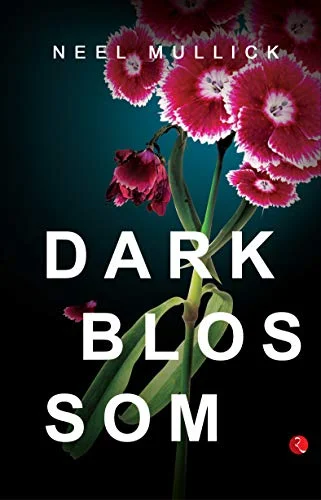
Spotlight: Dark Blossom by Neel Mullick

What happens when doctor and patient find themselves in the same sinking boat, yet rowing in opposite directions—one clinging to the past, and the other unable to move beyond it?

Sam returns home from a business trip a day before his son's thirteenth birthday to find his world cruelly shattered in one fell swoop. Initially thinking he can cope on his own, Sam finally seeks the help of Cynthia, an experienced therapist. What he doesn’t know is that Cynthia herself is trying to recover from a debilitating divorce and the sinister shadow of her ex-husband. In the midst of it all is Lily, Cynthia's daughter, who harbors a secret that has the power to explode the lives around her.

Taut with tension and intensity, Dark Blossom explores what lies beneath the surface of the lives of apparently “normal” people.

Excerpt

In the Same Boat

I love to stroll in the city but, that day, I had to be brisk. I needed to keep the cold out and didn’t want to miss the next train back home. Stepping carefully on the icy pavement, I planned the rest of my day. I still had a couple of patients to see later in the evening, giving me just enough time to prepare dinner for Lily and myself. I went through a mental checklist of the ingredients that would get us through with minimal fuss. Teens...Aargh! What I wouldn’t give for her to be all grown up? Or for me to be that age again?

As I entered the terminal, the aroma of coffee and sugar-steeped bread wafting through the labyrinth of people took my breath away. My fondest memory—that of my father standing near a pillar almost ten meters away and whispering how much he loves me, and my wonder at being able to hear it all the way across the whispering gallery—is another reason the terminal has that effect on me.

With more than forty platforms, it’s the largest station in the world. That almost three-quarters of a million people pass through it every day doesn’t overshadow its incredible history. The backwards Zodiac with 2,500 stars sprawled across the ceiling, the hocus-pocus the Vanderbilts fed the world about the mural being backwards because it was meant to depict god’s view of the universe, and the hole above Pisces serving as a reminder of the rocket that was housed there during the Cold War era—all add to its grandeur. And these are just parts of the opening act of the gala that is Grand Central.

Descending into New York City’s deepest basement to wait for the train to roll in, I looked down at the tracks running side by side. I couldn’t help but think of the parallels between Sam’s life and mine. While he had lost his family to a tragic accident, I had recently lost the veneer of mine to a debilitating divorce from Connor. My own loss was more bearable than his. Moreover, it was of my own making.

Following the tracks and seeing them criss-cross in the distant darkness, I thought of the paradoxes between our lives. While he couldn’t stop thinking of his family because he missed them and wanted them back, I couldn’t stop thinking of Connor because I couldn’t get rid of the sinister shadow he had cast over Lily and me.

I suddenly found myself in the same boat as Sam. And it was my job to keep him afloat. Only, we were rowing in opposite directions.

Settling into a window seat on the train, I thought of how a fatal crash at the turn of the nineteenth century had instigated a thirty-seven-year-old visionary to recommend the extravagant remedy of razing the existing depot to build the engineering marvel that is the Grand Central Terminal. Although I’m a staunch believer in just one life, I could see how in the passing of the old there is the birth of something new.

But not for Sam. My thoughts slipped back to him.

The loss of a loved one is like an amputation for the bereaved. Even though he may transition from anger to acceptance eventually, the phantom pain may never go away. I wanted to write some notes—all I had from our session was numbness in my index finger and thumb from holding the pen too tight.

I rummaged through my handbag for my Sam-notebook. I keep separate notebooks for each of my patients—they’re pocket-sized and each one comes with its own pen. That one was pastel blue with a darker, more vibrant embossing of Antoni Gaudí’s mosaic-dragon from the entrance of Park Güell in Barcelona. And it had a light-green pen nestled in a matching loop. It was distinctively Gaudí, as were most of my notebooks. He is my favorite architect, after my father of course.

Sam was stuck somewhere between denial and anger but much closer to the latter. He said he had gained weight, stopped socializing, and started smoking again. His work was his panacea but he had lost his mojo even for that—something that had never happened before. He had managed to pull himself together for the funeral, but his grief had exacerbated after the family had left.

The tussle between the past and the present—that of living through the experience and venting one’s emotions—is important for moving on. There is no better substitute than mourning—the lesser he mourned, the more difficulty he would have in letting go.

Yet something about our session didn’t add up. It had been a while since the tragedy, yet his memories had been very vivid, almost fresh. That’s not what piqued me though—what did surprise me was how angry he had been at the start of the session and how quickly he had crumbled. I wondered if he had expressed his feelings and shared the painful memories with anyone since the accident, or if our session was the first time he was talking about them. It mattered less for our therapy but more for his well-being that he had others to talk to as well about such intimate details. It was clear he needed to share and express more.

The announcement for Stamford broke my reverie. Even though it had been a somewhat tentative start with Sam, I was happy to be practicing again and knew I could help.

As I tucked away the notebook, my heart went out to him and then turned to Lily. I was filled with gratitude for having her in my life. She’s my pride and my passion. Even the rewards for helping my patients are a distant second to my gratification from nurturing her. She had gone through a lot but the worst was finally over—Connor had moved out and the divorce had come through.

I was almost at our doorstep as I thought—how could I have not seen it? How could my need to preserve the façade of a family have made me so blind to such a monster?

From Dark Blossom by Neel Mullick © 2019 by Neel Mullick.

Buy on Amazon | Barnes and Noble

About the Author

Neel Mullick is the author of Dark Blossom. The Head of Product and Information Security at a Belgian family-office technology company, Mullick is a graduate of Carnegie Mellon University and INSEAD. He mentors female entrepreneurs through the Cherie Blaire Foundation for Women, is involved in raising a generation of digital and socially aware leaders with Nigeria’s Steering for Greatness Foundation, supports improvement in the quality of life of domestic workers through Peru’s Emprendedoras del Hogar, and works with IIMPACT in India to help break the cycle of illiteracy plaguing young girls from socially and economically impoverished communities. Dark Blossom is his first novel.

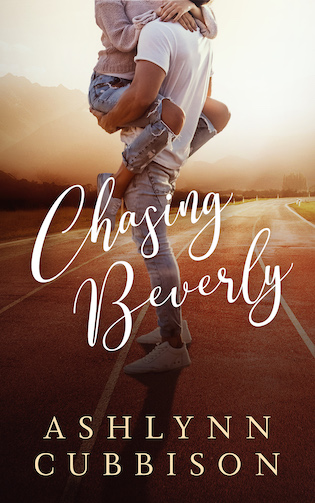
Cover Reveal: Chasing Beverly by Ashlynn Cubbison

Chasing Beverly
Ashlynn Cubbison
Published by: Acorn Publishing
Publication date: September 29th 2019
Genres: Romance, Sports, Young Adult

Two people. One chance to let it all go.

Seeking redemption, Beverly Morgan has spent the last four years building an empire that was someone else’s dream. Devoted to her work, a handful of friends, and an array of charities, she’s been able to lock away her heart and convince herself it’s dead. After an unthinkable tragedy, Beverly should know by now that a single day can change everything.

She can’t run from love forever.

Gavin has it all, a thriving business, phenomenal family, supportive friends, but an hour with Beverly Morgan makes him question his entire life and his own happiness.

She could be exactly what he needs, if she’s brave enough to open up again.

Add to Goodreads


Author Bio:

Ashlynn Cubbison is a goal-oriented, driven woman, who owns and operates four companies with her husband. They have two beautiful sons together, and although her life is chaotic, fun, full of love and never the same each day, somehow she finds room for writing as well.

Growing up Ashlynn struggled with reading. Then, in her sophomore year of high school, a small seed was planted. After acing a literary test, her teacher looked her square in the eye and said “you’ve been selling yourself short all year. I wonder what you could achieve with some effort.” After delving deeper into books, she discovered Pride and Prejudice, and has been an obsessive reader ever since.

Eventually her love of books translated into writing. She hopes to inspire others, especially children, to find their passion as she did.

Website / Facebook / Instagram


XBTBanner1