Q&A with Ivan Carl, The Equation
/
At the heart of the novel is a fascinating premise: what if human contentment could actually be expressed as a formula? What made you want to explore happiness and fulfillment through mathematics?
I've always liked solving big, complicated problems and trying to find the simplest answer. I don't think there is anything more complicated than the human experience and the pursuit of happiness. My engineering brain has been working on this for decades. When I finally settled on the math equation that is in the book, I got really excited and wanted to share it with everyone I could.
Nathan Brooks has optimized nearly every part of his life - his career, his routine, his productivity - yet he still feels that something is missing. Why was Nathan the right person to discover this particular secret?
There are a couple of reasons why Nathan was right for this. I wanted the main character to be relatable and also struggling in life. Nathan is a man who could measure everything except the thing that mattered. He'd optimized his whole life and still felt empty, so he's the perfect person to receive a discovery about contentment — because he's living proof of the problem it solves.
Nathan is a mathematician, but the mystery he uncovers ultimately becomes much bigger than mathematics. Did you see the book as a story about numbers, or was mathematics really a doorway into a much larger philosophical question?
Math was always the doorway to the bigger philosophical question. The math formula is the hook — but the real question is philosophical: what actually makes a life worth living? I landed on a math equation that can be used as a diagnostic to consider your own life. By design, the equation does not give you the answer; it simply gives you a framework to think about your life. I really want people to be entertained by The Equation, but my biggest hope is that people find cause to be self-reflective at the end of the book.
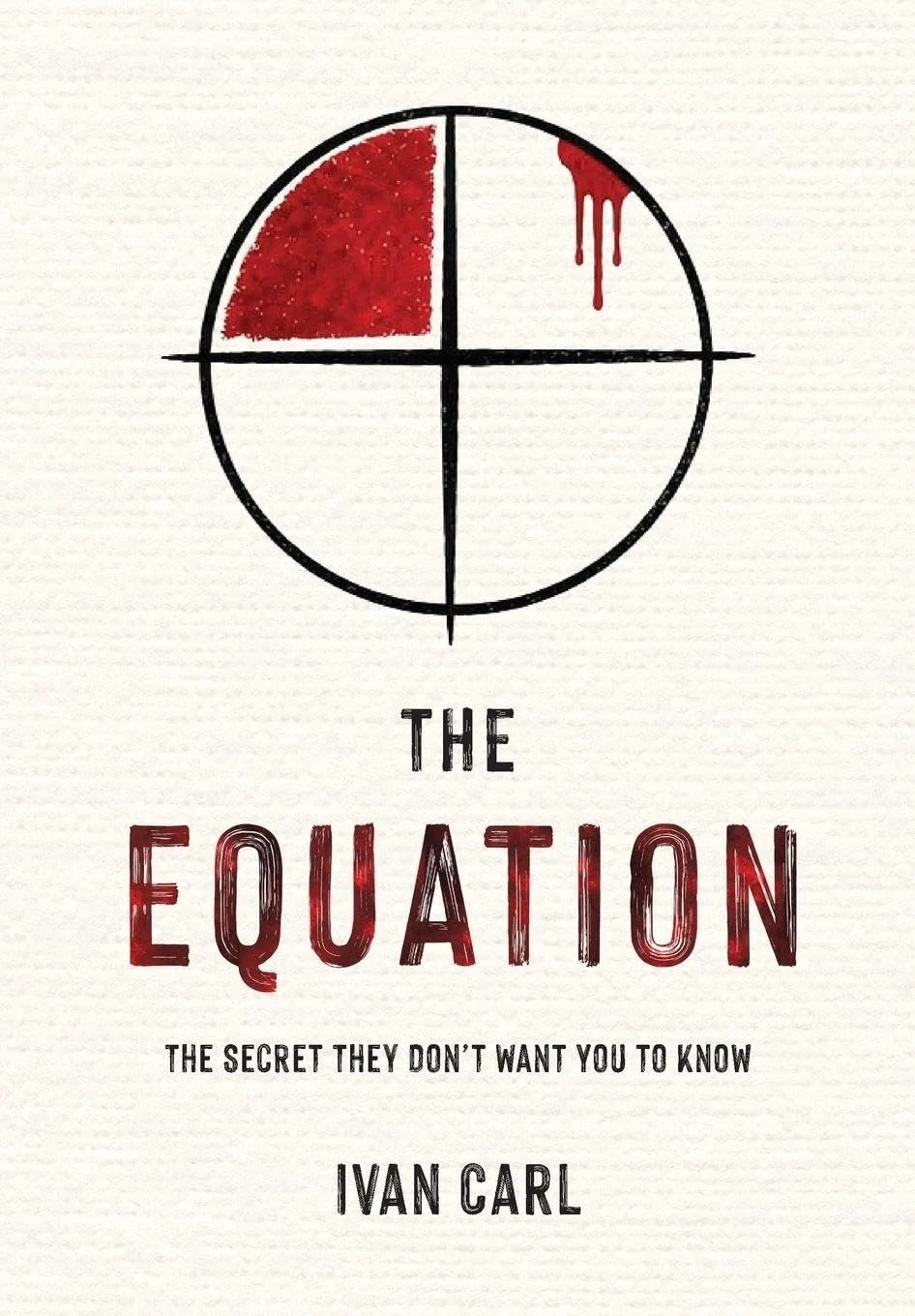
Nathan begins the story by finding his mentor murdered in a locked office, with “THE EQUATION” written in blood. What did you want readers to feel in that moment?
That the stakes are big from the first pages. That this idea is dangerous enough to kill for. I want the reader to be horrified and also curious about why someone was murdered and what made his idea so dangerous.
Nathan's mentor leaves behind very little, except a brass key and a mystery. Why was it important to make Nathan work from fragments rather than simply hand him the answers?
I have always liked thrillers that had a trail of breadcrumbs, a path of discovery. If Nathan's mentor just explained it, the reader stays passive. Making him assemble it from fragments brings the reader alongside him to solve the puzzle — and hopefully discover something meaningful.
The Continuum has spent two centuries suppressing research into human contentment. What makes an organization like that more frightening than a conventional villain?
I love the great good-versus-evil stories. A conventional villain is too singular and small for this story. The Continuum feels like something much bigger and more powerful to battle against. They are frightening because of the magnitude of their hidden global connections, and because they might believe they're right. The fact that they are so secretly woven into the powerful forces that control the world makes them the perfect big scale villain for this story.
The novel suggests that seventeen societies have already been silenced for getting too close to the truth. Did you create The Continuum primarily as a fictional conspiracy, or were you interested in exploring how real institutions can protect systems that benefit them?
The conspiracy is invented. There is no smoke-filled room of people controlling all of society. But I wanted readers to reflect on the bigger life pressures that seem beyond the individual. Naming those big pressures as The Continuum gives the story a powerful antagonist, and hopefully gives readers a way to categorize the big external pressures they think about in life.
Nathan's investigation takes him through monasteries, tide archives, and communities that have apparently been living according to principles the modern world has forgotten. How did you decide where to take readers physically and historically?
I wanted places that embody the book's argument, and I wanted to take the reader on a journey around the world. Monasteries, forgotten communities, places that measured life differently. The settings aren't just backdrops; each one is evidence that the alternative Nathan is chasing is real and has always been here. I also really wanted the book to feel global. The story is universal, so I tried to take the reader to places all over the world as part of the discovery path.
Was there a particular piece of research that made you stop and think, “This belongs in the book”?
It wasn't so much a piece of research, but rather destinations that I felt belonged in the book. I spent a lot of time in Colorado, so it felt right to base Arcadia in those mountains. I live near the ocean and have always been awed by the power of the tides, so I wanted to share that with readers. I have been fortunate to travel quite a bit around the world for work, and that inspired me to weave so many global destinations into the book.
How did you balance the intellectual and philosophical material with the pace and suspense readers expect from a conspiracy thriller?
Great question! The rule I kept was: the philosophical idea can never stop the chase and momentum of the thriller. Every philosophical beat had to be earned by tension in the chase — a revelation while running, not a lecture in a quiet room. If a passage got too heady, I asked whether a reader on a plane would keep turning pages. The thriller is the delivery system. The idea is the payload.
The book has been described as being in the tradition of The Da Vinci Code and The Alchemist. What do you think readers of those books will recognize in The Equation, and where does your novel take the idea somewhere different?
I hope the thriller engine of the book feels like a The Da Vinci Code kind of story: a centuries-old secret, a trail, an organization protecting it. From The Alchemist, I see the soul of the book: a journey toward what makes a content and meaningful life.
I think I diverge in two ways. First, I'm trying to combine these two very different styles of books, which honestly was not easy!. Second, the equation doesn't try to answer the life question for the reader; instead it gives the reader a diagnostic tool from which to examine their own life. What they see is up to them.
Did you set out to write a conspiracy thriller with philosophical questions, or did the philosophical questions come first and the thriller grow around them?
The philosophy came first, by decades. I'd been carrying the question — what makes a life content — long before I had a thriller storyline. This philosophical question has been on my mind since we lived in Peru twenty-five years ago. The thriller grew around it when the final formula landed in my mind. I have always loved ambitious large scale stories, and felt like a thriller was the best way to deliver my message to the world.
How much of The Equation did you have mapped out before you began writing? Did you know the answer to the mystery from the beginning?
I have always worked outward from the core structure of a project first, and then added the detail in the next phases. I had the core story pretty well mapped before I started writing. That said, once I got deeper into the character development and world-building, the story took some really fun turns.
Was there a scene or revelation that changed the direction of the book while you were writing it?
Elias, the Continuum's operative. I sat down to write him as the opposing force Nathan runs into, the face of the dark side in the book. But as I worked through his story, I realized he needed to believe that what he was doing was the right thing for the world. I think it makes for a more powerful story, especially in the back half, when he begins to contemplate his own life without abandoning The Continuum.
What was the most challenging part of writing The Equation: creating the mystery, developing Nathan, constructing The Continuum, or making the underlying ideas believable?
Making the ideas believable, without question. A conspiracy is fun to construct; a character grows as you write. But convincing a reader that a formula for contentment could be real enough to kill for — that it isn't just self-help dressed up — that was the tightrope. I needed both the philosophical idea and the chase of the thriller to feel true for the book to work.
Without giving us a spoiler, what moment in The Equation are you most excited for readers to reach?
Paris. This is the crux of the story, where everything in the world begins a subtle shift. It's a no-going-back kind of moment.
Your novel asks what may be the ultimate question: what if someone solved the secret to a meaningful life and powerful people were willing to kill to keep it buried? After writing this story, do you think knowing the secret to a meaningful life would actually make people happier?
Yes! But I don't think the answer lies in anything someone else defines. You have to do it yourself. I believe the hard work — asking yourself the honest questions about what makes your life meaningful — is what we should all be doing. The asking is where the work is. I hope this book gives people a way to think about how to ask those questions.
Finally, when readers close The Equation, what do you hope they start questioning about their own lives?
I hope they close the book and quietly run their own equation: what's actually working, what's just noise, what they might already have, what they are grateful for. Not the life path they've been told is correct, but rather their own perspective on their life. If a reader takes a long walk a week later, still thinking about the equation, then the book has done its job.
Learn more about The Equation, available on Amazon and Bookshop.org.