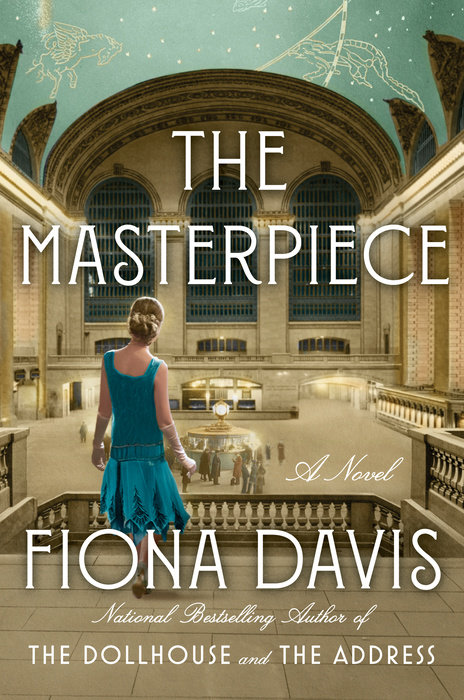
Read an excerpt from The Masterpiece by Fiona Davis

In her latest captivating novel, nationally bestselling author Fiona Davis takes readers into the glamorous lost art school within Grand Central Terminal, where two very different women, fifty years apart, strive to make their mark on a world set against them.

For the nearly nine million people who live in New York City, Grand Central Terminal is a crown jewel, a masterpiece of design. But for Clara Darden and Virginia Clay, it represents something quite different.

For Clara, the terminal is the stepping stone to her future, which she is certain will shine as the brightly as the constellations on the main concourse ceiling. It is 1928, and twenty-five-year-old Clara is teaching at the lauded Grand Central School of Art. A talented illustrator, she has dreams of creating cover art for Vogue, but not even the prestige of the school can override the public’s disdain for a “woman artist.” Brash, fiery, confident, and single-minded–even while juggling the affections of two men, a wealthy would-be poet and a brilliant experimental painter–Clara is determined to achieve every creative success. But she and her bohemian friends have no idea that they’ll soon be blindsided by the looming Great Depression, an insatiable monster with the power to destroy the entire art scene. And even poverty and hunger will do little to prepare Clara for the greater tragedy yet to come.

Nearly fifty years later, in 1974, the terminal has declined almost as sharply as Virginia Clay’s life. Full of grime and danger, from the smoke-blackened ceiling to the pickpockets and drug dealers who roam the floor, Grand Central is at the center of a fierce lawsuit: Is the once-grand building a landmark to be preserved, or a cancer to be demolished? For Virginia, it is simply her last resort. Recently divorced, she has just accepted a job in the information booth in order to support herself and her college-age daughter, Ruby. But when Virginia stumbles upon an abandoned art school within the terminal and discovers a striking watercolor hidden under the dust, her eyes are opened to the elegance beneath the decay. She embarks on a quest to find the artist of the unsigned masterpiece–an impassioned chase that draws Virginia not only into the battle to save Grand Central but deep into the mystery of Clara Darden, the famed 1920s illustrator who disappeared from history in 1931.

Excerpt

Chapter One

New York City, April 1928

Clara Darden's illustration class at the Grand Central School of Art, tucked under the copper eaves of the terminal, was unaffected by the trains that rumbled through ancient layers of Manhattan schist hundreds of feet below. But somehow, a surprise visit from Mr. Lorette, the school's director, had the disruptive power of a locomotive weighing in at thousands of tons.

Even before Mr. Lorette was a factor, Clara had been anxious about the annual faculty exhibition set to open at six o'clock that evening. Her first show in New York City, and everyone important in the art and editorial worlds would be there. She'd been working on her illustrations for months now, knowing this might be her only chance.

She asked her class to begin work on an alternate cover design for Virginia Woolf's latest book, and the four ladies dove in eagerly, while Wilbur, the only male and something of a rake to boot, sighed loudly and rolled his eyes. Gertrude, the most studious of the five members, was so offended by Wilbur's lack of respect that she threatened to toss a jar of turpentine at him. They were still arguing vociferously when Mr. Lorette waltzed in.

Never mind that these were all adults, not children. Whenever Wilbur made a ruckus, it had the unfortunate effect of lowering the entire class's maturity level by a decade. More often than not, Clara was strong enough to restore order before things went too far. But Mr. Lorette seemed possessed of a miraculous talent for sensing the rare occasions during which Clara lost control of the room, and he could usually be counted upon to choose such times to wander by and assess her skills as an educator.

"Miss Darden, do you need additional supervision again?" Mr. Lorette's bald pate shone as if it had been buffed by one of the shoeshine boys in the terminal's main concourse. The corners of his mouth curled down, even when he was pleased, while his eyebrows moved independently of each other, like two furry caterpillars trying to scurry away. Even though he was only in his early thirties, he exuded the snippety nature of a judgmental great-aunt.

He'd been appointed director three years earlier, after one of the school's illustrious founders, John Singer Sargent, passed away. The school had increased in reputation and enrollment with each new term, and Mr. Lorette had given himself full credit for its smashing success when he'd interviewed Clara. She'd been promoted from student monitor to interim teacher after Mr. Lorette's chosen instructor dropped out at the last minute, putting her on uneven footing from the beginning. It hadn't helped that the class had shriveled to five from an initial January enrollment of fifteen. Ten of those early enrollees had walked out on the first day, miffed at having a woman in charge.

Mr. Lorette's dissatisfaction, and the likelihood that she'd not be asked back next term, mounted each week, which meant tonight's faculty show would probably be her last opportunity to get her illustrations in front of the city's top magazine editors.

Since coming to New York the year before, Clara had dutifully dropped off samples of her work at the offices of Vogue and McCall's every few months, to no avail. The responses ranged from the soul-crushing-"Unoriginal/No"-to the encouraging-"Try again later." All that would change, tonight. She hoped. By seeing her work in the hallowed setting of the Grand Central Art Galleries, alongside the well-known names of other faculty members, the editors would finally appreciate what she had to offer. Even better, as the only illustrator on the faculty, she was sure to stand out.

Mr. Lorette cleared his throat.

"No, sir. We don't need any assistance. Thank you for checking in." She maneuvered around to the front of the table where she'd been working, in an attempt to block his view of her own sketches.

No luck. He circled around and stood behind it, his nose twitching. "What is this?"

"Some figures I was working on, to demonstrate the use of compass points to achieve the correct proportions."

"I thought you'd covered that already."

"You can never go back to the basics enough."

He offered a suspicious nod before winding his way through the tables, his eyes darting from drawing board to drawing board. Her students stood back, hoping for a kind word.

"Why is it each student seems to be drawing something completely different from the other?"

She nodded at the novel she'd left out on the still-life table. "The assignment was to create a cover for a book. I encouraged them to use their imaginations."

"Their examples of lighthouses and beaches are apropos. Yet you are drawing undergarments?"

Even if he had been a more sympathetic man, there was no way to explain how the hours stretched painfully long with her having so few students. How the skylights diffused the light in a way that made each day, whether sunny or overcast, feel exactly like every other. She routinely made the rounds, suggesting that a drybrush would work best to create texture or offering encouragement when Gertrude became frustrated, but at some point, the students had to be left alone to get to their work. Which is why today she'd pulled a chair up to a drawing table and sketched out the figures for her latest commission from Wanamaker Department Store: three pages of chemises for the summer catalog. The work paid a pittance, but at least it was something.

"This is for tomorrow's class," she lied. "As we do not have a live model to work from, I was planning on using a work of my own to guide them."

As she hoped, the mention of her standing request for a model redirected his attention.

His voice rose in pitch to that of a schoolgirl. "The students are free to take a life class at any time. This is an illustration class, and right now our models are reserved for the fine arts classes. As you said, they can use their imaginations, no?"

"But it is not ideal. If we can have a model to understand the anatomy underneath the fashions, to have the model begin nude and then add layers of clothing, we could build upon what we've learned already."

She never meant to be ornery, but somehow Mr. Lorette brought out a stubbornness in her every time.

"As yours is a class of mixed genders, taught by a woman, having a nude model would be most inappropriate. I'm sorry you find our school so deficient, Miss Darden." He clucked his tongue, which made her want to reach into his mouth and pull it out. "The other instructors, who have vastly more experience than you do, seem to manage just fine."

The other instructors-all men-had their every whim met by Mr. Lorette. She'd seen it in action, the director encouraging them to stop by his office for a smoke, the group laughing at some private joke, the director's feet propped up on his desk in an attempt to convey casual masculinity. Clara didn't fit the mold, which made her vulnerable.

"I'm sure we can manage, sir."

He shuffled off, closing the door behind him.

She directed the class to continue. Gertrude's work had only three rips from her overuse of the razor for corrections, a record low for her.

"Your stormy clouds are exquisite, but where would the lettering of the title and author go?" Clara asked.

Gertrude rubbed her nose with her wrist, leaving a gray streak at the tip. "Right. I got so caught up, I forgot."

Clara pointed to the top edge. "Try a damp sponge on the wet areas to lift out some color."

The girl was always eager, even if her strong hand was better suited to clay or oils than to the careful placement of watercolor, where mistakes were difficult to correct. Use too much water, and a brilliant cauliflower pattern would bloom where a smooth line ought to have been. Too dry, and the saturated color would stick to the page, resisting softening. But Clara loved watercolor in spite of, or perhaps because of, its difficult temperament. The way the paper shone after a wash of cool orange to convey a sunset, how the colors blended together in the tray to form new ones that probably didn't even have a name.

Finally, five o'clock came around. The students stored their artwork in the wooden racks, and once the room was empty, Clara hid her own sketches up on the very top of the storage cabinet, away from Mr. Lorette's prying eyes.

Starving, she headed downstairs to the main concourse, where cocoa-pink walls trimmed in Botticino marble soared into the air. Electrically lit stars and painted constellations twinkled along the turquoise vaulted ceiling, although the poor artist had inadvertently painted the sky backward, a mistake the art students loved to remark upon.

The first time she'd entered the hallowed space, stepping off the train from Arizona last September, she'd stopped and stared, her mouth open, until a man brushed past her, swearing under his breath at her inertia. The vastness of the main concourse, where sunshine beamed through the giant windows and bronze chandeliers glowed, left her gobsmacked. With its exhilarating mix of light, air, and movement, the terminal was the perfect location for a school of art.

Since then, she'd been sure to glance up quickly before joining in what seemed like an elaborate square dance of men and maids, of red-capped porters and well-dressed society ladies, all gliding by one another at various angles, yet never colliding. She liked best to lean over the banister on the West Balcony and watch the patterns of people flowing around the circular information booth, which sat in the middle of the floor, its four-faced clock tipped with a gleaming gold acorn.

Her stomach growled. She followed a group of smartly dressed men down the ramp to the suburban concourse and into the Grand Central Terminal Restaurant, where she secured a seat at the counter.

"Miss Darden?"

A young woman wearing a black velvet coat trimmed with fur hovered behind Clara, offering an inquisitive smile. "Yes, I thought that might be you. I'm Nadine Stevenson. I take painting classes at the school. You're having a bite before the show?"

"I am, Miss Stevenson."

"Oh now, call me Nadine."

Nadine's nose was large, her eyes close together and deep-set. Her right eye was slightly larger than the left, and the asymmetry was unsettling but powerful. Clara couldn't help but imagine how Picasso might approach her, all mismatched cubes and colors. Next to her stood an Adonis of a man whose symmetrical beauty offered a fascinating counterpoint. Shining blue-gray eyes under arched brows, hair the color of wheat.

"And this is Mr. Oliver Smith, a friend and poet."

Even though Clara had hoped to eat dinner in peace, she didn't have much of a choice. "Lovely to meet you both; please join me."

They took the stools next to her as the waiter stopped in front of them, pen in hand. Clara ordered the oyster stew, as did Oliver. Nadine requested peeled Muscat grapes, followed by a lobster cocktail.

Many of the young girls at the Grand Central School of Art had enrolled only so they could list it in their wedding announcements someday-a creative outlet that wouldn't threaten future in-laws. Nadine seemed to fall into that category, with her airs and pearls.

"Miss Darden is the only lady teacher at the Grand Central School of Art," said Nadine to Oliver. "She teaches illustration." She turned to Clara with a bright smile. "Now tell us about what you'll be showing tonight."

"Four illustrations that depict four seasons of high fashion." Clara couldn't help but elaborate. She'd put so much thought into the drawings. "For example, the one for winter depicts three women draped in fur coats, walking poodles sporting matching pelts."

"Well, that sounds pleasant."

Was Nadine making fun of her? Clara couldn't tell. She'd hardly had time to socialize, other than occasionally trading a few words with some of the other women artists who lived in her Greenwich Village apartment house. She'd been far too busy trying to make a living.

Nadine placed one hand on the counter and leaned in closely. The citrus scent of Emeraude perfume drifted Clara's way. "Did you know that Georgia O'Keeffe-she does those astonishing flowers-was a commercial artist at first? There's no need to be ashamed of it, not at all. Illustration is a common stepping-stone into the true arts."

"I'm not ashamed in the least." The audacity. Clara didn't enjoy being talked down to by a student. "I don't intend to do the 'true arts,' Nadine, as you put it. I enjoy illustration; it's what I do best."

"Well, I adore my life drawing and painting class. I'm learning so much from my instructor, Mr. Zakarian. He made me class monitor, and he's magnificent."

Jealousy pinged. None of Clara's students would describe her in such superlative terms, of that she was quite certain. "Class monitor, that's quite an honor. Do you plan on becoming an artist, then?"

Nadine gave out a squeak of a laugh. "Oh dear, no. I'm only taking classes for personal enrichment."

The waiter dropped off their bowls, and for a moment nothing was said. If Clara were alone, she would have surreptitiously folded a dozen or so oyster crackers into her handkerchief, to have something to snack on before bed.

The poet, who'd been silent the entire time, finally spoke. "My mother was an artist, although my father insisted she give it up after they married. She's been sick lately, but she very much misses going to museums and exhibits."

"I'm sorry to hear that," offered Clara. "Nadine mentioned that you're a poet?"

"Nadine is too kind in her description of me. Struggling poet, you might say. I suppose I take after my mother in that regard, having an innate love of the arts. My father is hoping I'll give it up eventually and go into banking."

Nadine placed a protective hand on his arm. "Oliver was accepted to Harvard and refused to go. Can you imagine? Instead, he's slumming it with us bohemians."

By all accounts, Nadine was hardly slumming it. But Clara understood firsthand what it was like to disappoint your family. "When I told my father I was moving to New York, he told me to not bother coming back. It's not an easy decision, but I'm glad I made it."

Oliver's blue eyes danced. "So there's hope for us miscreants?"

"Never."

They shared a look, a quick knowing smile, that sent Clara's pulse racing.

Usually, men didn't give her a second glance. Her father generously described her as "ethereal" for her blond hair, pale skin, and towering, skinny figure. Her mother said she looked washed out and encouraged her to wear clothes that added color to her complexion, but Clara preferred blacks and grays. Her ghostly pallor and height had always been sore points, embarrassing, and she preferred to avoid drawing attention to herself.

Oliver tucked into his stew. She did the same, embarrassed. She must have imagined the exchange.

Nadine took over the reins of the conversation. “Now, where are you from, Miss Darden?”

“Arizona.” She waited for the inevitable intake of breath. The American West might as well have been Australia, for how shocked most East Coast natives were at her having come all this way. “You’ve come all this way! Gosh. What does your father do? Is he a cowboy?”

“He sells metals.”

Clara deliberately used the present tense instead of the past when speaking of her family’s fortunes—now their misfortunes. Her father’s fraudulent scheming was no longer any of Clara’s concern, nor of anyone else’s. Luckily, Nadine went on and on about her own father’s real estate business, more for Oliver’s benefit than Clara’s, as Clara quickly finished her meal.

She looked up at the clock. “I must go; the doors will be opening soon.”

But there was no slipping away. Nadine locked arms with Clara as they walked out of the restaurant, as if they’d been friends for years. To the left and right, ramps sloped back up to the concourse, framed by glorious marble arches, and a vaulted ceiling rose above their heads in a herringbone pattern. Clara had tried to duplicate the earth‑and‑sable tones of the tiles in one of her illustrations to be shown tonight.

“Wait, before we go, stand over there.” Oliver pointed to a spot where two of the arches met.
“Face right into the corner and listen carefully.”

Clara had no time for games but watched as Nadine did as she was told. Oliver took up a spot at the opposite corner and mouthed something Clara couldn’t hear. Nadine giggled.

“What’s so funny?” Clara asked.

“You’ve got to try it. We’re in the Whispering Gallery.” Begrudgingly, Clara took up Nadine’s position.

“Clara, Clara.”

The words drifted over her like a ghost. Oliver might as well have been standing close by, speaking right into her ear. She looked up, trying to figure out how the shape of the ceiling transmitted sound waves so effortlessly. She faced the corner again. “Recite a poem to me.”

For a moment, she wasn’t sure if he would. Then the disembodied voice returned.

That whisper takes the voice
Of a Spirit, speaking to me, 
Close, but invisible,
And throws me under a spell.

She swore she could feel the heat of Oliver’s breath. They locked eyes as they met once again in the center of the space.

“Thomas Hardy. The poem’s called ‘In a Whispering Gallery,’” Oliver volunteered.

Nadine crossed her arms, indignant. “You didn’t recite verse to me.” “I’ll regale you next time, I promise. For now, I must head to a poetry reading downtown and amass further inspiration.”

Clara shook hands and they took their leave, the poem still echoing in her head.

The mob of nattily dressed art lovers trying to squeeze their way through the gallery’s doorway had already backed up to the elevator by the time Clara and Nadine arrived. They toddled through, tak‑ ing small steps so as not to get their toes crushed, until they were safely inside.

The Grand Central Art Galleries predated the school by two years, when a businessman‑turned‑artist named Walter Clark had enlisted the help of John Singer Sargent to convert part of the sixth floor into a massive exhibition space, a kind of artists’ cooperative where commissions were kept to a minimum. Clara stopped by at least once a week to see the latest works, and she encouraged her students to do the same. The rooms were rarely empty, as visitors to New York and everyday commuters continually drifted through.

Tonight, the room buzzed with energy. The faculty’s work would stay up for a week, before being replaced with the students’ work, a celebration of the school’s spring term and its growing prestige. Clara’s illustrations would be on the same walls that once displayed Sargent’s portraits. The thought made her giddy.

Located on the south side of the terminal, the Grand Central Art Galleries were four times as long as they were wide, a warren of rooms and hallways, twenty in all, that encouraged visitors to circulate in a counterclockwise manner without ever having to double back. Clara scanned the walls of the first gallery for her work, with no luck. In the middle of the space, the sculpture teacher stood be‑ side a table featuring two nymphs, both nude, one standing on a turtle.

“Now, that’s unremarkable,” said Nadine.

Clara agreed but kept her mouth shut. They continued on, to where a group of students surveyed an oil of an ungainly horse. Towering above them all was the artist, an instructor for the life drawing and painting class.

Clara had seen him a few times before. A foreigner, he was known to sing loudly during his classes and even dance about at times. This evening, he stood to the side, listening with intensity as his acolytes buttered him up, every so often tossing his head in a futile effort to flick a thatch of hair out of his eyes. Indeed, he was more horselike than the horse in his painting.

“That’s my teacher. Mr. Zakarian.” Nadine sidled up next to him. Clara had seen women like her before, flinging themselves into the orbits of handsome or powerful men to fend off their own insecurities. Clara had no time for such nonsense.

Back to the task at hand. The air had become stifling as more people crammed in. She ventured into room after room before circling back, and still she didn’t see her illustrations.

A flash of panic seized her. Her job with Wanamaker was ending soon. They’d recently announced that they’d be using only in‑house artists going forward. Her salary of seventy‑five dollars a month from teaching covered her expenses, but not much more. And she could not count on the next term.

She wormed her way back one more time through the mazelike space. Nothing. Down one hallway, off to the right, was a door marked sales office. She’d passed by it in her first go‑round, assuming it to be a place for clerks to write up invoices. The door stood halfway open, the lights on. She peered inside.

It was more a closet than a room, with a scratched‑up desk against one wall and a wooden file cabinet wedged into a corner.

There, above the desk, equally spaced apart and centered on the wall with great care, were her illustrations.

By the time she found Mr. Lorette, Clara’s limbs shook with rage. He was in an animated conversation with Mr. Zakarian while Mrs. Lorette looked on. Clara had met her in passing at one of the faculty get‑togethers, awed by the puffy, out‑of‑date pompadour that perched on the woman’s head like a long‑haired cat.

She inserted herself into the group. “Mr. Lorette, my illustrations have been hung in a back office. A back office!”

While Mr. Lorette sputtered at her rudeness, she continued on. “I am a faculty member of the School of Art, and yet my work has been placed in a cave where no one would think to go.”

“I am sorry, Miss Darden. We were in a tight spot, you see.” He paused. “Quite literally.”

As Mr. Lorette laughed at his own joke, Clara noticed the editor of Vogue headed for the exit. For certain, he’d never even seen her work.

Mr. Zakarian spoke up. “Where was her art hung?”

“Just off a main gallery,” said Mr. Lorette. “They are illustrations. We concluded they were more suited to an intimate environment.”

“Perhaps you could guarantee her a spot here in the first room next year, to make it up to her?” Mr. Zakarian held out his hand to Clara. “I don’t think we’ve met. I’m Mr. Levon Zakarian, one of your fellow teachers.”

She shook it without looking at him, her glare fixed on Mr. Lorette. “Next year it’ll be too late. It’s already too late.”

Unlike students such as Nadine, for whom the Grand Central School of Art was just a pit stop on the way to marital bliss, Clara had sunk every ounce of energy into her career as an artist.

Against her parents’ wishes, she’d arrived in New York, knowing no one, and done everything she could to make it as an illustrator. What made it worse was knowing she’d been given a shot that other artists would have been envious of—to teach at the Grand Central School of Art, to show her work at the galleries—only to see it vaporize.

Mr. Lorette shrugged. “I can’t seem to please anyone tonight. We will make it up to you; my deepest apologies, Miss Darden.” He turned to Mr. Zakarian. “Have you seen Edmund’s latest work? Come with me. I assure you it’ll give you something to think about.”

“I believe Miss Darden may give you something to think about, if you try to shake her off.” Mr. Zakarian wore a crooked smile. “I have an idea. Let’s take down one of mine, and we’ll replace it with her work. Get it right out there in the center.”

She didn’t need one of the faculty stars to swoop down and protect her. The very thought made her sick with embarrassment.

Unwilling to give Mr. Lorette any further satisfaction at her distress, Clara stormed out without uttering a reply.

Excerpted from The Masterpiece by Fiona Davis. Copyright © 2018 by Fiona Davis. All rights reserved. No part of this excerpt may be reproduced or reprinted without permission in writing from the publisher.

Buy on Amazon | Barnes and Noble

About the Author

Fiona Davis is the nationally bestselling author of The Dollhouse and The Address.She lives in New York City and is a graduate of the College of William and Mary in Virginia and the Columbia University Graduate School of Journalism.
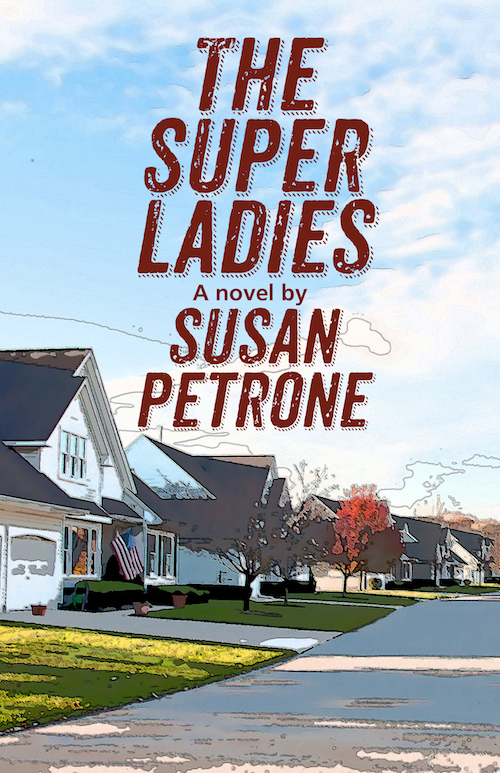

Spotlight: The Super Ladies by Susan Petrone

The Super Ladies

by Susan Petrone

August 13 - October 13, 2018 Tour

  The Super Ladies by Susan Petrone

Synopsis:

For three middle-aged women in the suburbs of Cleveland, the issues seemed compelling but relatively conventional: sending a child off to college, dealing with a marriage gone stale, feeling "invisible." But changes were coming . . . and not the predictable ones. Because Margie, Katherine, and Abra are feeling a new kind of power inside of them – literally. Of all the things they thought they might have to contend with as they got older, not one of them considered they'd be exploding a few gender roles by becoming superheroes.

At once a delightful and surprising adventure and a thoughtful examination of a woman's changing role through life's passages, THE SUPER LADIES is larger-than-life fiction at its very best.

PRAISE FOR SUSAN PETRONE'S THROW LIKE A WOMAN:

"While, on the surface, this is a novel about a woman battling to make her way in the man's world of professional baseball, debut author Petrone presents a stirring and humorous story of a woman doing considerably more than that--trying to rediscover herself, provide for her family, and perhaps find a little love along the way." - Booklist

"Throw Like a Woman is that rare baseball novel, both a paean to the game and a deeper exploration of character. Susan Petrone has a fan's heart and a scout's eye. Read it now. Don't wait for the movie." - Stewart O'Nan, co-author of Faithful and A Face in the Crowd

"For baseball fans who yearn for a female Jackie Robinson, reading Susan Petrone's fun and absorbing novel Throw Like a Woman becomes a kind of prayer. 'Please, Lord! Give talent a chance. Let this dream come true!'" - Mary Doria Russell, author of The Sparrow

"Someday there will be a woman who plays Major League Baseball. And when it happens, I suspect it will be an awful lot like Susan Petrone's fun Throw Like a Woman. Susan knows baseball and so the novel - and her hero Brenda Haversham - crackles with authenticity. You can hear the pop of the ball hitting the catcher's mitt." - Joe Posnanski, author of The Soul of Baseball, NBC Sports National Columnist

"Petrone's storytelling is first-rate, and she weaves a credible baseball tale with well-defined characters throughout." - The Wave


Book Details

Genre: Women's Fiction
Published by: The Story Plant
Publication Date: August 14th 2018 by Story Plant
Number of Pages: 320
ISBN: 1611882583 (ISBN13: 9781611882582)
Purchase Links: The Super Ladies on Amazon The Super Ladies on Barnes & Noble The Super Ladies on Goodreads
 

Read an excerpt:

On the way home, Katherine called shotgun, so Abra had to sit in the back of Margie’s minivan amid soccer shin guards, baseballs, stray sneakers, swim goggles, granola bar wrappers, a rubber-banded stack of Pokemon cards, and a book on playing Minecraft. “How was this shoe not on the seat when we left?” Abra asked.

“I really couldn’t tell you,” Margie replied over her shoulder. “Things back there just seem to migrate around on their own. Hold it up.” Abra did so, and Margie took a quick look at it in the rearview mirror as they pulled out of the parking lot and onto Superior Avenue. “I don’t even think that belongs to one of mine.”

“Now you know why I called shotgun. The backseat scares me,” Katherine said. “I sometimes get overwhelmed with one kid. How do you manage three?”

“I have no life. Duh,” Margie replied.

Margie cut south onto East 12th Street and then turned east onto Chester Avenue, which would take them through Midtown, up Cedar Hill, and back home. As they drove by Cleveland State University, she asked Katherine, “Do we still have to flip the bird to CSU for denying Hal tenure?”

“Nah, the statute of limitations has expired on that one, I think.”

“I like the new housing they’re building down here,” Abra said. “If I ever move downtown, would you two come and visit me?”

“Hell yes,” said Katherine.

“Sure,” Margie added. “Are you seriously thinking of moving or just toying with it?”

“Toying. If I can unload the house to the bank, I’ll have to rent somewhere. And I’d be closer to work.”

“If you move, who will I run with every morning?” “I don’t know. Get another dog?”

Chester was a wide, three-lanes-in-each-direction boulevard that took them past the university neighborhood and through the dead zone in between downtown, where most of the office buildings and entertainment areas were, and University Circle, where most of the city’s museums and cultural gems were ensconced. Economic development hadn’t hit this middle area, and much of it was taken up by vacant buildings, empty lots, and boarded-up houses.

Nine fifteen on a Thursday night in mid-May isn’t late and isn’t scary. Still, Margie got a bad feeling when she saw a young woman on the sidewalk walking fast, hands folded across her chest, not looking at the man who walked next to her. The girl was a stranger—not her age, not her race, not her neighborhood, but still, the girl was someone, some mother’s daughter.

Margie pulled over to the curb, leaving the engine running.

“Why are you stopping?” Katherine asked.

The few other cars on the wide road passed by without slowing. No cars were parked on the street; Margie’s van was the only stopped vehicle for blocks. Katherine and Abra followed Margie’s gaze to the scene unfolding on the sidewalk. The man was yelling at the woman now. They couldn’t make out exactly what he was yelling but heard the words “bitch” and “money” a few times. And they could see his flailing arms, his face leering up against hers. She stopped walking and said something to him, and he hit her. She lost her balance and fell against the chain-link fence that ran along the sidewalk. They were in front of an empty lot, where once there might have been a house but now was only a square of crabgrass and crumbling concrete and stray garbage. For a moment, there were no other cars on the road. There was no one else on the street, no inhabited buildings for a couple blocks either way. If not for them, the woman was on her own.

“Call nine-one-one,” Abra said as the man hit the woman again. The woman tried to get away, but he grabbed her shoulders and shoved her hard against the fence.

“There’s no time,” Katherine said. In a heartbeat, she was out of the car.

“Darn it, come on…” Abra muttered as she fumbled with the sliding side door and jumped out. “Keep the engine running,” she said as she followed Katherine.

“I’ll go with you…” Margie started to say. No, Abra was right. Someone had to stay with the van, keep the engine running, stay behind the wheel in case they needed to make a quick getaway. Glancing behind her, she backed up alongside the people on the sidewalk. It felt proactive. She could hear Katherine’s strong teacher voice saying loudly but calmly, “Leave her alone” and the woman yelling, “Call the police!” It suddenly occurred to Margie that she had a phone. She could call the police. Hands trembling and heart racing, Margie frantically fumbled through her bag for her phone.

She told the 911 dispatcher where she was and what was happening, the whole time watching Katherine and Abra and the couple on the sidewalk. Suddenly, there was a glint of something shiny in the streetlight as the man rushed toward Katherine. She heard a scream, and then she couldn’t see Abra anymore.

Katherine got out of the car purely through instinct. There was someone in trouble—helping is what you were supposed to do, right? It wasn’t until she was on the sidewalk, walking toward the man and woman, saying loudly, “Leave her alone” and watching the man turn to face her that she realized she had absolutely no idea what to do next. None. It was then that her heart started pounding and a hot wave of fear tingled through her arms and legs.

Up close, she could see the guy was taller and more muscular than he appeared from the safety of the van. He was maybe white, maybe light-skinned African American with a shaved head. An indecipherable neck tattoo peeked out from under his close-fitting, long-sleeved black T-shirt. She tried to burn a police description into her brain. The woman yelled, “Call the police!” at the same time the guy said, “This is none of your damn business, lady” to Katherine. The utter disdain in his voice cleared everything out of her brain except one thought: This was such a mistake. This was such a stupid mistake. There was no way this could end well. For a split second, she imagined Hal and Anna without her, wondered if they would think her foolish for getting herself killed in this way. She heard Abra say softly, “Just let her go, man.”

Katherine could just see Abra off to her right. Margie had backed up, and the open doors of the van were only a few yards away. She could faintly hear Margie’s voice, talking to 911 maybe? Knowing they were both nearby gave her a tiny bit more courage. Katherine took a tentative step toward the woman, who was kneeling by the fence. Her face was bloodied, the sleeve of her shirt ripped. “Miss?” she asked. She looked about nineteen or twenty. Not a woman. A girl. “Why don’t you come with us? We’ll give you a ride.”

“She don’t need a ride,” the man said.

The rest of the street seemed eerily quiet. Couldn’t someone else stop and help? Someone big? Someone male maybe? Katherine wasn’t that big, but she was big enough, strong enough. She could help. Slowly she extended her left arm. If the woman wanted to take her hand, she could. Katherine held the woman’s gaze, hoping she could silently convince her that leaving with some strangers was preferable to getting beaten up by her boyfriend. Katherine was so focused that she didn’t see the knife until it was against her arm, in her arm. The man cut so fast that she hardly saw the blade, only the flash of metal against her pale white skin. It occurred to her that she needed to get out in the sun. Why am I worried about how pale I am? I just got cut. She felt the sensation of the blade slicing through flesh, felt a momentary spark of pain, and then the pain was gone. It happened faster than a flu shot—a quick prick, then nothing.

The man only made one swipe, then stopped, triumphant, staring at her arm, expecting blood, expecting her to scream, to fall. There wasn’t any blood on her arm or the knife. No blood, just Katherine staring at him wide-eyed and unharmed.

Then the man was on the ground, hit from the side by…something, something Katherine couldn’t see. The knife dropped from his hands and landed near her foot. She kicked it away at the same time she heard Abra’s voice yell, “Run!” But where the hell was Abra? She must be in the van. Katherine couldn’t see her.

Katherine said, “Come on” to the woman, who was now up and moving toward her. The woman needed no more convincing and was in the car before Katherine, even before Abra. Where had Abra been? How could she be the last one to pile into the minivan, yelling, “Go! Go!” to Margie, who was slamming on the gas before the door was even closed.

Nobody said anything for a moment. The only sound in the car was that of four women catching their breath, being glad they had breath left in their bodies. Then all of them simultaneously erupted into words of relief and fear, asking each other “Are you all right? Are you all right?”

“Oh sweet mother, I can’t believe you all just did that,” Margie said. “I thought—Katherine, I honestly thought he was going to kill you.”

“So did I,” Abra said. “How the hell did he not cut you? How did he miss you?”

“He didn’t miss me,” Katherine replied quietly. Feeling fine seemed intrinsically wrong, but there it was. Unreal sense of calm? Yes. Pain and blood? No.

Before Margie or Abra could respond, the woman exclaimed, “Oh my God, thank you! Sean would’ve done me in this time, I know it. Y’all were like superheroes or something. You saved my life.”

The three women were quiet for a heartbeat. For the moment, the hyperbole of the phrase “You saved my life” was gone. It was arguably true. This was a new sensation. Frightening and humbling. Then Margie said, “Shoot, I dropped the phone.” With one hand on the wheel, she felt around in the great vortex of tissues, empty cups, and scraps of paper in the molded plastic section in between the two front seats.

“I got it,” Katherine said, coming up with the phone. The 911 dispatcher was still on the line, wondering what was going on. “Hello?” Katherine said. “We’re okay. We got away, the woman is safe. We’re going—where are we going?”

“Anywhere away from Sean,” the woman in the back said.

“There’s a police station right down the street at one hundred and fifth,” Abra said.

“Right, I know where that is,” Margie said.

A police car with the siren off but lights flashing came roaring down Chester Avenue in the opposite direction.

“Was that for us?” Margie asked.

“I think so,” Abra said.

Katherine hardly had time to explain what had happened to the dispatcher before they were at the station. There was a long hour-plus of giving witness statements to a jaded-looking police officer who told them several times how lucky they were to have gotten out of the situation with no harm done. “What you three ladies did was very brave and very stupid,” he said in closing.

“We know,” Abra replied.

They were told they might be called as witnesses if the woman, Janelle, decided to press charges against her boyfriend. Then they were free to go. The three of them walked out of the police station and to the waiting minivan. It was nearing midnight, and the spring evening had moved from cool to downright chilly. Even so, none of them moved to get into the van. Margie unlocked it and opened the driver’s door, then just stood looking at the ground, one hand on the door, the other on the side of the van, breathing slowly. Abra paced in a slow oval near the back of the van, while Katherine leaned against it and gazed up at the few faint stars that could be seen against the city lights. She suddenly wanted to be somewhere quiet, away from the city, away from people. Margie’s voice brought her back: “I’m sorry I didn’t do anything to help.”

What are you talking about?” Katherine said. “If it weren’t for you, we never would have gotten out of there.”

Abra walked around the van to Margie. “You were the only smart one. I’m sorry I got out of the car. That was stupid.” As Abra said this, she shivered, her lips trembled, and she started to shake. “That was so stupid.” “I got out first,” Katherine said. “I’m the stupid one.” Katherine almost never saw Margie cry. Even when her eldest child was going through hell, Katherine had been amazed and admiring of her friend’s resilience. But now Margie seemed overwhelmed by heaving sobs. “I’m just so glad the two of you are okay,” Margie stammered. Crying people generally made her nervous, but Katherine joined Margie and Abra on the other side of the van.

When your friends need you, they need you.

***

Excerpt from The Super Ladies by Susan Petrone. Copyright © 2017 by Susan Petrone. Reproduced with permission from Susan Petrone. All rights reserved.


Author Bio:

Susan Petrone

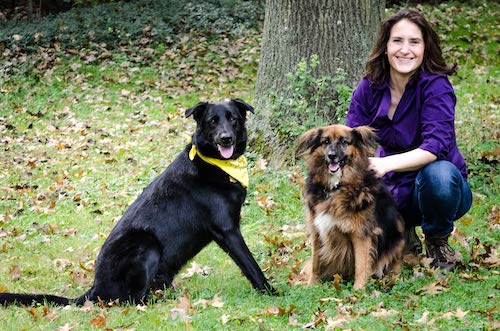
Susan Petrone lives with one husband, one child, and two dogs in Cleveland, Ohio. Her superpower has yet to be uncovered.

Catch Up with Susan Petrone Online:

  • Website: susanpetrone.com
  • Twitter: @SusanPetrone
  • Facebook: @susan.petrone.54
  • Goodreads: @Susan Petrone
  •  
     

    Tour Host Participants:

    Visit these other great hosts on this tour for more great reviews, interviews, guest posts, and giveaways!  

    Giveaway:

    This is a rafflecopter giveaway hosted by Providence Book Promotions for The Story Plant. There will be 5 winners of one (1) PB copy of THROW LIKE A WOMAN by Susan Petrone. The giveaway begins on August 13, 2018 and runs through October 13, 2018. Open to U.S. addresses only. Void where prohibited.
    a Rafflecopter giveaway &nbap;

    Find Your Next Great Read at Providence Book Promotions!

    Spotlight: Cowboy Need Not Apply by Robert Tate Miller

    No, prima donna ballerina Jessica Carmichael isn’t interested in the rough-and-tumble rodeo cowboy she met in physical therapy. In fact, she’s actively uninterested in his cocky smile, and his go-with-the-flow attitude, and how his silly little bets make her work harder than ever to fix her knee. She’d like nothing more than to strangle him, if she wasn’t so busy thinking about kissing him.

    Matt Walker's best hope of getting back in the saddle is charming Jessica into teaching him ballet. He needs to get back on the bronc…even if he has to get there in tights. Only the uptight ballerina lives in a completely different world, one he wouldn't touch with a ten-foot mechanical bull. But maybe the one thing she needs more than control is to lose control for once—with him.

    Excerpt

    “Dance with me?” Jessica hesitated for a moment, her eyes resting on his. She didn’t want to seem too eager though, at that moment, at the top of The Peninsula Hotel on 5th Avenue, there was nothing in the world she wanted more than to dance with Matt Walker. She placed her hand in his, and he helped her down. 

    As they danced close to the creamy smooth sounds of that soulful wedding singer, Jessica moved her face and cheeks in close to his shoulder. His hand on her waist made her lose her train of thought and, for a moment, she tried to imagine his body pressed against hers, him kissing her softly then harder as passion took over, and he started to lose control. She tried to ID his cologne, but couldn’t place the scent. Her cheek brushed against his, and she could feel his stubble scratch her face. In his cowboy attire he was woefully underdressed and, though she’d at least managed to slip on a sleeveless summer dress for the reception crashing, so was she. The evening was cool up on the roof, and the heat lamps were on, but Jessica felt warm and flushed in Matt’s arms. 

    With each word your tenderness grows, tearing my fears apart…

    The auburn-haired singer moved into the final verse, and Jessica suddenly wanted her to slow down, maybe start all over again or meld into an encore: maybe something like Still by the Commodores or At Last. The ballerina wasn’t ready to let go quite yet. She felt a weakness in her knees, a light-headedness and wondered if Matt felt the same. Then he looked at her, as if he could feel her thoughts on him.

    “You know what, Tiny?”

    “What?” Jessica said. “She smiled up at him. He was taller than she thought, yet she figured he wouldn’t have to bend down too far to kiss her. Again, she imagined that kiss, wondered if he was imagining it, too. She wondered what his stubble would feel like. She tried to remember if she’d ever kissed a man with stubble and knew immediately she hadn’t. Up to this point in her life, she’d been a clean-shaven kinda girl. Then she remembered that he was about to say something, and she tried to look curious and attentive.

    “For a ballerina,” he said, “you’ve got a serious set of balls.”

    Jessica smiled as the music swelled and the singer held the final note. It was the nicest thing anyone had ever said to her. “So, Mad Dog, guess what time it is?” she said. 

    Matt gave her a crooked smile. “Why do I get the feeling you’re not talking about the actual time?”

    Jessica smiled. “It’s time for you to pay up. I gave a toast to the groom and groom, you’re going to sing to them. Our bull riding bet, remember?”

    Matt grinned. “I was hoping you’d forgotten about that.”

    “Oh no,” Jessica said. “Not a chance. And I’ve got the perfect song.”

    Buy on Amazon | Barnes and Noble

    About the Author

    Robert Tate Miller was raised in the North Carolina mountain town of Hendersonville and began writing at an early age. He began his writing career with homespun essays of small town life that were published in such publications as Reader's Digest, The Christian Science Monitor and the Chicken Soup for the Soul book series. He moved to Los Angeles in the late 1980s and wrote hugely successful family-oriented telefilms for NBC, ABC Family and the Hallmark Channel. Robert lives in Northridge, CA..

    Connect: Website | Facebook | Twitter | Goodreads

    Cover Reveal: Not Quite Perfect (The Rocky Cove Series, #1) by Rebecca Norinne

    I can’t believe I met the perfect man ...

    On the ferry to my mother’s wedding, I met the most amazing man—his love of Faulkner notwithstanding. Professor David Carstairs was funny, intelligent, and had the sexiest hands I’d ever seen. 

    A conversation about classic American literature led to a romantic dinner at his house ... and then a whole lot of dessert afterward. I’d never done anything like that before, but what we had was something special. 

    Unfortunately, everything came crashing down the next day. Because my supposedly perfect professor? His dad just married my mom, and now he’s my stepbrother! 

    Thanksgiving dinner just got a whole lot more complicated.

    I’ve finally found the perfect woman ...

    En route to watch my father marry yet another young gold digger, I met the perfect woman—her hatred of Faulkner notwithstanding. Victoria Witherspoon was kind, witty, and had the most kissable lips I’d ever seen. 

    We spent the day together, and then stayed up all night exploring each other’s bodies. I don’t do relationships, but for someone as perfect as Victoria, I was ready to make an exception. 

    If only her mom hadn’t just married my dad, putting the object of all my fantasies firmly in the “off limits” category. 

    And I thought the holidays were awkward before.

    Add the book to Goodreads: https://www.goodreads.com/book/show/39676740-not-quite-perfect

    Buy on Amazon | Barnes and Noble

    About the Author

    USA Today bestselling author Rebecca Norinne writes sexy romance from the heart. Her heroines are bold and headstrong, and her heroes will do anything for the ones they love. 

    When not banging away at the keyboard, she is watching rugby, enjoying a pint of craft beer, or traveling the globe in search of inspiration for her next book. 

    Originally from California, Rebecca currently resides in a small coastal community outside of Boston where she's renovating an antique colonial built in the 1700s and trying valiantly not to be eaten alive by mosquitos.

    Connect: Website | Facebook | Twitter | Instagram | Newsletter | Goodreads | Bookbub

    Spotlight: His True Queen by Jodi Ellen Malpas


    HIS TRUE QUEEN
    The Smoke and Mirrors Duology #2
    by Jodi Ellen Malpas
    Genre: Contemporary/Erotic Romance

    Pub Date: 8/7/14


    The breathtaking conclusion of the Smoke & Mirrors Duology.
    A beautiful, defiant princess. A renowned, sinfully gorgeous Hollywood actor.
    A love affair that is sure to rock the British Monarchy…and the world.
    Their love affair began intensely and passionately. Princess Adeline and Josh Jameson knew any future together was impossible—her status as a princess and his standing as a Hollywood heartthrob dictated that. But the heights of pleasure they could take each other to were wildly unanticipated by them both. Josh’s absolute disregard for Adeline’s status quickly drew her into his hedonistic world. And her perfectly worn mask and false façade captivated Josh to the point of obsession. The boundaries became blurred. The physical became emotional. Their hearts became entwined.
    But a cruel turn of events rips their worlds apart and Adeline is more bound than ever by the protocol and expectations her title commands. The army of royal advisors who guard the secrets and scandals of the Monarchy will go to unthinkable lengths to keep the smoke and mirrors in place…and Josh away from Adeline. She knows the power she possesses comes with agonizing sacrifices. Walking away from Josh devastates her…but it keeps him safe from the corrupt institution that has ruled her life.
    Yet Josh refuses to lose the woman who has consumed him so completely, distorted his boundaries, and stripped him of all sensibility.
    Will the power of the British Monarchy triumph? Or will their fierce love for each other change the course of history?


    The Controversial Princess
    The Smoke and Mirrors Duology #1

    Her father is The King of England.

    She is The Controversial Princess.

    Regarded as down to earth by the press and rebellious by the King, Princess Adeline refuses to bow to the royal expectations her title carries. She knows better than anyone that the united front of the Royal Family is nothing but smoke and mirrors - lies and secrets masked by power and privilege. She wants no part of it, and she will never surrender to the King’s demand to marry a man she does not love. But despite Adeline’s determination to retain her free will, she remains deeply unfulfilled, feeling caged and suffocated.

    That is until she meets Josh Jameson. Drawn in by his confidence, Adeline is soon captivated by the scandalously sexy American actor. His ability to penetrate her defences overwhelms her - his touch is pure fire, and his allure overpowering. Nothing has ever made her feel so alive in a world where she’s otherwise slowly drowning. However, while Josh may be Hollywood royalty, he’s not actual royalty, and Adeline knows the King and his advisors will do everything in their power to keep them apart.

    But Josh Jameson becomes the princess’s ultimate vice.

    And although she bows to no one, she bows to him.


    Jodi Ellen Malpas wrote her debut series, The This Man Trilogy, in secret, worried about what people might think if they knew what her imagination was capable of. She was shocked herself. But she finally found the courage to unleash her creative streak and self-published THIS MAN - the first book of the This Man Trilogy - in October 2012. She took a chance on a story with a hero who soon became one of modern day fictions most prolific alpha male characters. Jesse Ward – also affectionately known as The Lord of The Manor, sparked incredible reactions from women across the globe and catapulted Jodi into the world of women’s fiction. With so much love and enthusiasm from her readers, and a thirst for more of her words, Jodi suddenly wasn't afraid of her imagination anymore. She went on to write The One Night Trilogy with the delectable and mysterious Miller Hart, and stole the hearts of her readers once again. She’s now a proud #1 New York Times bestselling author – all seven of her published novels having hit the New York Times best sellers list – as well as a Sunday Times bestseller and international bestseller. Her work is published in over 20 languages across the world.

    Jodi was born and raised in the Midlands town of Northampton, England, where she lives with her two boys and a beagle. She is a self-professed daydreamer, a Converse & mojito addict, and has a terrible weak spot for Alpha Males. Writing powerful love stories and creating addictive characters has become her passion – a passion she shares with her devoted readers


    Follow the tour HERE for exclusive content and a giveaway!


    Cover Reveal: Change of Plan by Keeley Holmes

    Change of Plan
    Keeley Holmes
    (Serendipity Series, #4)
    Publication date: September 17th 2018
    Genres: Adult, Comedy, Romance

    Penelope hadn’t planned on getting pregnant.

    But now she is, her plan includes a water birth, calming candles and music, it also includes keeping the baby far away from her controlling mother.

    With her mother interfering in her life demanding she had a sophisticated baby shower with her snobbish friends, Penelope takes charge and organises a week in London… Two weeks before her due date.

    What could possibly go wrong?

    Theatre plays, crazy golf and fake celebrities are planned, but she should know by now that plans don’t always work out. And when she goes into labour far way from home, does it really matter that she can’t have the water birth and whale music…? What she needs is a hospital, and her husband here with her.

    With her friends rallied around her, she’s about to add a baby to the baby shower, and thanks to the drugs, she’s even happy that her mother is here.

    It’s time to meet Baby Wilson.

    Add to Goodreads

    Previous books in the series:


    Author Bio:

    I've loved reading and writing since before I can remember. It's always been a passion of mine to write for people and for them to enjoy my work.

    I'm currently writing my way through an adult series and thinking about what I can do for the Young Adult/New Adult scene. There's always ideas floating around in my head.

    When I'm not writing I'm reading or watching films and enjoying time with my boyfriend, little dog and family.

    Website / Goodreads / Facebook / Twitter


    XBTBanner1