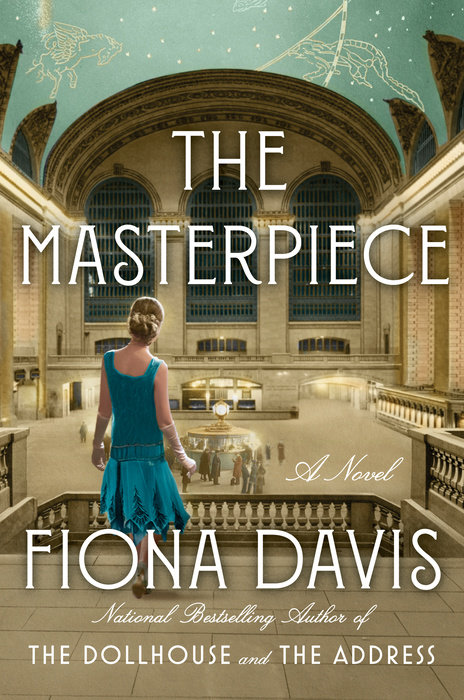
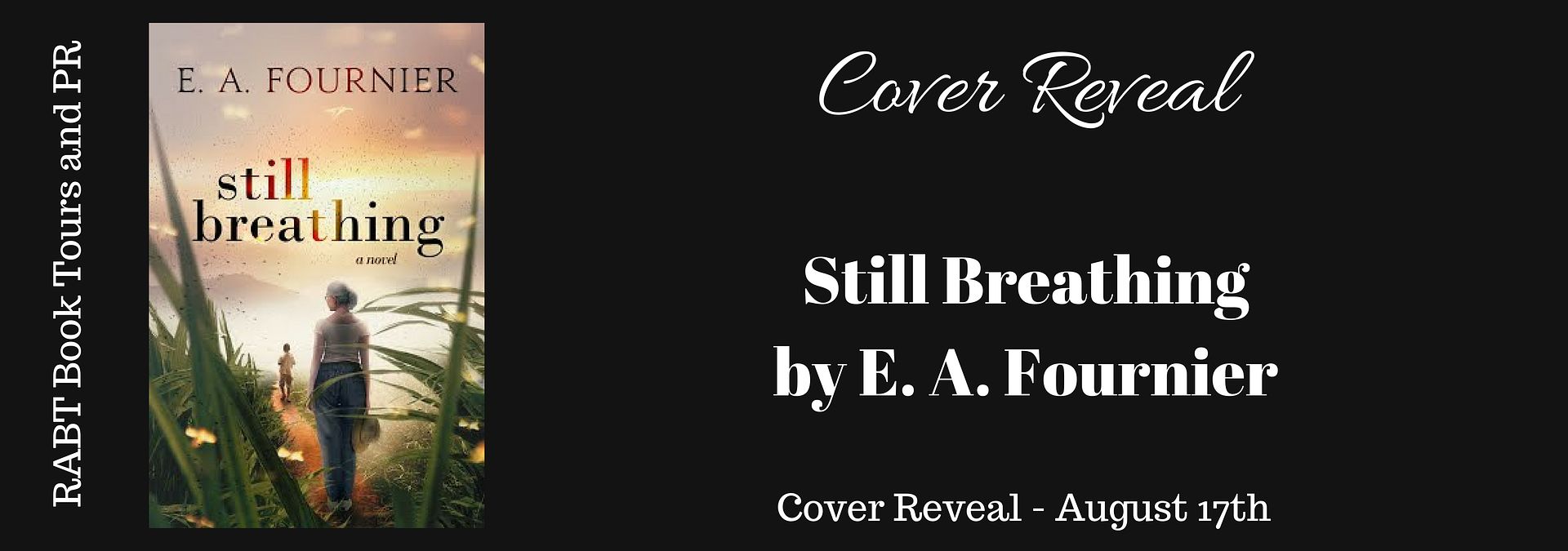
In her latest captivating novel, nationally bestselling author Fiona Davis takes readers into the glamorous lost art school within Grand Central Terminal, where two very different women, fifty years apart, strive to make their mark on a world set against them.
For the nearly nine million people who live in New York City, Grand Central Terminal is a crown jewel, a masterpiece of design. But for Clara Darden and Virginia Clay, it represents something quite different.
For Clara, the terminal is the stepping stone to her future, which she is certain will shine as the brightly as the constellations on the main concourse ceiling. It is 1928, and twenty-five-year-old Clara is teaching at the lauded Grand Central School of Art. A talented illustrator, she has dreams of creating cover art for Vogue, but not even the prestige of the school can override the public’s disdain for a “woman artist.” Brash, fiery, confident, and single-minded–even while juggling the affections of two men, a wealthy would-be poet and a brilliant experimental painter–Clara is determined to achieve every creative success. But she and her bohemian friends have no idea that they’ll soon be blindsided by the looming Great Depression, an insatiable monster with the power to destroy the entire art scene. And even poverty and hunger will do little to prepare Clara for the greater tragedy yet to come.
Nearly fifty years later, in 1974, the terminal has declined almost as sharply as Virginia Clay’s life. Full of grime and danger, from the smoke-blackened ceiling to the pickpockets and drug dealers who roam the floor, Grand Central is at the center of a fierce lawsuit: Is the once-grand building a landmark to be preserved, or a cancer to be demolished? For Virginia, it is simply her last resort. Recently divorced, she has just accepted a job in the information booth in order to support herself and her college-age daughter, Ruby. But when Virginia stumbles upon an abandoned art school within the terminal and discovers a striking watercolor hidden under the dust, her eyes are opened to the elegance beneath the decay. She embarks on a quest to find the artist of the unsigned masterpiece–an impassioned chase that draws Virginia not only into the battle to save Grand Central but deep into the mystery of Clara Darden, the famed 1920s illustrator who disappeared from history in 1931.
Excerpt
Chapter One
New York City, April 1928
Clara Darden's illustration class at the Grand Central School of Art, tucked under the copper eaves of the terminal, was unaffected by the trains that rumbled through ancient layers of Manhattan schist hundreds of feet below. But somehow, a surprise visit from Mr. Lorette, the school's director, had the disruptive power of a locomotive weighing in at thousands of tons.
Even before Mr. Lorette was a factor, Clara had been anxious about the annual faculty exhibition set to open at six o'clock that evening. Her first show in New York City, and everyone important in the art and editorial worlds would be there. She'd been working on her illustrations for months now, knowing this might be her only chance.
She asked her class to begin work on an alternate cover design for Virginia Woolf's latest book, and the four ladies dove in eagerly, while Wilbur, the only male and something of a rake to boot, sighed loudly and rolled his eyes. Gertrude, the most studious of the five members, was so offended by Wilbur's lack of respect that she threatened to toss a jar of turpentine at him. They were still arguing vociferously when Mr. Lorette waltzed in.
Never mind that these were all adults, not children. Whenever Wilbur made a ruckus, it had the unfortunate effect of lowering the entire class's maturity level by a decade. More often than not, Clara was strong enough to restore order before things went too far. But Mr. Lorette seemed possessed of a miraculous talent for sensing the rare occasions during which Clara lost control of the room, and he could usually be counted upon to choose such times to wander by and assess her skills as an educator.
"Miss Darden, do you need additional supervision again?" Mr. Lorette's bald pate shone as if it had been buffed by one of the shoeshine boys in the terminal's main concourse. The corners of his mouth curled down, even when he was pleased, while his eyebrows moved independently of each other, like two furry caterpillars trying to scurry away. Even though he was only in his early thirties, he exuded the snippety nature of a judgmental great-aunt.
He'd been appointed director three years earlier, after one of the school's illustrious founders, John Singer Sargent, passed away. The school had increased in reputation and enrollment with each new term, and Mr. Lorette had given himself full credit for its smashing success when he'd interviewed Clara. She'd been promoted from student monitor to interim teacher after Mr. Lorette's chosen instructor dropped out at the last minute, putting her on uneven footing from the beginning. It hadn't helped that the class had shriveled to five from an initial January enrollment of fifteen. Ten of those early enrollees had walked out on the first day, miffed at having a woman in charge.
Mr. Lorette's dissatisfaction, and the likelihood that she'd not be asked back next term, mounted each week, which meant tonight's faculty show would probably be her last opportunity to get her illustrations in front of the city's top magazine editors.
Since coming to New York the year before, Clara had dutifully dropped off samples of her work at the offices of Vogue and McCall's every few months, to no avail. The responses ranged from the soul-crushing-"Unoriginal/No"-to the encouraging-"Try again later." All that would change, tonight. She hoped. By seeing her work in the hallowed setting of the Grand Central Art Galleries, alongside the well-known names of other faculty members, the editors would finally appreciate what she had to offer. Even better, as the only illustrator on the faculty, she was sure to stand out.
Mr. Lorette cleared his throat.
"No, sir. We don't need any assistance. Thank you for checking in." She maneuvered around to the front of the table where she'd been working, in an attempt to block his view of her own sketches.
No luck. He circled around and stood behind it, his nose twitching. "What is this?"
"Some figures I was working on, to demonstrate the use of compass points to achieve the correct proportions."
"I thought you'd covered that already."
"You can never go back to the basics enough."
He offered a suspicious nod before winding his way through the tables, his eyes darting from drawing board to drawing board. Her students stood back, hoping for a kind word.
"Why is it each student seems to be drawing something completely different from the other?"
She nodded at the novel she'd left out on the still-life table. "The assignment was to create a cover for a book. I encouraged them to use their imaginations."
"Their examples of lighthouses and beaches are apropos. Yet you are drawing undergarments?"
Even if he had been a more sympathetic man, there was no way to explain how the hours stretched painfully long with her having so few students. How the skylights diffused the light in a way that made each day, whether sunny or overcast, feel exactly like every other. She routinely made the rounds, suggesting that a drybrush would work best to create texture or offering encouragement when Gertrude became frustrated, but at some point, the students had to be left alone to get to their work. Which is why today she'd pulled a chair up to a drawing table and sketched out the figures for her latest commission from Wanamaker Department Store: three pages of chemises for the summer catalog. The work paid a pittance, but at least it was something.
"This is for tomorrow's class," she lied. "As we do not have a live model to work from, I was planning on using a work of my own to guide them."
As she hoped, the mention of her standing request for a model redirected his attention.
His voice rose in pitch to that of a schoolgirl. "The students are free to take a life class at any time. This is an illustration class, and right now our models are reserved for the fine arts classes. As you said, they can use their imaginations, no?"
"But it is not ideal. If we can have a model to understand the anatomy underneath the fashions, to have the model begin nude and then add layers of clothing, we could build upon what we've learned already."
She never meant to be ornery, but somehow Mr. Lorette brought out a stubbornness in her every time.
"As yours is a class of mixed genders, taught by a woman, having a nude model would be most inappropriate. I'm sorry you find our school so deficient, Miss Darden." He clucked his tongue, which made her want to reach into his mouth and pull it out. "The other instructors, who have vastly more experience than you do, seem to manage just fine."
The other instructors-all men-had their every whim met by Mr. Lorette. She'd seen it in action, the director encouraging them to stop by his office for a smoke, the group laughing at some private joke, the director's feet propped up on his desk in an attempt to convey casual masculinity. Clara didn't fit the mold, which made her vulnerable.
"I'm sure we can manage, sir."
He shuffled off, closing the door behind him.
She directed the class to continue. Gertrude's work had only three rips from her overuse of the razor for corrections, a record low for her.
"Your stormy clouds are exquisite, but where would the lettering of the title and author go?" Clara asked.
Gertrude rubbed her nose with her wrist, leaving a gray streak at the tip. "Right. I got so caught up, I forgot."
Clara pointed to the top edge. "Try a damp sponge on the wet areas to lift out some color."
The girl was always eager, even if her strong hand was better suited to clay or oils than to the careful placement of watercolor, where mistakes were difficult to correct. Use too much water, and a brilliant cauliflower pattern would bloom where a smooth line ought to have been. Too dry, and the saturated color would stick to the page, resisting softening. But Clara loved watercolor in spite of, or perhaps because of, its difficult temperament. The way the paper shone after a wash of cool orange to convey a sunset, how the colors blended together in the tray to form new ones that probably didn't even have a name.
Finally, five o'clock came around. The students stored their artwork in the wooden racks, and once the room was empty, Clara hid her own sketches up on the very top of the storage cabinet, away from Mr. Lorette's prying eyes.
Starving, she headed downstairs to the main concourse, where cocoa-pink walls trimmed in Botticino marble soared into the air. Electrically lit stars and painted constellations twinkled along the turquoise vaulted ceiling, although the poor artist had inadvertently painted the sky backward, a mistake the art students loved to remark upon.
The first time she'd entered the hallowed space, stepping off the train from Arizona last September, she'd stopped and stared, her mouth open, until a man brushed past her, swearing under his breath at her inertia. The vastness of the main concourse, where sunshine beamed through the giant windows and bronze chandeliers glowed, left her gobsmacked. With its exhilarating mix of light, air, and movement, the terminal was the perfect location for a school of art.
Since then, she'd been sure to glance up quickly before joining in what seemed like an elaborate square dance of men and maids, of red-capped porters and well-dressed society ladies, all gliding by one another at various angles, yet never colliding. She liked best to lean over the banister on the West Balcony and watch the patterns of people flowing around the circular information booth, which sat in the middle of the floor, its four-faced clock tipped with a gleaming gold acorn.
Her stomach growled. She followed a group of smartly dressed men down the ramp to the suburban concourse and into the Grand Central Terminal Restaurant, where she secured a seat at the counter.
"Miss Darden?"
A young woman wearing a black velvet coat trimmed with fur hovered behind Clara, offering an inquisitive smile. "Yes, I thought that might be you. I'm Nadine Stevenson. I take painting classes at the school. You're having a bite before the show?"
"I am, Miss Stevenson."
"Oh now, call me Nadine."
Nadine's nose was large, her eyes close together and deep-set. Her right eye was slightly larger than the left, and the asymmetry was unsettling but powerful. Clara couldn't help but imagine how Picasso might approach her, all mismatched cubes and colors. Next to her stood an Adonis of a man whose symmetrical beauty offered a fascinating counterpoint. Shining blue-gray eyes under arched brows, hair the color of wheat.
"And this is Mr. Oliver Smith, a friend and poet."
Even though Clara had hoped to eat dinner in peace, she didn't have much of a choice. "Lovely to meet you both; please join me."
They took the stools next to her as the waiter stopped in front of them, pen in hand. Clara ordered the oyster stew, as did Oliver. Nadine requested peeled Muscat grapes, followed by a lobster cocktail.
Many of the young girls at the Grand Central School of Art had enrolled only so they could list it in their wedding announcements someday-a creative outlet that wouldn't threaten future in-laws. Nadine seemed to fall into that category, with her airs and pearls.
"Miss Darden is the only lady teacher at the Grand Central School of Art," said Nadine to Oliver. "She teaches illustration." She turned to Clara with a bright smile. "Now tell us about what you'll be showing tonight."
"Four illustrations that depict four seasons of high fashion." Clara couldn't help but elaborate. She'd put so much thought into the drawings. "For example, the one for winter depicts three women draped in fur coats, walking poodles sporting matching pelts."
"Well, that sounds pleasant."
Was Nadine making fun of her? Clara couldn't tell. She'd hardly had time to socialize, other than occasionally trading a few words with some of the other women artists who lived in her Greenwich Village apartment house. She'd been far too busy trying to make a living.
Nadine placed one hand on the counter and leaned in closely. The citrus scent of Emeraude perfume drifted Clara's way. "Did you know that Georgia O'Keeffe-she does those astonishing flowers-was a commercial artist at first? There's no need to be ashamed of it, not at all. Illustration is a common stepping-stone into the true arts."
"I'm not ashamed in the least." The audacity. Clara didn't enjoy being talked down to by a student. "I don't intend to do the 'true arts,' Nadine, as you put it. I enjoy illustration; it's what I do best."
"Well, I adore my life drawing and painting class. I'm learning so much from my instructor, Mr. Zakarian. He made me class monitor, and he's magnificent."
Jealousy pinged. None of Clara's students would describe her in such superlative terms, of that she was quite certain. "Class monitor, that's quite an honor. Do you plan on becoming an artist, then?"
Nadine gave out a squeak of a laugh. "Oh dear, no. I'm only taking classes for personal enrichment."
The waiter dropped off their bowls, and for a moment nothing was said. If Clara were alone, she would have surreptitiously folded a dozen or so oyster crackers into her handkerchief, to have something to snack on before bed.
The poet, who'd been silent the entire time, finally spoke. "My mother was an artist, although my father insisted she give it up after they married. She's been sick lately, but she very much misses going to museums and exhibits."
"I'm sorry to hear that," offered Clara. "Nadine mentioned that you're a poet?"
"Nadine is too kind in her description of me. Struggling poet, you might say. I suppose I take after my mother in that regard, having an innate love of the arts. My father is hoping I'll give it up eventually and go into banking."
Nadine placed a protective hand on his arm. "Oliver was accepted to Harvard and refused to go. Can you imagine? Instead, he's slumming it with us bohemians."
By all accounts, Nadine was hardly slumming it. But Clara understood firsthand what it was like to disappoint your family. "When I told my father I was moving to New York, he told me to not bother coming back. It's not an easy decision, but I'm glad I made it."
Oliver's blue eyes danced. "So there's hope for us miscreants?"
"Never."
They shared a look, a quick knowing smile, that sent Clara's pulse racing.
Usually, men didn't give her a second glance. Her father generously described her as "ethereal" for her blond hair, pale skin, and towering, skinny figure. Her mother said she looked washed out and encouraged her to wear clothes that added color to her complexion, but Clara preferred blacks and grays. Her ghostly pallor and height had always been sore points, embarrassing, and she preferred to avoid drawing attention to herself.
Oliver tucked into his stew. She did the same, embarrassed. She must have imagined the exchange.
Nadine took over the reins of the conversation. “Now, where are you from, Miss Darden?”
“Arizona.” She waited for the inevitable intake of breath. The American West might as well have been Australia, for how shocked most East Coast natives were at her having come all this way. “You’ve come all this way! Gosh. What does your father do? Is he a cowboy?”
“He sells metals.”
Clara deliberately used the present tense instead of the past when speaking of her family’s fortunes—now their misfortunes. Her father’s fraudulent scheming was no longer any of Clara’s concern, nor of anyone else’s. Luckily, Nadine went on and on about her own father’s real estate business, more for Oliver’s benefit than Clara’s, as Clara quickly finished her meal.
She looked up at the clock. “I must go; the doors will be opening soon.”
But there was no slipping away. Nadine locked arms with Clara as they walked out of the restaurant, as if they’d been friends for years. To the left and right, ramps sloped back up to the concourse, framed by glorious marble arches, and a vaulted ceiling rose above their heads in a herringbone pattern. Clara had tried to duplicate the earth‑and‑sable tones of the tiles in one of her illustrations to be shown tonight.
“Wait, before we go, stand over there.” Oliver pointed to a spot where two of the arches met.
“Face right into the corner and listen carefully.”
Clara had no time for games but watched as Nadine did as she was told. Oliver took up a spot at the opposite corner and mouthed something Clara couldn’t hear. Nadine giggled.
“What’s so funny?” Clara asked.
“You’ve got to try it. We’re in the Whispering Gallery.” Begrudgingly, Clara took up Nadine’s position.
“Clara, Clara.”
The words drifted over her like a ghost. Oliver might as well have been standing close by, speaking right into her ear. She looked up, trying to figure out how the shape of the ceiling transmitted sound waves so effortlessly. She faced the corner again. “Recite a poem to me.”
For a moment, she wasn’t sure if he would. Then the disembodied voice returned.
That whisper takes the voice
Of a Spirit, speaking to me,
Close, but invisible,
And throws me under a spell.
She swore she could feel the heat of Oliver’s breath. They locked eyes as they met once again in the center of the space.
“Thomas Hardy. The poem’s called ‘In a Whispering Gallery,’” Oliver volunteered.
Nadine crossed her arms, indignant. “You didn’t recite verse to me.” “I’ll regale you next time, I promise. For now, I must head to a poetry reading downtown and amass further inspiration.”
Clara shook hands and they took their leave, the poem still echoing in her head.
The mob of nattily dressed art lovers trying to squeeze their way through the gallery’s doorway had already backed up to the elevator by the time Clara and Nadine arrived. They toddled through, tak‑ ing small steps so as not to get their toes crushed, until they were safely inside.
The Grand Central Art Galleries predated the school by two years, when a businessman‑turned‑artist named Walter Clark had enlisted the help of John Singer Sargent to convert part of the sixth floor into a massive exhibition space, a kind of artists’ cooperative where commissions were kept to a minimum. Clara stopped by at least once a week to see the latest works, and she encouraged her students to do the same. The rooms were rarely empty, as visitors to New York and everyday commuters continually drifted through.
Tonight, the room buzzed with energy. The faculty’s work would stay up for a week, before being replaced with the students’ work, a celebration of the school’s spring term and its growing prestige. Clara’s illustrations would be on the same walls that once displayed Sargent’s portraits. The thought made her giddy.
Located on the south side of the terminal, the Grand Central Art Galleries were four times as long as they were wide, a warren of rooms and hallways, twenty in all, that encouraged visitors to circulate in a counterclockwise manner without ever having to double back. Clara scanned the walls of the first gallery for her work, with no luck. In the middle of the space, the sculpture teacher stood be‑ side a table featuring two nymphs, both nude, one standing on a turtle.
“Now, that’s unremarkable,” said Nadine.
Clara agreed but kept her mouth shut. They continued on, to where a group of students surveyed an oil of an ungainly horse. Towering above them all was the artist, an instructor for the life drawing and painting class.
Clara had seen him a few times before. A foreigner, he was known to sing loudly during his classes and even dance about at times. This evening, he stood to the side, listening with intensity as his acolytes buttered him up, every so often tossing his head in a futile effort to flick a thatch of hair out of his eyes. Indeed, he was more horselike than the horse in his painting.
“That’s my teacher. Mr. Zakarian.” Nadine sidled up next to him. Clara had seen women like her before, flinging themselves into the orbits of handsome or powerful men to fend off their own insecurities. Clara had no time for such nonsense.
Back to the task at hand. The air had become stifling as more people crammed in. She ventured into room after room before circling back, and still she didn’t see her illustrations.
A flash of panic seized her. Her job with Wanamaker was ending soon. They’d recently announced that they’d be using only in‑house artists going forward. Her salary of seventy‑five dollars a month from teaching covered her expenses, but not much more. And she could not count on the next term.
She wormed her way back one more time through the mazelike space. Nothing. Down one hallway, off to the right, was a door marked sales office. She’d passed by it in her first go‑round, assuming it to be a place for clerks to write up invoices. The door stood halfway open, the lights on. She peered inside.
It was more a closet than a room, with a scratched‑up desk against one wall and a wooden file cabinet wedged into a corner.
There, above the desk, equally spaced apart and centered on the wall with great care, were her illustrations.
By the time she found Mr. Lorette, Clara’s limbs shook with rage. He was in an animated conversation with Mr. Zakarian while Mrs. Lorette looked on. Clara had met her in passing at one of the faculty get‑togethers, awed by the puffy, out‑of‑date pompadour that perched on the woman’s head like a long‑haired cat.
She inserted herself into the group. “Mr. Lorette, my illustrations have been hung in a back office. A back office!”
While Mr. Lorette sputtered at her rudeness, she continued on. “I am a faculty member of the School of Art, and yet my work has been placed in a cave where no one would think to go.”
“I am sorry, Miss Darden. We were in a tight spot, you see.” He paused. “Quite literally.”
As Mr. Lorette laughed at his own joke, Clara noticed the editor of Vogue headed for the exit. For certain, he’d never even seen her work.
Mr. Zakarian spoke up. “Where was her art hung?”
“Just off a main gallery,” said Mr. Lorette. “They are illustrations. We concluded they were more suited to an intimate environment.”
“Perhaps you could guarantee her a spot here in the first room next year, to make it up to her?” Mr. Zakarian held out his hand to Clara. “I don’t think we’ve met. I’m Mr. Levon Zakarian, one of your fellow teachers.”
She shook it without looking at him, her glare fixed on Mr. Lorette. “Next year it’ll be too late. It’s already too late.”
Unlike students such as Nadine, for whom the Grand Central School of Art was just a pit stop on the way to marital bliss, Clara had sunk every ounce of energy into her career as an artist.
Against her parents’ wishes, she’d arrived in New York, knowing no one, and done everything she could to make it as an illustrator. What made it worse was knowing she’d been given a shot that other artists would have been envious of—to teach at the Grand Central School of Art, to show her work at the galleries—only to see it vaporize.
Mr. Lorette shrugged. “I can’t seem to please anyone tonight. We will make it up to you; my deepest apologies, Miss Darden.” He turned to Mr. Zakarian. “Have you seen Edmund’s latest work? Come with me. I assure you it’ll give you something to think about.”
“I believe Miss Darden may give you something to think about, if you try to shake her off.” Mr. Zakarian wore a crooked smile. “I have an idea. Let’s take down one of mine, and we’ll replace it with her work. Get it right out there in the center.”
She didn’t need one of the faculty stars to swoop down and protect her. The very thought made her sick with embarrassment.
Unwilling to give Mr. Lorette any further satisfaction at her distress, Clara stormed out without uttering a reply.
Excerpted from The Masterpiece by Fiona Davis. Copyright © 2018 by Fiona Davis. All rights reserved. No part of this excerpt may be reproduced or reprinted without permission in writing from the publisher.
Buy on Amazon | Barnes and Noble
About the Author
Fiona Davis is the nationally bestselling author of The Dollhouse and The Address.She lives in New York City and is a graduate of the College of William and Mary in Virginia and the Columbia University Graduate School of Journalism.







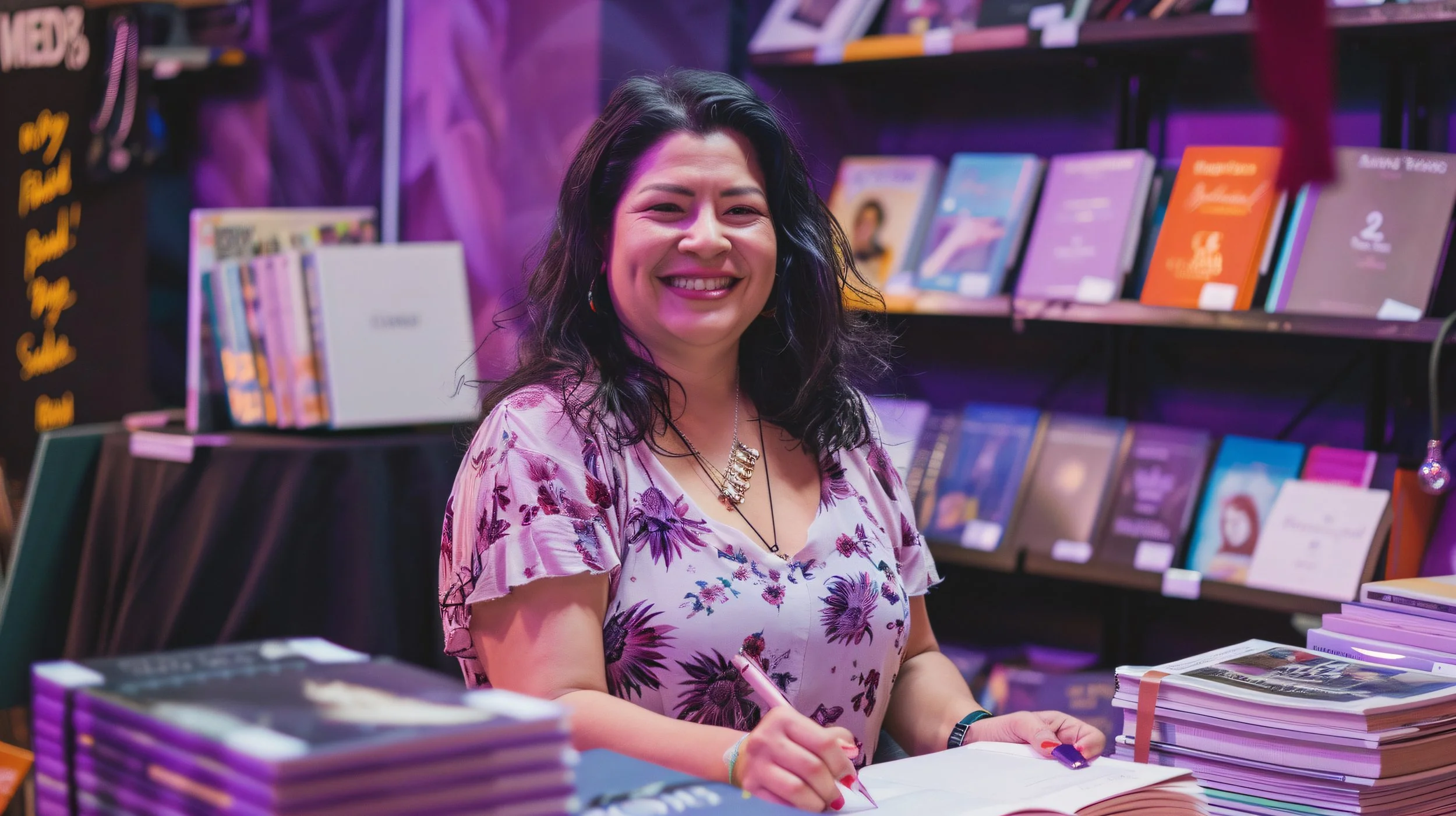
 Meet Tarrah. She’s a contemporary romancer who is all about the feels, with the twists of sexy mixed in between. She’s been writing since before she can remember. Writing was always a passion, that was kept it under wraps, stayed on the backburner and never vocalized or followed through with my desire to be a writer, until she read a horrible book and thought: ‘I could do better than that!’ She kept her writing romance from her husband for nearly two years, but finally told him because… royalties and taxes. Now, he lovingly helps with ‘research’ and uses him for his amazing Photoshop skills for her covers.
She is originally from the San Francisco Bay Area, but living in beautiful San Diego with her own little family while working during the day as a social worker working with the homeless. She is a hardcore San Francisco Giants fan and anything dealing with cupcakes and Zombies.
Her writing style is that she tries to keep on earth. She tries her best to not be too unrealistic with her characters, what they do and how they live. She wants her books to be relatable and not to create too many eye rolls, when a character starts calling his love interest baby after knowing her for 5 minutes.
She has written and self-published 4 books and one novella. They’re all dual point of view aside from the novella. She is currently working on several pieces but focusing on two mainly. Thematically, the novels are friends to lovers, random hook-ups and office romances mixed with a whole lot of fun in the middle.
Meet Tarrah. She’s a contemporary romancer who is all about the feels, with the twists of sexy mixed in between. She’s been writing since before she can remember. Writing was always a passion, that was kept it under wraps, stayed on the backburner and never vocalized or followed through with my desire to be a writer, until she read a horrible book and thought: ‘I could do better than that!’ She kept her writing romance from her husband for nearly two years, but finally told him because… royalties and taxes. Now, he lovingly helps with ‘research’ and uses him for his amazing Photoshop skills for her covers.
She is originally from the San Francisco Bay Area, but living in beautiful San Diego with her own little family while working during the day as a social worker working with the homeless. She is a hardcore San Francisco Giants fan and anything dealing with cupcakes and Zombies.
Her writing style is that she tries to keep on earth. She tries her best to not be too unrealistic with her characters, what they do and how they live. She wants her books to be relatable and not to create too many eye rolls, when a character starts calling his love interest baby after knowing her for 5 minutes.
She has written and self-published 4 books and one novella. They’re all dual point of view aside from the novella. She is currently working on several pieces but focusing on two mainly. Thematically, the novels are friends to lovers, random hook-ups and office romances mixed with a whole lot of fun in the middle.