Spotlight: The Forbidden Door (Jane Hawk Series #4) by Dean Koontz

When this relentless rogue FBI agent comes knocking, her adversaries will have to answer—with their lives—in the latest thrilling Jane Hawk novel by the #1 New York Times bestselling author of The Silent Corner.

She was one of the FBI’s top agents until she became the nation’s most-wanted fugitive. Now Jane Hawk may be all that stands between a free nation and its enslavement by a powerful secret society’s terrifying mind-control technology. She couldn’t save her husband, or the others whose lives have been destroyed, but equipped with superior tactical and survival skills—and the fury born of a broken heart and a hunger for justice—Jane has struck major blows against the insidious cabal.

But Jane’s enemies are about to hit back hard. If their best operatives can’t outrun her, they mean to bring her running to them, using her five-year-old son as bait. Jane knows there’s no underestimating their capabilities, but she must battle her way back across the country to the remote shelter where her boy is safely hidden . . . for now. As she moves resolutely forward, new threats begin to emerge: a growing number of brain-altered victims driven hopelessly, violently insane. With the madness spreading like a virus, the war between Jane and her enemies will become a fight for all their lives—against the lethal terror unleashed from behind the forbidden door.

Buy on Amazon | Barnes and Noble

About the Author

Dean Koontz, the author of many #1 New York Times bestsellers, lives in Southern California with his wife, Gerda, their golden retriever, Elsa, and the enduring spirits of their goldens, Trixie and Anna.

Spotlight: When We Were Young (Baxter Family Series) by Karen Kingsbury

From #1 New York Times bestselling author Karen Kingsbury comes a classic story about second chances, featuring the beloved Baxter family and a young father who finds his whole world turned upside down on the eve of his divorce.

What if you could see into the future and know what will happen tomorrow, if you really walk out that door today. Pay attention. Life is not a dress rehearsal.

From their first meeting, to their stunning engagement and lavish wedding, to their happily-ever-after, Noah and Emily Carter were meant to be together. Theirs is a special kind of love and they want the world to know. More than a million adoring fans have followed their lives on Instagram since the day Noah publicly proposed to Emily. But behind the carefully staged photos and encouraging posts, their life is anything but a fairytale, and Noah’s obsession with social media has ruined everything.

Distraught, Emily reaches out to her friend Kari Baxter Taylor and tells her the truth: Noah and Emily have decided to call it quits. He is leaving in the morning.

But when Noah wakes the next day, everything is different. Emily is gone and the kids are years older. Like Scrooge in A Christmas Carol, bizarre and strange events continue throughout the night so that Noah is certain he’s twenty years older, and he is desperate for a second chance.

Now it would take a miracle to return to yesterday.

When We Were Young is a rare and beautiful love story that takes place in a single day. It’s about the gift of knowing what tomorrow will bring if you really walk out that door today.

Buy on Amazon | Barnes and Noble

About the Author

Karen Kingsbury, #1 New York Times bestselling novelist, is America’s favorite inspirational storyteller, with more than twenty-five million copies of her award-winning books in print. Her last dozen titles have topped bestseller lists and many of her novels are under development as major motion pictures. Her Baxter Family books have been developed into a TV series now available everywhere. Karen is also an adjunct professor of writing at Liberty University. In 2001 she and her husband, Don, adopted three boys from Haiti, doubling their family in a matter of months. Today the couple has joined the ranks of empty nesters, living in Tennessee near four of their adult children.

Spotlight: Presidents of War by Michael Beschloss

From a preeminent presidential historian comes a groundbreaking and often surprising saga of America’s wartime chief executives

Ten years in the research and writing, Presidents of War is a fresh, magisterial, intimate look at a procession of American leaders as they took the nation into conflict and mobilized their country for victory. It brings us into the room as they make the most difficult decisions that face any President, at times sending hundreds of thousands of American men and women to their deaths.

From James Madison and the War of 1812 to recent times, we see them struggling with Congress, the courts, the press, their own advisors and antiwar protesters; seeking comfort from their spouses, families and friends; and dropping to their knees in prayer. We come to understand how these Presidents were able to withstand the pressures of war—both physically and emotionally—or were broken by them.

Beschloss’s interviews with surviving participants in the drama and his findings in original letters, diaries, once-classified national security documents, and other sources help him to tell this story in a way it has not been told before. Presidents of War combines the sense of being there with the overarching context of two centuries of American history. This important book shows how far we have traveled from the time of our Founders, who tried to constrain presidential power, to our modern day, when a single leader has the potential to launch nuclear weapons that can destroy much of the human race.

Buy on Amazon | Barnes and Noble

About the Author

Michael Beschloss is the author of nine books on presidential history, including, most recently, the New York Times bestsellers Presidential Courage and The Conquerors, as well as two volumes on Lyndon Johnson’s White House tapes. He was also editor of the number-one global bestseller Jacqueline Kennedy: Historic Conversations on Life with John F. Kennedy. He is the NBC News Presidential Historian and a PBS NewsHour contributor and has received an Emmy and six honorary degrees. He is on Twitter at @BeschlossDC.

Spotlight: The Air You Breathe by Frances de Pontes Peebles

The story of an intense female friendship fueled by affection, envy and pride–and each woman’s fear that she would be nothing without the other.

Some friendships, like romance, have the feeling of fate.

Skinny, nine-year-old orphaned Dores is working in the kitchen of a sugar plantation in 1930s Brazil when in walks a girl who changes everything. Graça, the spoiled daughter of a wealthy sugar baron, is clever, well fed, pretty, and thrillingly ill behaved. Born to wildly different worlds, Dores and Graça quickly bond over shared mischief, and then, on a deeper level, over music.

One has a voice like a songbird; the other feels melodies in her soul and composes lyrics to match. Music will become their shared passion, the source of their partnership and their rivalry, and for each, the only way out of the life to which each was born. But only one of the two is destined to be a star. Their intimate, volatile bond will determine each of their fortunes–and haunt their memories.

Traveling from Brazil’s inland sugar plantations to the rowdy streets of Rio de Janeiro’s famous Lapa neighborhood, from Los Angeles during the Golden Age of Hollywood back to the irresistible drumbeat of home, The Air You Breathe unfurls a moving portrait of a lifelong friendship–its unparalleled rewards and lasting losses–and considers what we owe to the relationships that shape our lives.

Excerpt

Time is short and the water is rising.

This is what one of Sofia Salvador’s directors—I can’t recall his name—used to shout before he’d start filming. Each time he said it, I imagined all of us in a fishbowl, our hands sliding frantically along the glass sides as water crept above our necks, our noses, our eyes.

I fall asleep listening to our old records and wake with my mouth dry, my tongue as rough as a cat’s. I pull the handle of my La‑Z‑Boy and, with a jolt, am sitting upright. A pile of photos rests in my lap.

I own the most famous photograph of Sofia Salvador—the Brazilian Bombshell, the Fruity Cutie Girl, the fast‑talking, eye‑popping nymph with her glittering costumes and pixie‑cut hair who, depending on your age and nationality, is either a joke, an icon of camp, a victim, a traitor, a great innovator, or even, as one researcher anointed her, “an object of serious study of Hollywood’s Latinas.” (Is that what they’re calling us now?) I bought the original photo and its negative at auction, paying much more than they were worth. Money isn’t an issue for me these days; I’m filthy rich and am not ashamed to say so. When I was young, musicians had to pretend that success and money didn’t matter. Ambition, in a sambista and especially in a woman, was seen as an unforgivable fault.

In the photo, taken in 1942, Sofia Salvador wears the pixie cut she made famous. Her eyes are wide. Her lips are parted. Her tongue flicks the roof of her mouth; it is unclear if she is singing or screaming. Earrings made to resemble life‑sized hummingbirds—their jeweled eyes glinting, their golden beaks sharp—dangle from her ears. She was vain about her lobes, worried they would sag under the weight of her array of earrings, each one more fantastical than the next. She was vain about everything, really; she had to be.

In the photograph she wears a gold choker, wrapped twice around her neck. Below it are strand upon strand of fake pearls, each one as large as an eyeball. Then there are the bracelets—bands of coral and gold—taking up most of her forearms. At the end of each day, when I’d take those necklaces and bracelets off her and she stopped being Sofia Salvador (for a moment, at least), Graça flapped her arms and said, “I feel so light. I could fly away!”

Graça drew Sofia’s dark eyebrows arched so high she always looked surprised. The mouth—that famous red mouth—was what took her the longest to produce. She lined beyond her lips so that, like everything else, it was an exaggeration of the real thing. Who was the real thing? By the end of her short life, even Graça had trouble answering this question.

The picture was taken for Life magazine. The photographer stood Graça against a white backdrop. “Pretend you’re singing,” he ordered. “Why pretend?” Graça replied.

“I thought that’s all you knew how to do,” the photographer shot back. He was famous and believed his fame gave him the right to be nasty.

Graça stared. She was very tired. We always were, even me, who signed Sofia Salvador’s name to hundreds of glossy photos while Graça and the Blue Moon boys endured eighteen‑hour days of filming, costume fittings, screen tests, dance rehearsals, and publicity shoots for whatever her latest movie musical was. It could have been worse; we could have been starving like in the old days. But at least in the old days we played real music, together.

“Then I will pretend to respect you,” Graça said to that fool photographer. Then she opened her mouth and sang. People remember the haircut, the enormous earrings, the sequined skirts, the accent, but they forget her voice. When she sang for that photographer, his camera nearly fell from his hands.

I listen to her records—only our early recordings, when she sang Vinicius’s and my songs—and it is as if she is still seventeen and sitting beside me. Graça, with all of her willfulness, her humor, her petty resistances, her pluck, her complete selfishness. This is how I want her, if only for the span of a three‑minute song.

When the song ends, I’m exhausted and whimpering. I imagine her here, nudging me, bringing me back to my senses.

Why the hell are you upset, Dor? Graça chides. At least you’re still around.

Her voice is so clear, I have to remind myself she isn’t real. I have known Graça longer in my imagination than in real life.

Who wants real life? Graça asks, laughing at me. (She is always laughing at someone.)

I shake my head. After all this time—ninety‑five years, to be exact— I still do not know the answer.

My current life is a dull jumble of walks along the beach chaperoned by a nurse; trips to the grocery store; afternoons in my office; evenings listening to records; tedious hours spent tolerating a steady stream of physical therapists and doctors with their proclamations and humorless devotion. I live in a vast house surrounded by paid help. Once, long ago, I wished for such ease.

Be careful what you wish for, Dor.

It’s too late to be careful now, amor.

Now, I wish for the early, chaotic part of my life—those first thirty or so years—to return to me, even with its cruelty, its sacrifice, its missteps, its misdeeds. My misdeeds. If I could hear my life—if I could put it on a turntable like a worn‑out LP—I’d hear samba. Not the boisterous kind they play during Carnaval. Not one of those silly marchinhas, as short‑lived and vapid as bubbles. And not the soft‑spoken, romantic sort, either. No. Mine would be the kind of samba you’d find in a roda: the kind we played in a circle after work and a few stiff drinks. It begins quite dire‑sounding, perhaps with the lonely moan of a cuíca. Then, ever so slowly, others join the roda—voices, guitars, a tamborim drum, the scratch of a reco‑reco—and the song begins to claw its way out of its lowly beginning and into something fuller, thicker, darker. It has all of the elements of a true samba (though not necessarily a great one). There is lament, humor, rebelliousness, lust, ambition, regret. And love. There is that, too. It is all improvisation, so if there are mistakes I must move past them and keep playing. Beneath it all, there is the ostinato—the main groove that never varies, never wavers. It keeps its stubborn pace; the beat that’s always there. And here I am: the only one left in the circle, conjuring voices I have not heard in decades, listening to a chorus of arguments I should never have made. I have tried not to hear this song in full. I have tried to blot it out with drink and time and indifference. But it remains in my head, and will not stop until I recall all of its words. Until I sing it out loud, from beginning to end.

THE SWEET RIVER

Share this bottle with me,

share this song.

The years have hardened my heart.

Drink will loosen my tongue.

Come, walk with me,

to the places I once loved.

Man made the fire

to burn the fields of cane.

God made music

to take away my pain.

I come from a land

where sugar is king and the river is sweet.

They say a woman drowned there,

her ghost haunts the deep.

Sit beside me now, at the riverbank

hear my voice, loud and strong.

Wade into these sweet waters with me,

let me open your heart with a song.

Now we’re both pulled under, friend,

singing the same refrain:

Dive back, again, to the place you once loved

and you’ll find it’s never the same.

Man made the fire

to burn the fields of cane. God made music

to take away my pain.

THE SWEET RIVER

It would be better to begin with Graça—with her arrival, with our first meeting. But life isn’t as orderly as a story or a song; it does not always begin and end at compelling points. Even before Graça’s arrival, even as a small child, I sensed that I’d been born into a role that didn’t fit my ambitions, like a stalk of sugarcane crammed into a thimble.

I survived my own birth, a true feat in 1920 if you were born to a dirt‑poor mother living on a sugar plantation. The midwife who delivered me told everyone how surprised she was that such a hearty girl could’ve come from my mother’s tired womb. I was her fifth and final child. Most women who worked on the plantation had ten or twelve or even eighteen children, so my mother’s womb was fresher and younger than most. But she was not married and never had been. All of my long‑lost brothers and myself—I was the only girl in our lot—had different fathers. This made my mother worse than a puta in many people’s minds, because at least a puta had the sense to charge for her services.

I didn’t dare ask about my mother, afraid of what I might hear and not willing to risk a beating; I was not allowed to ask any questions at all, you see. No one spoke of her, except to insult me. They said I was big‑boned, like her. They said I had a temper, like her. They said I was ugly as sin, like her, except I did not have scars covering my arms and face from the cane. She was, for a little while at least, a sugarcane cutter—one of a handful of women who could stomach the work. But the insult that came up the most was the one about her easy way with men. If I didn’t use enough salt to scrub blood from the plantation’s cutting boards, or if I stopped stirring the infernally hot jam on the stove for even a second, or if I was too slow bringing Cook Nena or her staff ingredients from the pantry or garden, I was smacked with a wooden spoon and called “puta’s girl.” So I came to know my mother through all of the things people despised about her, and about me. And I realized, though I could not articulate it clearly as a child, that people hated what they feared, and so I was proud of her.

The midwife took pity on me, being such a healthy baby, and instead of smothering me, or throwing me in the cane for the vultures pick at, or giving me to some plantation owner to raise like a pet or a slave (all common practices back then for girl children without families), she gave me to Nena, the head cook on the Riacho Doce plantation. There were hundreds of cane plantations along the coast of our state of Pernambuco, and Riacho Doce was one of the largest. In good times, when sugar prices were high, Cook Nena led a staff of ten kitchen maids and two houseboys. Nena was as full‑breasted as a prize rooster and had hands as large and as lethal as her cast‑iron frying pans. The Pimentel family owned Riacho Doce and were the masters of its Great House, but Nena ruled in the kitchen. This is why no one objected when, after the midwife brought me, naked and wailing, to Nena, the cook decided to raise me as her kitchen girl.

Everyone in the Great House—maids, laundresses, stable boys, houseboys—went to Nena’s kitchen to get a look at me. They freely remarked on my rosy skin, my long legs, my perfect feet. A day later, I stopped drinking the goat’s milk Nena gave me in a bottle. Nena visited a local wet nurse and I spat the woman’s teats from my mouth. I was too young to eat manioc porridge but Nena tried to feed it to me anyway. I spat that out, too, and soon turned shriveled and yellow‑skinned like an old crone. People said I’d been cursed by the evil eye. Olho mau, they called it, olho gordo. Both are different names for the same bad luck.

Nena went to Old Euclides for help. Euclides was wrinkled, gossipy, and the color of blackstrap scraped from the sugar mill’s vats. He’d worked at R iacho Doce longer than Nena had, first as a stable boy and then as its groundskeeper. He had a donkey who’d given birth and lost her foal but not her milk. Nena took me to the stables and held me straight to that jega’s teat, and I drank. I drank that jega’s milk until I was fat and strong again. My color changed; I was less like a rose and more like that donkey’s tan coat. My hair grew in thick. After that, I was called Jega.

In people’s superstitious and backward minds, the girl I became was inextricably linked to the mother’s milk I’d drunk.

“Jega’s as dumb as an ass,” the houseboys teased.

“Jega’s as stubborn as an ass,” the kitchen maids complained.

“Jega’s as ugly as an ass,” the stable boys said when they felt spiteful.

They all wanted me to believe it. They wanted me to become that Jega. I would never give them that satisfaction.

The Great House sat on a hill. You could stand on its pillared front porch and see nearly all of Riacho Doce’s workings: the main gate, the mill with its blackened smokestack, the horse and donkey stables, the administrator’s house, the carpenter’s shed, the old manioc mill, a small square of pasture and corn, the distillery and warehouses with their thick iron doors. And you could see the brown line of water that gave Riacho Doce its name, although it was much wider than a creek and its waters were not sweet.

Every plantation had a ghost story and ours was no different: a woman had drowned in the creek and lived there still. Some said she was killed by a lover, others said a master, others said she killed herself. They said you could hear her at night, under the waters, singing for her lost love or trying to lure people into the waters and drown them to keep her company; the story depended on whether you believed in the kind ghost or the vengeful one. R iacho Doce’s mothers told their chil‑ dren this before bed, and it kept them away from the river. I heard the ghost’s story from Nena.

Behind the Great House was an orchard, and behind that the low‑ roofed slaves’ senzalas that had been converted into servants’ quarters. Nena and I were the only staff allowed to sleep in the Great House it‑ self, which set us apart from the rest of the servants. This special status didn’t affect Nena as much as it did me. I was Jega—the lowest soul in the strict hierarchy of the Great House—and the maids and houseboys were determined to remind me of this fact. They slapped me, pinched my neck, cursed and spat at me. They thwacked me with wooden spoons and greased the staff doorway with lard to make me slip and fall. They locked me in the foul‑smelling outhouse until I kicked my way out. Nena knew about these pranks but didn’t stop them.

“That’s the way a kitchen is,” Nena said. “You’re lucky the boys aren’t trying to get under your skirts. They will soon enough. Better learn to fight them now.”

Nena always issued such warnings to me:

Better keep your head down.

Better stay out of sight.

Better make yourself useful.

If I failed to heed her warnings she beat me with a wooden spoon, or an old bullwhip, or with her bare hands. And while I feared these beatings I didn’t think them odd or bad; I knew no other kind of affection, and neither did Nena. She used her fists to teach me things she couldn’t articulate, lessons that would keep me alive. Nena could keep me safe in her kitchen but nowhere else. I was a creature without family or money. I was another mouth to feed. And, even worse, I was a girl. At the owners’ whim, I could be thrown out of the Great House and left to fend for myself in that sea of sugarcane. And what did an ugly little girl have to offer the world but her body? So I had to learn to defend that body ruthlessly against any stable boys or millworkers or others who might try to use it roughly. And, at the same time, I had to learn how to make myself useful within the house, to obey my patrons at all costs or, better yet, stay out of their sights completely. As long as I was invisible, I was safe.

So while little girls like Graça were playing with dolls and dresses, I learned to play other kinds of games. Games where force was power, and where cleverness meant survival.

When I was nine years old, the world’s great financial crash hit Brazil and sugar became as valuable as dirt. Smaller plantations near R iacho Doce boarded up their Great Houses and put workers out of their gates. Riacho Doce’s mill closed. After getting into crippling debt, the Pimentel family moved away. There were rumors of a sale. Soon afterward, the cane cutters left to work on other plantations that had weathered the crisis. The fields were abandoned. The distillery was locked. One by one, the housemaids and kitchen girls and stable boys left. Soon, only Nena, Old Euclides, and I were left.

“They’ll be back,” Nena said of the Pimentels. “No one leaves their land. And when they do come back, they’ll remember who was loyal and who wasn’t.”

Nena was driven by loyalty and fear. She and Old Euclides were born on Riacho Doce before slavery had been banned in Brazil in 1888, and had stayed on even after they were freed. During the abandonment, Old Euclides took care of the grounds, making sure no one took animals from the stables or stole fruit from the orchard. Nena wouldn’t let her copper pots and iron pans fall into the hands of looters or bill collectors so she hid anything of value. Porcelain dining sets, silver platters and tureens, pure gold cutlery, a bowl made of mother‑of‑pearl were stashed under the Great House’s floorboards. We ate whatever food was left in the pantry and then, because none of us had been paid since the Pimentels left, began to trade at the local market. Eggs for flour, star fruit from the orchard for a bit of salted meat, bot‑ tles of molasses for beans. These were lean times but not unhappy ones. Not for me.

For many months the Great House was empty and I spent my days inside it. I skipped across its stone floors. I slipped my hands under dust covers and felt cool marble, the slopes and curves of table legs, the gilded bevels of mirrors. I pulled books from shelves and opened them wide to hear their bindings snap. I walked proudly up and down the wide wooden staircase, like I imagined the lady of the house would. For the first time in my nine years of life, I had the luxury of time and freedom—to explore, to pretend, to play without fear of being hit or scolded, to live without the constant worry that I would be cast out of R iacho Doce for some small infraction. I was allowed to be a child, and began to believe that I would always have such freedom. I should have known better.

One day, as I sat in the library and tried to decode the mysterious symbols inside the Pimentels’ books, I heard a terrible growling outside. It sounded as if there was a giant dog snarling at the Great House gate. I ran to Nena, who opened the front door.

A motorcar rumbled outside the front gate. Old Euclides scrambled, suddenly as spry as a puppy, down the drive and pushed open the gate. The car stopped and a man emerged from the driver’s side. He wore a hat and a long canvas coat to protect his suit. He opened the passenger and back doors. Two women emerged: a pale one also wearing a driving coat, and another in a maid’s striped uniform and lace cap. The maid attempted to tug something from the backseat. There was a hiss and a screech. For a moment, I believed there was an animal in the car—a cat or some kind of possum—until I saw the maid’s hands wrapped around two tiny feet in patent leather boots. The boots kicked free of the maid’s grip. The woman wedged herself deeper into the car’s doorway. Then there were screams, grunts, a swirl of white petticoats and, finally, a cry. The maid jumped from the automobile’s backseat, her eyes watering, her hand pressed to a fresh scratch on her face.

“Leave her inside!” the man snapped. “She’s old enough to climb out herself.”

The maid nodded, her hand still clamped to her face. The other woman sighed and unbuttoned her canvas driving coat, revealing a silk dress and a tangle of pearls at her neck.

A halo of red curls surrounded her face. Her skin was what we called “mill white” because that was the prized color of sugar. The sugar we used in the Great House kitchen was the mill’s seconds—raw and muddy‑colored, not white but not quite brown, just like me.

“It’s better she doesn’t come outside,” the man said, staring at the dirt road. “She’ll get herself filthy.” He had darker coloring, a square jaw, and a Roman nose that sloped like an arrow pointing at his full mouth.

“We’ll all have to get used to a little dirt from now on,” the mill white woman replied, and her lips pursed as if she was holding back laughter, as if she’d told herself a naughty joke.

At the mention of dirt, a girl my own age wiggled from the backseat. She wore a dress the color of butter, and white gloves. A bow sat crookedly atop her head; the girl snatched it from her hair and flung it to the ground. She kicked at the dirt, scuffing her boots, and then glared at the adults around her, daring them to tell her to stop. Then she saw me, and stood still. To her, I was not invisible.

Her eyes were the color of cork. Her mouth looked as if it had been painted onto her face, like a doll’s. I don’t know how long we stared at each other; I only remember not wanting to break first, determined not to let her win.

Still staring at me, the girl pressed her gloved hand to the car’s body and dragged it across the entire side. Then she raised her hand. The glove’s palm was as red as the earth under my bare feet. The girl smirked, as if sharing a joke, but I knew she didn’t intend to amuse me. Gloves were for the rich. They were expensive and delicate. Some poor laundress would have the unenviable task of trying to clean that soiled glove, so small it would bunch in her hands and make her knuckles scrape against the washboard until they bled. But the girl didn’t care about the glove, or the laundress, or anything. She would ruin something perfectly good, for no reason at all. I felt both respect and revulsion.

“Graça!” the man shouted.

The man and woman bickered. Nena, Old Euclides, and I kept very still, waiting for them to acknowledge our presence. Only when they needed help did we become flesh‑and‑blood to them—the man ordered Euclides to get the bags from the car’s trunk; the pale woman dropped her driving coat into Nena’s arms. This is when I knew that those people were not visitors but owners, come to claim Riacho Doce and the Great House for themselves.

They were also Pimentels—cousins of the previous owners. As we walked through the Great House together, Senhora Pimentel moved languidly alongside her husband, looking tired as she pointed out leaks and cracks, peeling paint and rotted wood. Her husband, Senhor Pimentel, yanked dust covers from the furniture, like a magician revealing his trick.

“I remember my grandfather using this desk!” he cried. And, later, “I was the one who spilled ink on this chair!”

The giddy freedom I’d felt over several months leaked away in the single hour after those new Pimentels arrived. All of the books I’d slipped from the shelves, all of the ivory and glass knickknacks I’d polished and stroked, all of the tables I’d hidden under, pretending I was in a tent in some exotic land, all of the mirrors in which I’d studied myself, would never again be mine to play with. I would once again have to be useful and invisible, to obey or be cast away. When her parents weren’t looking, the cork‑eyed girl stuck out her tongue at me. It was as pink and slick as a jambo fruit. I had the urge to bite off its tip.

Finally, the new Pimentels pulled the covers from two armchairs and sat, exhausted, in the formal sitting room. They ordered Nena to make coffee. We raced to the kitchen, where Nena grabbed my arm and told me to get the last, precious beans she’d hidden under her cot. Back upstairs, I peeked through the slatted door of the sitting room as Nena served coffee to the new Pimentels. They waited to drink until she’d left the room; I did not follow her to the kitchen.

Senhor Pimentel took a sip from his cup and made a face. “Did she use an old sock to strain this?” he asked.

Senhora Pimentel shook her head. “We’ll have to train a new staff. How exhausting.”

“Nena’s a good cook—you’ll see. She’s been here since I was a kid,” Senhor Pimentel replied.

“You think she and the old man had that child together? Poor little ugly thing.”

Senhor Pimentel laughed. “Nena’s as old as the hills. And the girl’s too light‑skinned to be theirs. I bet she’s not so ugly under all that dirt; she just needs a good scrubbing.”

“She’ll stay in the kitchen,” Senhora Pimentel snapped. “If she grows up to be decent‑looking she can serve the table.”

Senhor Pimentel took his wife’s hand. She fixed him with the same weary expression she’d had when she’d inspected the Great House. They discussed their plans for the house. Furniture that was upstairs would go downstairs. Rugs would be thrown out. Curtains replaced. Water pipes and a f lush toilet installed, which meant hacking into the house’s thick white walls.

There were footsteps behind me. Before I could hide, I felt a terrible stinging on the back of my arm. The cork‑eyed Pimentel girl pinched the skin above my elbow. I glared and shook her loose.

“Marta always cried when I pinched her,” the girl said.

“Who’s Marta?”

“The kitchen girl at my other house, in Recife. It’s a mansion. Better than this pigsty.”

“This is the best house of any plantation,” I said.

The girl shrugged. “You must die of boredom out here.”

“Do I look dead?”

“It’s a way of talking. Are you dumb?”

“Not half as dumb as you look.”

The girl’s eyes widened. “You can’t talk to me like that.”

She was right—I was risking my place in that Great House. I blame those many months of freedom for my boldness, and for what happened next.

“This is my house now,” the girl said.

My hand made a crisp, exhilarating slap against her cheek. The girl gasped. I ran.

The kitchen pantry was an empty, cool space. I sat inside, waiting. My fingers throbbed from the slap I’d dealt. I had sickening thoughts of Nena finding me and giving me the worst thrashing of my life. Or, worse, Senhor Pimentel stalking into the kitchen and casting me out of the only home I’d ever known. After what felt like an eternity, there were footsteps and chatter, then the automobile growled again and the new Pimentels left with a promise to return and begin renovations.

I was impressed that the Pimentel girl hadn’t snitched; it made her tolerable to me, but also dangerous. What would she want in return for her silence? What would I owe her? These were the questions I asked myself in the weeks before the new Pimentels returned, while carpenters and stonemasons and plumbers sawed and pounded and pressed copper pipes into the Great House’s walls.

Years later, I asked Graça about the day we met and she laughed. I remembered it all wrong, she said. She’d slapped me.

Excerpted from The Air You Breathe by Frances de Pontes Peebles. Copyright © 2018 by Frances de Pontes Peebles. All rights reserved. No part of this excerpt may be reproduced or reprinted without permission in writing from the publisher.

Buy on Amazon | Barnes and Noble

About the Author

Frances de Pontes Peebles is the author of the novel The Seamstress, which was translated into nine languages and won the Elle Grand Prix for fiction, the Friends of American Writers Award, and the James Michener-Copernicus Society of America Fellowship. Born in Pernambuco, Brazil, she is a graduate of the Iowa Writers’ Workshop.


Spotlight: Sight by Jessie Greengrass

In Jessie Greengrass’ dazzlingly brilliant debut novel, our unnamed narrator recounts her progress to motherhood, while remembering the death of her own mother ten years before, and the childhood summers she spent with her psychoanalyst grandmother.

Woven among these personal recollections are significant events in medical history: Wilhelm Rontgen’s discovery of the X-ray; Sigmund Freud’s development of psychoanalysis and the work that he did with his daughter, Anna; and the origins of modern surgery and the anatomy of pregnant bodies.

Sight is a novel about being a parent and a child: what it is like to bring a person in to the world, and what it is to let one go. Exquisitely written and fiercely intelligent, it is an incisive exploration of how we see others, and how we might know ourselves.

Excerpt

I

The start of another summer, the weather uncertain but no longer sharply edged, and I am pregnant again. In front of me is all the ordinary and useful disarrangement of my desk and beyond it the rain-smudged window with a view across our garden to where my daughter plays, watched over by Johannes. She has begun to lose, lately, the tumbling immediacy of toddlerhood. I notice it when we walk together, our strides separate, or when we sit face to face across a table—how she is taller now and straighter, and inflects her actions with intent. Once her thoughts broke like weather across her face, but that readable plasticity is gone and she is not so transparent: complexity has brought concealment. The weight of her body when I lift her takes me by surprise, its unfamiliarity a reiteration of the distance between us. She used to clamber over me, her legs around my waist, her arms around my neck, as though I were furniture or an extension of herself, unthought-of or intimately known. Now she stands apart and I must reach for her, on each occasion a little further until it seems her progress towards adulthood is a kind of disappearing and that I know her less and less the more that she becomes herself. This is how things ought to be, her going away while I remain, but still I think that if I could then I might reach across to where she stands, outlined against the violent yellow mass of a forsythia bush, and pull her back to me, to keep her always in my sight so that she might be nothing more than the sum of what I know of her.

On 28 December 1895 at the Salon Indien du Grand Café in Paris the Lumière brothers, Auguste and Louis, presented to the public for the first time a screening of a selection of their cinematographic films. All that afternoon along the Boulevard des Capucines a line of people waited, their breath rising through the freezing air, in expectation of a wonder. Later, sat in rows on slat-backed chairs, they saw it: the flickering black-and-white image of Auguste holding his baby daughter up to a fishbowl, balancing the child on her feet so that she might look down at the water inside, the tumbling elision of the film’s frames making manifest inside the winter darkness a months-old summer afternoon—and at the same time, 600 miles away in the Bavarian city of Wurzburg, Wilhelm Conrad Röntgen, chair of physics, ran through the streets to hand over a paper to the president of the university’s Physical Medical Society, a first description of the X-ray. For weeks, while the Lumière brothers had prepared their films, Röntgen, alone in his laboratory, its windows draped with heavy cloth to keep the winter’s weakened sunlight out, had seen all that had been solid grow towards transparency. Opaque materials—wood, stone, his own flesh—had been reduced for him to shadowed outline, leaving the image of a substrate world spread out across a photographic plate, a catalogue of metal and bone and all that would not rot to set against cinema’s preservation of surface—

There was a point, some years ago, when this concatenation of dates preoccupied me. I was trying to decide whether to have a child. For months, all through a wet spring and an early, lightless summer, Johannes and I sat side by side in the evenings on the sofa or in the garden and we talked about it, or we didn’t talk about it, but it seemed that we never talked of anything else, all our words mere surtext to my inability to find a way out of the bind in which I had placed myself. I wanted a child fiercely but couldn’t imagine myself pregnant, or a mother, seeing only how I was now or how I thought I was: singular, centreless, afraid. I was terrified of the irrevocability of birth and what came after it, how the raising of a child, that unduckable responsibility, might turn each of my actions into weighted accidents, moulding another life without intention into unpropitious shapes, and caught between these two poles—my desire, my fear—I was miserable and made Johannes miserable, too. Minute by minute I would be sure that a decision had been reached but they wouldn’t stick: I felt that I was staring at a fissure to be leapt across, and each time, making my feint at its nearer bank, I would run out, and over and over again that year I knelt on the floor in front of Johannes and said

—I don’t know what to do, what should I do?

until he could only hold my head in his hands and say

—I love you

because he had exhausted all argument. For him the answer was obvious: we would have a child, and the rest would follow. He didn’t fear himself to be inadequate, insufficient to the task of making someone whole, nor see how afterwards, when it was too late, the ground might give beneath our feet to let us fall, the child that we had wanted tumbling through the air between us; and although he was never less than kind he didn’t know what to say to me and I began to catch, at times, a hastily suppressed frustration in his voice. During the day, instead of working, I sat at my desk with its view across the garden, empty then, and watched the 42-second-long La Pêche aux poissons rouges, the Lumière brothers’ film. This is what we cling to at such times: the illusion that in the world there is a solution, if only we can find it, and it seemed to me that into that infant’s face, turned towards the curiosity the camera made on a hundred-years-ago Lyon afternoon, a whole childhood had been distilled, and that if I looked hard enough, absorbing into my own body each detail of the way Auguste’s hands held his daughter, of her responding smile as she reached down to pat the surface of the water, then I might understand what it would be like to be either of them. I had no idea how it might function, Johannes and me and a child inside the same house. My own father had slipped out halfway through my childhood, leaving little of himself behind, and my mother had died when I was in my early twenties, her death so desolating that for months afterwards I had been unable to recognise my unhappiness, mistaking the joyless pall I wore for adulthood’s final arrival: the understanding, come at last, that the world was nothing but what it appeared to be, a hard surface in a cold light. To fill the space that even grief refused to occupy I had read, at first indiscriminately and widely and then, as I began at last to reconstruct myself, building piecemeal on the foundations of all that had been demolished by my mother’s death, on Wilhelm Röntgen and the early history of the X-ray. Now, happening on the coincidence of that single darkening afternoon at the end of the nineteenth century, I began to believe that if I could see how these two events fitted together, the way that simultaneity tied them, then perhaps I might see also through their lens the frame on which my own life had been constructed, its underlying principle, or how it was that I should find myself considering motherhood when it seemed that I had barely altered from unhappy adolescence. Perhaps, too, I might find the guarantee I wanted that in the future I would not fail or fall—but after all there was nothing to it. What I had mistaken for significance was mere concurrence—the burghers of Paris waiting in the street while elsewhere Röntgen ran through an empty university—and so as each long afternoon bled towards its close, as the cat began its plaintive cry for food and as Johannes, working in the room above, began to shift and stir, the floorboards creaking out their sympathetic indication of his winding down towards the evening, I remained as I was, La Pêche aux poissons rouges playing over and over on my computer screen, the image of the child and her father, a key which failed to fit a lock.

As a child in the Netherlands, where his family had moved from their native Germany when he had just turned three, Wilhelm Conrad Röntgen showed no particular academic talent. He was marked out, if at all, by little more than a precocious skill with machinery, an imagination articulated from cogs and levers, and a manual dexterity that he would later use to make his own laboratory equipment, believing that it was with this intimacy of construction that insight might be bought. Beyond this he was an ordinary child without particular aptitude for lessons, easily distracted, although possessing a kind of outdoorsy curiosity, an interest in the natural world which in a less solid boy might have been called dreaminess. At the age of seventeen, for refusing to divulge the authorship of a caricature of one of the masters, he was expelled from his technical school in Utrecht without the necessary qualifications for university admittance, becoming instead a student of mechanical engineering at the polytechnic in Zurich, where entrance was by examination rather than qualification; but even after he had moved from there to the university and gained his PhD, coming under the influence and patronage of Professor August Kundt, his lack of a school certificate was a stumbling block, so that it was some years before he could secure an academic position in his own right, moving instead between Würzburg and Strasbourg as Kundt’s assistant. By then, though, he had learned the habit of application, an unfaltering dedication which appeared imagination’s opposite, and he tackled these obstacles with the same solid determination with which he approached all aspects of his life—his marriage, friendships, interests, his work: a steady, undeflected, incremental progress towards a goal, each step taken cautiously, tested and retested so that at the end he could be sure that what he had made was sound. He retained the meticulousness which as a child he had used to make mechanical devices, developing an interest in photography and in player pianos alongside his scientific work, buying a Welte-Mignon for the drawing room to demonstrate to guests. He also kept his love of the outdoors, a fondness for snow and winter sports, spending his autumns in the Engadin mountains and his springs at Lake Como where he took his wife, Bertha, whose health was not always good, on excursions in a horse and cart. By the winter of 1895, six months past his fiftieth birthday, it seemed that his life had attained a kind of coasting form, the satisfactory shape of one of his own mechanisms: something soundly made and set upon a steady course, well-tended, gently oiled. His position in the university was assured and his career was an ordinarily distinguished one. He was respected in his field and his name would be remembered, if not in chapters, then in footnotes and appendices: those places clarity inhabits, the carefully worked-through detail in which a subject’s virtue lies; and afterwards, after the few short weeks that he spent working on X-rays before returning to his previous work, after he had written the three papers which were all that he could find in himself to say on the subject, he seemed to look back on this smaller renown as something lost, its sudden overturning an act to be regretted.

My mother fell ill shortly after my twenty-first birthday and for a long time, despite the fact that I became responsible, by increments, for her care, I tried to carry on as if nothing was happening, living in the shared flat behind the Elephant and Castle roundabout that I had moved to after leaving university and travelling each morning out to my mother’s house, an unprepossessing mid-60s’ villa set back behind a driveway deep in the eliding sprawl that seeps for miles beyond the city’s boundaries, small towns running into one another under a canopy of trees. This was the house I had lived in all my life but I felt little affection for it, and nor I think did my mother. Our place in it had been built not on choice or fondness but on circumstance, a constant provisionality defined by our wish to leave if only those things which kept us there—work, school, a habit of thought or of routine, the convenient proximity to the city which we valued in principle but rarely took advantage of—could be evaded. Leaving for university three years earlier I had thought myself to have escaped from it at last, the process of growing up an inevitable upward curve, exponential and away—but then my mother became ill and once more I was pulled back. I gave up my attempts to find a job and instead each morning I sat in an empty outbound train to make this journey backwards, watching through the scratched windowpane the full carriages run past in the opposite direction, heavy with their complements of lives. The unfairness of this forced return angered me, but I felt too the impossibility of my anger, the imperviousness of events towards it; and sometimes as I struggled in the morning to force my way to the ticket barrier against the suited tide I felt again the disempowerment of childhood, that awareness of injustice and the futility of its protest. Then, in the evenings, after the hospital appointments and the hours on drips, after the loads of washing done and the twin plates drying in the empty kitchen, after the silent afternoons, the long gap between lunch and tea filled with nothing but the anxious, empty tedium of the ends of lives, I would travel back the other way; or, more often than not, some minor crisis would keep me where I was so that instead of going back to the city I would lie awake in my childhood bedroom listening to the sounds from the garden, the bark of foxes and the hoot of owls where the roundabout’s traffic roar should be, and feel that the world was turning elsewhere while I lay, still and confined, rerouted from that easy future which I had assumed would be my right.

By degrees, over the course of the months after her initial collapse, caused by a sudden burst of blood into the soft substance of her brain which, while stemmed, could not be stopped, my mother’s illness stripped her of strength and agency. Her muscles were unsprung, her joints unlocked. The medication which she took to keep the worst at bay caused her body to swell, doubling in size to a facsimile of health, her face plump and ruddy. For a while, with a diagnosis made and treatment-regime established, with radiotherapy a fortnightly inconvenience, she had seemed almost well, until that first week during which she had lain pale as paper in a hospital bed became a memory that left us giddy with relief for all it had marked an end to unchecked time. She was tired, perhaps, a little unsteady on her feet, and down one side of her skull, surrounded by a fur of regrowing hair, a scar ran that was the length of my hand and pink and smooth, but although she was not what she had been, neither had she become what I had feared she might, as I had sat amongst the tangle of tubes and monitors, the drips and beeps, and waited for what was left of her to surface from the surgeon’s work. Those first weeks, when it still seemed to us that we might pick up our old lives again somehow, had the stolen air of holidays and our sorrow was exultant, a pouring forth of hope and love, because we had not yet felt the truth of it: that there would be no afterwards from which we might look back and count ourselves lucky to have escaped. My mother needed help at first only with domestic chores, with cooking and cleaning and trips to the supermarket, and someone to accompany her on hospital visits, to sit next to her in hot rooms and stare out of windows as bad news was delivered and explained; but as time went on these solid remains of her health began to erode and more and more things became impossible for her. She started to need help moving about the house, climbing steps and manoeuvring herself in and out of chairs and, when her left arm began to weaken, with cutting up her food and washing her face; and so our lives began to fold in around one another, tangling, contracting, her need for me forcing into reverse that inevitable process of separation which was the work of adolescence. We both felt it. As I sponged her head with water to get out the last of the soap from what was left of her hair or as I helped her dress I tried to be kind but for me to be so, for me to try to comfort or to shield her, to be more gentle with her than was necessary for the completion of the immediate task at hand, would have been only to more brutally invert our natural roles, and that itself would have been a kind of violence towards this woman who had always sought to protect me, to soften the impact of the world and keep me safe. We were often silent with one another. It began to seem that the only solution to our physical closeness was an emotional distance—we hid from one another, we shrank apart, until all affection was leached from our touch and only pragmatism, necessity, was left. We allowed practicality to stand in for compassion and my nominal residence elsewhere acted as a boundary line, a point of principled separation, until one morning I arrived at the house to find her curled up on the bathroom floor, asleep, a child’s steroidal plumpness at her elbows and her wrists. For weeks, since that part of her brain which governed spatial awareness had begun to fail, she had been unable to dress herself, her knickers having come to represent a geometrical puzzle that she couldn’t solve, but now she had lost the ability to navigate from one room to another, becoming confused in doorways, turning herself in odd directions. Although she still recognised the house, although she said that nothing really looked any different to her, and although she still knew that, for example, the kitchen was on the left of the living room and the bathroom at the top of the stairs, when she tried to translate this knowledge into action it confounded her. That mental construct which she had of the house we had lived in for the entirety of my life—the two of us echoing backwards through the sheltering closeness of its rooms, our arguments, our gestures of anger and our reconciliations, our particular celebrations and our daily grinding still present in the marks across the walls and floors, the ghost stains on the carpets, the wonky handle to the study door—this no longer bore any relation to the space through which she moved, the fact of it unparsable even while her memory of it remained clear and detailed. Her body, too, had become strange to her, its shape no longer matching the map she had of it, so that her idea of where she was in space floundered and was unreliable and any movement was a conscious effort of attention, a matter of watching, pushing her body about as though it were mere mechanism while elsewhere, on an empty plane, its mental analogue moved freely through a steady silence. The following day I packed up my room in the Elephant and Castle flat and moved home, stuffing my belongings into a holdall and, when that was full, into plastic carrier bags. I took a taxi to the station and then at last I found myself going in the same direction as everyone else, sat as the evening rush hour began in the corner of a commuter train on top of my unwieldy pile of things. Changing at Clapham Junction one of my bags split, sending a cascade of jumbled paperbacks and underwear slithering down into the gap between the train and the platform to settle on the tracks. I stood in the crowd of homing workers, my dirty jeans and high-tops squalid amongst the multitude of suits and brogues, the remaining bags slouched about my legs, and I watched the trains run again and again across my things—

and if, afterwards, I was unable to see quite how deeply grief ran, if I felt I had no right to my unhappiness, then in part I think it was because I was ashamed that this last journey home was one that I had made, not out of love, nor even from compassion, but only from expediency, because it was necessary and because there was no one else to do it.

Excerpted from Sight by Jessie Greengrass. Copyright © 2018 by Jessie Greengrass. All rights reserved. No part of this excerpt may be reproduced or reprinted without permission in writing from the publisher.

Buy on Amazon | Barnes and Noble

About the Author

JESSIE GREENGRASS was born in 1982. She studied philosophy in Cambridge and London, where she now lives with her partner and child. Her story collection, An Account of the Decline of the Great Auk, According to One Who Saw It, won the Edge Hill Prize 2016 and a Somerset Maugham Award, and she was shortlisted for the PFD/Sunday Times Young Writer of the Year. Sight is her first novel.

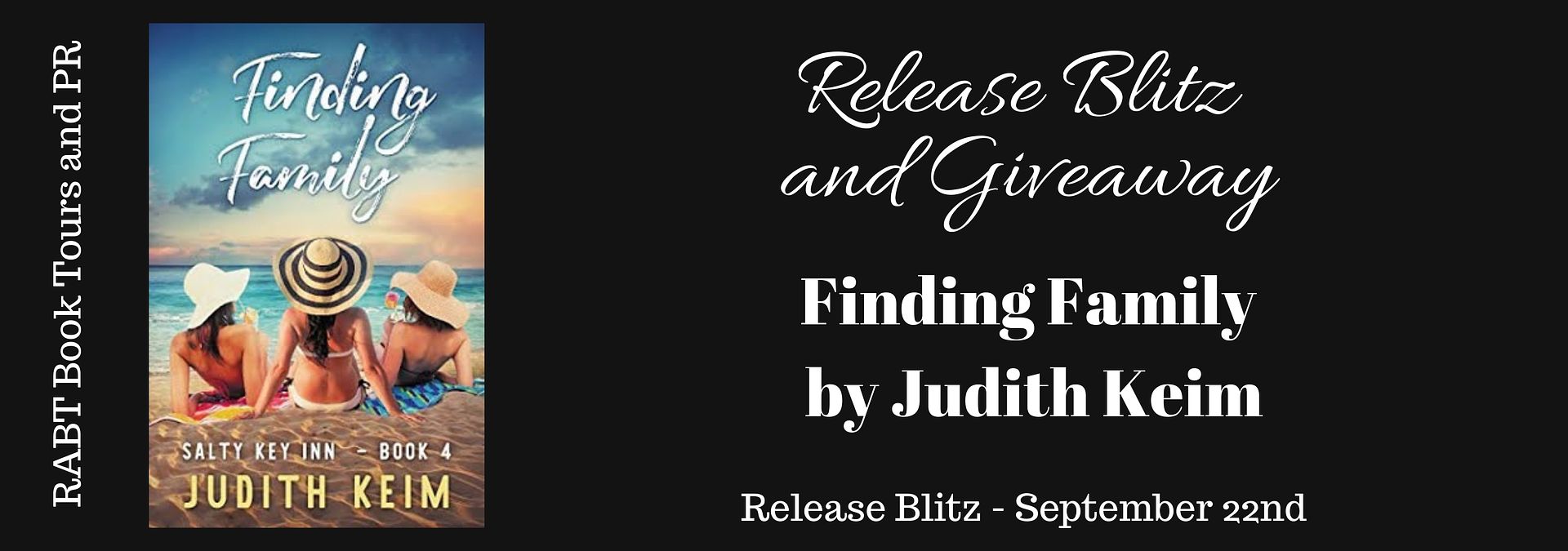
Spotlight: Finding Family by Judith Keim


 photo Finding Family_zpsdwxkccgh.jpg
Salty Key Inn Series, Book 4
Women’s Fiction
Date Published: September 22, 2018
Publisher: Wild Quail Publishing

 photo add-to-goodreads-button_zpsc7b3c634.png

Sheena Sullivan Morelli and her sisters, Darcy and Regan, work to complete their Uncle Gavin’s challenge of turning his rundown hotel into a profitable operation within one year. Winning means earning a share in their uncle’s sizable estate. More than that, it determines how they’ll spend the rest of their lives. Sheena wants to stay on at the hotel, overseeing the hotel operation. But Darcy and Regan want to move on with their lives—Darcy writing a novel and Regan going into the interior decorating business with Mo. But life has other plans for them. And in the end, all three realize that the only thing that really matters is finding—and keeping—family.


Other Books in the Salty Key Inn Series:


 photo Finding Me_zpsnvsncmra.jpg

Finding Me
Salty Key Inn Series, Book 1

Publisher: Wild Quail Publishing

Published: February 2017


Sheena Sullivan Morelli and her sisters, Darcy and Regan, receive the unexpected news that their Uncle Gavin Sullivan, the black sheep of the family, has left them a hotel on the Gulf coast of Florida. The gift comes with a twist. They must live together for one year at the hotel and prepare the hotel to receive guests within a year. Sheena, eager to escape her role of unappreciated wife and mother, can’t wait for the opportunity to find herself. Dreams of sitting on the beach sipping margaritas are shattered when they see the property in need of renovation. But they begin their work of meeting the challenge. If they succeed, the bulk of Gavin’s estate will be theirs. Facing the unexpected, working together, the three sisters learn a lot about each other and the gift of family love.


 photo Finding My Way book two_zpsanflhvja.jpg

Finding My Way book twoFinding My Way
Salty Key Inn Series, Book 2

Publisher: Wild Quail Publishing

Published: June 2017


Darcy Sullivan and her two sisters continue to work hard at the Salty Key Inn, the small, Florida hotel they unexpectedly inherited. In order to inherit the rest of Uncle Gavin’s sizeable estate, they must meet his challenge to open the neglected hotel by the end of the year. Darcy figures once they meet the challenge, she’ll take off, travel the world, and maybe, just maybe, begin writing the world’s best novel. When she meets Nick Howard, an older man who is a reporter for the local newspaper and takes over his weekly column, her life changes. Under his tutelage, she writes about local residents, learning to see people in a different way—especially after meeting a cousin no one knew about. Her joy at having the part-time job that’s always been her dream is shattered when she learns Nick is dying. For support, she turns to Austin Blakely, whose grandmother is terminally ill, and through their growing relationship, comes to understand what true love is.


 photo Finding Love book three_zpshoh4egqg.jpg

Finding Love
Salty Key Inn Series, Book 3

Publisher: Wild Quail Publishing

Published: February 2018


As Regan Sullivan continues to work with her sisters, Sheena and Darcy, to meet their Uncle Gavin’s challenge to make the Salty Key Inn a success, she wonders why she can never find the man of her dreams. Her sisters are happily settled with men they love. Why can’t she do the same? When she’s involved in a motorcycle accident with Brian Harwood, Regan learns to think differently about both her appearance and herself. And as she deals with her injuries and helps Brian recover from the accident she feels guilty about causing, Regan discovers that the love she’s always sought has been there all along.


Excerpt


CHAPTER ONE

SHEENA


Sheena Sullivan Morelli stood outside Gavin’s, the new restaurant at the Salty Key Inn on the Gulf Coast of Florida, feeling as festive as the mini-lights wound around the trunks of the palm trees that softened the outline of the building. She was dressed in her finest on this unusually warm, mid-December night, and the tropical Gulf breezes felt good as they caressed her skin.

From among the hibiscus planted around the perimeter of the restaurant, lights twinkled like the stars in the inky sky above and lent a sense of peace to the area. That, and the fact that Petey, the pesky peacock Rocky Gatto had rescued and brought to the hotel, had decided not to bother with this celebration and was hanging out down by the bay.

“Let’s make this an evening to remember!” said Sheena, giving her younger sisters, Darcy and Regan, an encouraging smile.

Named after their uncle, the restaurant would, they hoped, bring in enough revenue for them to be considered successful in meeting the terms of his will. With less than a month before their final meeting with Gavin’s estate lawyer in Boston, they were trying their best to prove to him that they had succeeded in beating the challenge of turning his rundown hotel into a profitable operation within one year. Winning meant they would inherit Gavin’s sizable estate along with the hotel. More than that, it would determine how they’d spend the rest of their lives.

Sheena brushed an imaginary crumb off her blue linen dress and studied her sisters. Darcy was wearing a green sheath that offset her red curls nicely. And Regan, beautiful as ever, even with the scar on her face she couldn’t quite hide, had chosen a violet, flowy dress that matched her striking eyes. Funny, Sheena thought, how she hadn’t really known her sisters until the three of them had been forced to live and work together at the hotel. And when Regan and Brian Harwood, now her fiancé, were in a serious motorcycle accident a few months ago, frightening everyone, they’d become even closer.

“I hope everyone likes what they see,” Regan said. “Mo and I did our best decorating the interior with the budget we had.”

“Don’t worry. It’s gorgeous,” said Darcy, giving Regan an impish nudge with her elbow.

“The restaurant is stunning,” said Sheena, “and the food is great. We were lucky to get Graham Howard as our chef.” She turned as a stream of people headed their way from the parking lot, which was filling up fast.

“Here we go! Make it good,” said Sheena softly, prompting Darcy and Regan to roll their eyes at the big-sister moment Sheena couldn’t help.

They’d invited county commissioners, members of nearby city and town councils, other government officials, news people, owners and managers of other hotels in the area, and even the governor of Florida to join them for this grand opening. It had been a bold move on their part, but it had already paid off in publicity, even though the governor and some county commissioners had politely declined. The fact that Darcy had been writing a column for a local newspaper helped them. She was acquainted with the ins and outs of generating publicity and had invited several writers of local social columns, travel bloggers, and magazines.

 Sheena was soon swept up greeting people and ushering them inside to enjoy drinks and to taste the delicious-looking food displayed in the bar and on a long buffet in the dining room.

The dark wood paneling on the walls of the main dining room supplied a rich background for the brass and crystal wall sconces that spread a soft glow along the room’s edges. Crystal chandeliers hung from the ceiling, casting their own warm light. White linen cloths covered the tabletops, which were set with sparkling wine goblets and silverware that reflected the light from the chandeliers and sconces. Flickering battery candles sat among tasteful, holiday greenery, adding a pine perfume to the mouth-watering aroma of the hors d’oeuvres being passed by staff.

Upstairs, the large function room held another bar and more food to sample, drawing people through the entire restaurant. A buzz of conversation enhanced the sense of excitement. The crowd was a pleasing mixture of people who, hopefully, would be a source of future business.

Kenneth Cochran, better known as Casey, was a Cornell Hotel School grad and manager of the restaurant. Tall and thin, he was a natural at his job with his ever-present smile and alert blue eyes. Tonight, he seemed to be everywhere, overseeing staff, and greeting people. Sheena observed him with satisfaction as guests responded to his attention. If she and her sisters won the challenge, they hoped to hire Casey as the hotel manager to help Sheena, who would remain an active overseer of the property.

Sheena looked up as her husband, Tony, appeared with their two children. Tears stung her eyes when she noticed the effort Michael, at eighteen, and Meaghan, at fifteen, had put into their appearance. After initially being against her plan to come to Florida, they now embraced their new lives and were proud of all she was doing.

“Hi, Mom,” said Michael. His brown eyes, so like Tony’s, sparkled. “Okay if I help myself to some of the food?”

She laughed at the typical, teenage hunger of a still-growing, young man. “Of course.   Enjoy.”

“You look pretty, Mom,” Meaghan said. “Thanks for letting me wear your necklace. It’s great with my new holiday dress.” She twirled in front of Sheena. Her auburn hair, like Sheena’s, swung above her shoulders and brought out the hazel in her eyes.

“You look pretty, too, sweetheart,” Sheena said. Her little girl was growing into a beautiful young woman.

Tony gave her a smile that warmed her heart. His smile had been one of the reasons their marriage had been prompted by the unexpected creation of Michael all those years ago. And though they’d always loved each other, their relationship had grown even stronger during their time in Florida.

He kissed her. “See you later. I’m going to mix with the crowd a little. Brian and I are hoping to pick up some new business.”

She gave him a heartfelt smile. Following Brian Harwood’s motorcycle accident with Regan, Tony had agreed to become a partner in Brian’s construction company and was now settled into his new life in Florida. As Tony walked away, Sheena noticed Blackie Gatto headed in her direction.

Blackie was Uncle Gavin’s financial advisor and a great supporter of her and her sisters as they attempted to do as their uncle wished by transforming what had been a small, run-down, family hotel into the upscale, full-service resort property he’d envisioned.

“Welcome to Gavin’s,” Sheena said to him, giving him a quick hug. “I’m so glad you could make it.”

“I wouldn’t miss it for the world,” he replied, lifting her hand, and kissing it in a gallant gesture. He indicated their surroundings with a sweep of his arm. “I think Gavin would be very pleased with this.”

“We hope it brings in enough new business and revenue for us to complete our challenge here the Salty Key Inn.”

He nodded and settled his gaze on her. “I hope so, too. The downside of borrowing the money from Gavin’s estate to complete the restaurant could be difficult for you and your sisters if you fail.”

Sheena’s stomach curled inside her, but she didn’t want Blackie to see how worried she was. For the sake of her sisters and her family, she had to remain upbeat. With only a few weeks remaining to accomplish everything they had left to do, self-doubt could ruin them.


 photo Finding Family on tablet with ocean background_zpso9vxp0d3.jpg


About the Author

 photo Finding Family Author Judith Keim_zpsvr2wuk8f.jpg
Judith Keim was born and raised in Elmira, New York, and now makes her home in Idaho with her husband and their two dachshunds, Winston and Wally, and other members of her family.

Growing up, books were always present being read, ready to go back to the library, or about to be discovered. Information from the books was shared in general conversation, giving all of us in the family a wealth of knowledge and a lot of imagination. Perhaps that is why I was drawn to the idea of writing stories early on. I particularly love to write novels about women who face unexpected challenges and meet them with strength.

A hybrid author who both has a publisher and who self-publishes, Ms. Keim writes heart-warming stories of strong women who face challenges and find love and happiness along the way. Her books are based, in part, on many of the places she's lived or visited and on the interesting people she's met, creating believable characters and realistic settings her many, loyal readers love.


Contact Links


Purchase Links


RABT Book Tours & PR