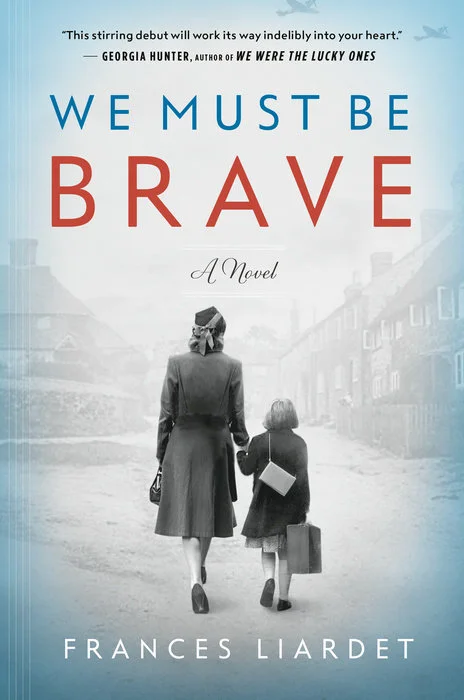
Spanning the sweep of the twentieth century, We Must Be Brave explores the fierce love that we feel for our children and the power of that love to endure. Beyond distance, beyond time, beyond life itself.
One woman. One little girl. The war that changed everything.
December 1940. In the disorderly evacuation of Southampton, England, newly married Ellen Parr finds a small child asleep on the backseat of an empty bus. No one knows who little Pamela is.
Ellen professed not to want children with her older husband, and when she takes Pamela into her home and rapidly into her heart, she discovers that this is true: Ellen doesn’t want children. She wants only Pamela. Three golden years pass as the Second World War rages on. Then one day Pamela is taken away, screaming. Ellen is no stranger to sorrow, but when she returns to the quiet village life she’s long lived, she finds herself asking: In a world changed by war, is it fair to wish for an unchanged heart?
In the spirit of We Were the Lucky Ones and The Nightingale, here is a novel about courage and kindness, hardship and friendship, and the astonishing power of love.
Excerpt
1
She was fast asleep on the backseat of the bus. Curled up, thumb in mouth. Four, maybe five years old.
I turned round. The last few passengers were shuffling away from me down the aisle to the doors. "Whose is this child?" I called.
Nobody looked back. Perhaps the bombing had deafened them. Or maybe they simply didn't want to hear.
"Please. Someone's left a child!"
But they were gone, making their way down the steps and joining the line of people straggling toward the village hall.
It was lucky I was there, checking every bus. Otherwise this small girl might have gone all the way back to Southampton. Everybody knew the city was still on fire. We'd seen the smoke from Beacon Hill.
She hadn’t stirred in spite of my calling. She lay senseless, a gossamer net of light brown hair clinging to her forehead. Her puff-sleeved dress was a dusty mid-blue, the color of the endpapers in the board books of my childhood. No coat or cardigan, despite it being the first day of December. Just a grimy white blanket tangled round her legs, the kind mothers wrapped their babies in, a special knit honeycombed with little holes.
I shook her small round shoulder. "Wake up, little one. Wake up."
Her thumb fell out of her mouth, but she didn't open her eyes. I stroked back her hair. Her skin was warm and slightly damp. Her tongue was ticking against the roof of her mouth. Thumb or no thumb, she was still sucking.
Suppose she started crying when I woke her? I had no great experience with tearful children. Perhaps I should simply carry her into the village hall, and never mind if she was asleep. I took off my new brooch, a silver bar with a pearl, and put it in my pocket. I didn't want it to scrape the child's face.
I slid my hands against her hot sides, into her hotter armpits, and pulled her toward me. She was amazingly solid, made of denser stuff than the rest of the world. I got one arm round her back and the other under her bottom, and hoisted her up. Her head rocked back as far as it could go, forward again to bump against my collarbone. Then her whole body gave a series of jerks, as if a faulty electrical current was running through her. Perhaps she'd been hit on the head during the air raid. I should get her to the doctor.
The dirty blanket fell down over my feet and I kicked it away and walked with a strange swinging tread down the aisle of the bus. You had to walk this way, I realized, with a child in your arms. There was a powerful odor of Jeyes Fluid in the bus but she smelled warm, salty, of new-baked bread.
Deirdre Harper came out of the village hall, forearms red to the elbow and dripping suds.
"Deirdre, is anyone missing a girl?"
She wiped her hands on her apron and delved in the pocket to produce a single wrinkled cigarette. "You're having me on, Mrs. Parr. Now I've seen it all. They can't even remember their own kiddies."
"I'm sure it's not like that. Everyone's in shock . . ."
Deirdre lit up and exhaled smoke with a wide, down-curving smile of contempt. "In a funk, more like. Funk is all this is, you know. Look at them, scarpering on the buses instead of staying put in their shelters."
I didn't point out that not everyone in Southampton had shelters. Deirdre had lost her son at the beginning of the war, in the sea off the coast of Norway; she no longer cared what she said, and nobody took her to task.
"They've got tea, anyway," I said.
"Yes, the stockpile we were saving for the Christmas Carols." She regarded the child sourly. "Your Mr. Parr will find that mother of hers. Trained for this, isn't he. Billeting officer and all."
"Yes. I should go in, Deirdre."
Just then she sighed, and suddenly her eyes filled. "Christ, poor bloody Southampton. Fifteen mile away, and such a glow off the clouds last night, it damn near lit me home."
I made my way into the village hall, carrying the child through the crowd of bedraggled, bewildered, noisy people, edging past overturned chairs and youngsters sliding through puddles of spilled tea. "Whose is this little girl?" I called out. "Has anyone seen her mother?" Nobody replied. I pushed onward past a squirming terrier, a camp of sleeping babies wedged among baskets and coats, a gang of disheveled old men making free with a hip flask. "Is anyone looking for this child?" I called, louder this time.
"Where are we, doll?" said one of the old men.
"Upton," I told him. "The village of Upton. Do you know this little girl?"
He shook his head. An odd smell was coming off his coat, a reek of something burned. I moved away but the smell remained in my nostrils. I glanced up at the high windows of the hall and saw that the light was fading fast. We didn't have long until blackout.
Halfway down the hall I found Mrs. Daventry and Miss Legg. Two pillars of our little community, they were standing by a table and picking hopelessly at the knot on a bale of blankets. I hitched my burden higher with one hand-astonishingly, she had not stirred-and with the other I grasped one loop of the knotted rope and pried it loose.
"Ellen has such strong fingers," Mrs. Daventry said to Miss Legg.
"She's so practical," Miss Legg said to Mrs. Daventry.
"I simply know where to pull," I told them.
They looked at me silently.
"Have you seen a woman-" I began, but just then the wind rattled the tin roof. A small boy in the corner screamed, cowering like a hen when the hawk goes over. Other children joined him, and then everyone broke out into wordless wails and cries of fright. "I must find Mr. Parr," I told the ladies, and made my way toward the back of the hall. I could hear Selwyn speaking, his true tenor that carried through the hubbub. Such a good singer my husband was, a merry singer. I followed his voice until the crowd parted at last to reveal him bending over a middle-aged couple huddled on their chairs. "Are you hurt?" he was asking them.
"Selwyn!" I felt breathless, as if I had run a long way.
"Ellen, darling." He straightened up with a smile. "Where are you taking this young person?"
I twisted my neck away from the child's hot face. "She was asleep in the back of the bus, all alone. I can't find her mother."
His eyes widened. "She was left on the bus?"
"Yes." I stared around the room. "Selwyn, what are we going to do with all these people? Another busload and we'll run out of tea, and then it'll be pandemonium. And what about the blackout?"
"It will not be pandemonium." He chuckled. "The Scouts are coming to put up the blackout curtains. And we've got blankets for the men. The women and children we'll take into the village. Colonel Daventry's bringing his cart." He scratched his head, disordering his fine sandy hair. "They'll be on the floors, but it's the best we can do. I can't find an empty bed in Upton."
"I smelled something awful," I said. "Something charred. I don't know what it was." To my dismay, tears started to sting my eyes.
"Come now, sweetheart." Selwyn squeezed my arm. "Chin up. Try that lady over there on the camp bed. She's completely collapsed." He pointed with his pen. "I heard her saying, 'Daphne, Daphne.'"
I stared up at him.
"This child may be she." His voice was patient. "Daphne."
The woman lay rigid, her eyes flicking like a metronome from side to side. ÒDaphne,Ó she declared.
I kneeled down beside her, cradling the child on my lap to let the woman see her face. "Madam, is this Daphne? Is this your daughter?"
Her eyes flicked to and fro. They seemed to glance at the girl. "Daphne."
"That ain't Daphne," said a voice behind me. "Daphne's her Siamese cat. This lady's Mrs. Irene Cartledge and she was right as rain when we got off the bus. We're waiting for your doctor to come and have a look at her."
I turned to the speaker. She was sitting on the floor like me, her huge, pallid bare knees pressed together, one of her eyes half-closed under a swelling purple bruise. "I'm Mrs. Berrow, Phyl Berrow."
"My name's Ellen Parr. Do you need a compress for that poor eye, Mrs. Berrow? I'm sure we can rustle something up."
"No, dear. Shock or what, it don't hurt. Parr," she repeated. "Your dad's got a hell of a job to billet us all."
I managed to smile. "Mr. Parr's my husband." I thought of my pearl brooch, and felt a little swell of pride. "It's our first wedding anniversary today."
"Oh, lor. What a way to spend it." She looked me up and down. "Ain't he the lucky one."
"Actually, Mrs. Berrow, I count myself extremely lucky."
A friendly glint came to her eye. "Right you are, dear." She shuffled closer. "Let's have a look at the kiddy."
Once again I smoothed back the light hair from the child's face. She was rosy, disdainful in sleep, eyebrows raised and lips turned down. The piped seam of the bus seat had made a darker pink crease in the pink of her cheek.
"Wake her up, dear."
"She won't wake. And she went very jerky earlier. I'm frightened she might have damage to her brain."
"Bless you." Mrs. Berrow revealed five sound teeth in a slot of black. "They all do that. Sleep through the Second Coming at this age. Give her here."
She stood the child on her feet, blew into her face, and let go. My own arms leaped out but Mrs. Berrow got there first and held her fast, blew again, let go once more. The blowing ruffled the child's eyelashes and she squeezed her eyelids shut. Then she wobbled, righted herself, and sniffed in a sharp breath.
"Here, lovey." Mrs. Berrow grasped the small chubby arms. "Come, open those peepers."
The little girl did so, suddenly, wide open and startled. Her eyes were clear hazel, almost the same color as her hair.
"What's your name, dear?"
"Daphne," said the woman on the camp bed.
"Pack it in, Irene." Mrs. Berrow fixed the child with her one good eye. "Let me see. Might you be called Mavis Davis?"
The child gave a slow blink. Still waking.
"Or Sally O'Malley?"
She shook her head.
"Or Nancy Fancy? Help me, dearie, I'm running out of names," said Mrs. Berrow, and the little girl spoke.
"I'm not Nancy Fancy! I'm Pamela! Where's Mummy?"
Her voice was clear, piping, like a twig peeled of its bark. She was well-spoken.
"Pamela." Mrs. Berrow patted her cheek. "Ain't that a pretty name."
"Where's my mummy?" Pamela spun around. "Mummy? Where's Mummy?" Her voice wavered. She pulled away from Mrs. Berrow. "I can't see Mummy."
Ten seconds had passed, a small time but enough for her mouth to quiver and large tears to spill down her cheeks. "Pamela." I clasped her hand. "We think Mummy got off the bus and left you there by mistake, so we need to find her. What does Mummy look like?"
"Beautiful." She scrubbed at her face. "But she wasn't on my bus, she was on the one before."
"Her ma got on a different bus?" Mrs. Berrow started to heave herself to her feet. "How the hell did she manage that?"
"The ladies said!" Pamela stood on tiptoes to peer into the crowd-so futile, in a person barely a yard high. "They said I should get on the bus with them and then I'd find her."
I gasped. "What ladies?"
"The ladies," she said impatiently, as if it were obvious. "They saw me. The bus came." Her face crumpled. "They said if I got on, we'd find Mummy." Her lungs began to pump out sobs and her arms went up and down, striking her sides. I gathered her to me once again and lifted her up. She wept and thrashed in my arms as I took her over to one side of the hall, set her down on a huge unlit radiator. "What's your other name, Pamela?"
"Jane," she sobbed.
"No, your family name." But she was crying too hard. I stood up straight. "Does anyone know this little girl?" I called out. "Her name's Pamela. Pamela Jane." Heads turned and shook, and I saw women gathering their children together, and a bustle in the doorway-people from the village, arriving to take them away. The tide was running out. "Pamela Jane! Did anyone travel with this child?"
At last. A woman was emerging from the throng, incongruously elegant in a fur coat and maroon toque, making her way to us. "I was with this little one," she said when she arrived at my side. "I helped her on board the bus."
"Didn't you hear me call earlier?" I spoke flatly out of exasperation. If she thought I was rude, she made no sign.
"I might have been in the lavs, dear." She pointed to another, large woman. "That lady said the little girl's mother was on the bus before ours. So we took her on the next one, with us." The large woman was already approaching, buttoning her cardigan over her bust. "Isn't that right?" asked the lady wearing the toque. "You saw her ma on the first bus?"
"That's what the little one said." The second woman's voice was a creaky whisper. "Pardon me. Smoke's got my throat."
Pamela gasped. "You said Mummy was on the other bus. But she wasn't!"
"No, you was saying it, sweetheart," the woman croaked, her eyes full of alarm.
"No!" Pamela was frantic. "I just thought she was!"
"So I said, we'll catch up with Mummy, sweetie, and I took her on board." The large woman put her hands to her cheeks. "Now I think about it, how could any woman get on a blooming bus without her little daughter? But the little one was insistent!"
"I wasn't 'sistent!" Pamela continued her choleric weeping. "I saw her head but I didn't know it was her head! You said!"
The elegant woman put her hand to her toque. "And we just got off the bus leaving her there." She turned to me. "I'm so sorry. We was bombed, dear. I can't find any other excuse."
Now they were both crying. I heard Selwyn calling. "Ladies-ladies, please come and join this group."
"You both need to leave," I said. "I'll find you if I have to."
Excerpted from We Must Be Brave by Frances Liardet. Copyright © 2019 by Frances Liardet. All rights reserved. No part of this excerpt may be reproduced or reprinted without permission in writing from the publisher.
Buy on Amazon | Barnes and Noble
About the Author
Frances Liardet has an MA in Creative Writing from the University of East Anglia and studied Arabic at Oxford before traveling to Cairo, where she translated modern Egyptian novelists including Nobel-prize winner Naguib Mahfouz and Edwar al-Kharrat. She currently lives in Somerset, England, and helps to run a summer writing session called Bootcamp, where local writers get together to share work and constructive criticism. Her first novel, The Game, won a Betty Trask Award.