Spotlight: The Second-Worst Restaurant in France (Paul Stuart Series #2) by Alexander McCall Smith
/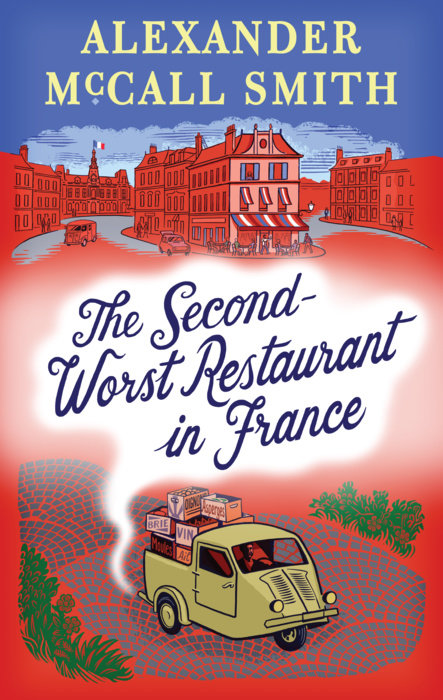
In this delightful sequel to the best-selling comedic novel My Italian Bulldozer, Paul Stuart’s travels taie him to a French village, where the local restaurant’s haute cuisine leaves a lot to be desired.
Renowned Scottish cookbook writer Paul Stuart is hard at work on his new book, The Philosophy of Food, but complicated domestic circumstances, and two clingy cats, are making that difficult.
So when Paul’s cousin Chloe suggests that he join her at the house she’s rented in the French countryside, he jumps at the chance. The two quickly befriend the locals, including their twin-sister landladies, who also own the infamous local restaurant known to be the second-worst eatery in all of France. During their stay, the restaurant’s sole waitress gives birth mid-dinner service and the maitre d’ storms off after fighting with the head chef. Paul is soon drafted to improve the gastronomy of the village, which Chloe, ever on the hunt for her next romance, busies herself with distracting the handsome but incompetent chef. Could he be husband number six?
With all this local drama to deal with, Paul finds it next to impossible to focus on his writing, and that’s before he learns that Chloe’s past is far more complicated than he’d ever imagined. Paul will have to call upon al his experience—with food and with people—to bring order back to the village. And he may just learn something about family—and about himself— along the way.
Excerpt
1. Remarkable Cousin Chloe
It was one of Paul Stuart’s friends who said to him, “I can’t stress this enough, you know: breathing is important. Really important.”
“I’d already worked that out,” Paul replied.
“Oh, I know it sounds obvious . . .”
It does, thought Paul.
“But people forget. And they just breathe—you know, like this.”
Paul waited.
“Whereas,” his friend continued, “you should breathe like this.”
In, out . . .
“I thought I already was,” said Paul. “In, out. Like that?”
“Deeper. And hold the breath in for a while. Like this.”
There was silence. Then the friend said, “And while you hold it in, think. That’s the important thing. Concentrate your thoughts. Think of the present, Paul. The right now. The actual.”
“I’m thinking.”
“Good. You need to be mindful, Paul. Mindful. In. Think. Out. Still thinking.”
And he should also close his eyes from time to time, the friend said, and think about where he was and what he was doing, rather than about where he was going to be, and what he was going to be doing. And it was for this reason then that Paul, well--known food writer, celebrated cook, and a kind but slightly accident-prone man, now closed his eyes and took a deep breath.
He smelled coffee, and this was, he thought, a mindful sort of smell. In front of him, in the real world, was a freshly made, piping-hot cup of Brazilian coffee, its aroma drifting up to him on little wisps of steam. He loved the smell of that; a dark smell, a chocolate smell, but without chocolate’s note of sweetness. The smell of coffee, really; that, he decided, was the way he would describe it. He opened his eyes, and gazed out of the window.
He thought—as he took a deep breath—Should I go? He knew that was not mindful. He needed to think again, not about what he should do in the future, but about what he was doing now. But still the same question came back. Should I go to France? Should I call Chloe right now and tell her: no France?
He exhaled. He could still smell the coffee, which was now.
***
It was late spring in Scotland and life was undoubtedly good—as was the view. From where he was sitting, in the kitchen of his flat, Paul could see in the distance, kissed by sunlight, the castle that dominated the city. Beneath it, the roofs and spires of the Old Town, with, here and there, those odd architectural spikes for which Edinburgh was so well known, sticking up as if to proclaim Scotland’s ancient motto Nemo me impune lacessit—Nobody challenges me with impunity. Spikes placed on the tops of buildings, prickly thistles, the sharp-tipped antlers of Highland deer: these all played a major part in the iconography of Scotland, Paul thought; but so did the hills, those gentle, feminine hills; so did the waterfalls, and the light, and the cold blue sea; so did this city, that was like an opera set, on which at any moment somebody might fling open a window and start to sing.
Paul lived—in a part-time way, as he put it—with his girlfriend, Gloria, who was also the editor of his books, and with her two Siamese cats. It was living with somebody in a part-time way because Gloria kept her own flat on the other side of town, and still spent much of the day there. That was where her office was, where her mail was delivered, and where most of her clothes—a disorganised wardrobe, a riot of colour—were kept. It would have been easier, of course, if they had co-habited fully, but Gloria simply could not face sorting out the detritus of the years she had spent in that particular flat. It was just all too complicated; much simpler to leave things as they were. Besides, the arrangement gave both of them space, and space, she felt, was what every relationship—with anyone at all—required.
Paul and Gloria got on well. It had never been one of those passionate affairs, in which two people, in mutual intoxication, filled their waking moments with thoughts of one another. “It’s not like that, with us,” Gloria had said to a friend. “It’s different with Paul; it really is. We’re not like two love-struck kids, gazing into one another’s eyes. We’re . . .”
“Mature adults?” supplied her friend.
“Exactly.”
“Oh, well,” said the friend.
It had its moments, though, and neither Paul or Gloria wanted or expected much more out of it. They were friends, as well as lovers, and that, they had both decided, was a good state to be in. To be a lover was easy enough; to be a friend required rather more. To be both was something not given to everyone.
There were disagreements, though—areas where a different view was taken of something that might not have been of great importance in itself, but was capable of disturbing the otherwise tranquil waters of their domestic relationship. Such as cats, and it was of these cats that Paul was thinking as he looked out from his kitchen window that morning.
Gloria was the owner of two Siamese cats, Hamish and Mrs. Macdonald. They were sleek, self-satisfied creatures, cuttingly arrogant and effortlessly handsome in a way in which lesser cats were not. They had light blue eyes that stared at you with a somewhat off-putting intensity. They had silky coats of a shade that a Belgian chocolatier might have taken years to perfect. They were vocal in a way that only Siamese cats can be, voicing their opinion in long-drawn-out cat-sounds that seemed to demand an instant response. They had several recognisable yowls: what Paul called an asking yowl; what he described as a complaining yowl; and finally, and more seriously, a warning yowl. The cats lived in Gloria’s flat, among the books, papers and colourful clothing. They had cat beds hooked onto radiators, and timed, battery-operated cat feeders that opened at set hours to reveal supplies of salmon and tuna within. They had everything, it seemed to Paul, that any cat could possibly want. And yet they always seemed to expect more. These cats, he said to himself, would never understand the virtue of moderation. Do not want too much did not apply to cats.
“How fond are you of those cats of yours?” he asked Gloria one evening.
This brought a surprised response. “What a question. Really, Paul! It’s like asking a parent if she likes her children . . . or almost.”
Paul did his best to explain. “Don’t take this the wrong way, but those cats seem almost indifferent to you—or so it seems to me. The way they look at you . . .”
He now realised just how far he had strayed into sensitive territory. “Indifferent?” said Gloria, her tone now one of decided reproof. “Hamish and Mrs. Macdonald are not indifferent to me. How could you say such a thing?”
“I’m sorry, it’s just the way they . . . Maybe that’s the way cats are. I don’t know much about these creatures.”
Again, he was cut short. “Hamish and Mrs. Macdonald are both very fond of me,” said Gloria firmly. “In fact, they love me—actually love me.” She intercepted Paul’s look of incredulity. “No, don’t be cynical. I’m absolutely sure of that. In fact, I positively bask in the love of my cats.”
Paul had thought she might be speaking ironically, but now realised his mistake. Discretion might have prompted him to leave the matter there, but he persisted.
“I’m not sure that cats love humans,” he mused. “Dogs do, of course.”
Gloria shook her head. “Dogs . . .” she began.
“All right then, dogs,” Paul interjected. “How about dogs? Dogs will sacrifice their lives for their owners, if necessary. You know how it is—they’ll jump into rivers to save a drowning child—tackle an armed burglar—that sort of thing. Whereas cats . . .” He looked up at the ceiling. “Is there any recorded instance of a cat doing anything unselfish? Feline altruism?” This, he felt, was the clinching argument. “An oxymoron?”
Gloria stared at him reproachfully.
“You see,” Paul went on, “I have a theory that cats are perfect psychopaths.” He had just thought of it, but it seemed to make sense.
Gloria looked doubtful. “You’re making this up, Paul.”
He smiled. She was right—but so, he felt, was his theory.
“If you want to understand the psychopathic personality, look at a cat. They never experience guilt—unlike dogs, who look so guilty if they do anything wrong.”
Gloria sniffed. “It might be that you don’t understand cats, Paul. Cats are not . . .” She searched for the right word. “They’re not obvious.”
“Obvious?”
“Yes. You mentioned dogs, so let’s go back to them. They wear their heart on their sleeve. All that grinning and barking and slobbering.” She gave a shudder.
“Whereas cats?”
Gloria was in no doubt. “Cats are effortlessly cool. Cats, one might say, have it.”
Paul knew that it existed, but was uncertain as to what it was. “I think we’re going to have to disagree,” he said. “Perhaps the world is divided into dog and cat factions, just as it is into those who like chocolate and those who like strawberries.”
Gloria laughed. “Really? There are many—millions, I suspect—who adore both chocolates and strawberries. There are people who eat those strawberries covered with chocolate.”
Paul thought about the taste wheel in one of his kitchen encyclopaedias; chocolate was earthy while strawberries were fruity, and he was sure that they were on different segments of the wheel. “Let me tell you, Gloria, strawberry and chocolate do not go together. They just don’t.”
“Yes, they do,” said Gloria. “I like them.”
“I won’t argue,” said Paul.
She brightened. “Which reminds me . . . Taste, aesthetics, philosophy . . . The offer for the new book: Have you decided yet?”
As Paul’s freelance editor, Gloria’s job was to edit the highly successful books that he wrote on a wide range of culinary subjects. She had nothing to do with contractual matters, but she had an obvious interest in his keeping up the supply of the manuscripts she would read and knock into shape. Paul wrote well but tended to use long sentences that Gloria would have to chop into two, or sometimes even three parts. She also arranged his illustrations, consulting picture librarians or engaging food photographers to ensure that Paul’s reputation for lusciously presented books be preserved.
Paul was happy to abandon the subject of cats. He felt that he had somehow argued himself into an unwanted corner. He was not anti-cat—far from it—he was just being realistic about them. Cats were fine, but there was no getting away from their fundamental attitude. That was it, he thought: cats had attitude, whereas dogs . . . He stopped himself. It was time to address the offer for the new book.
He found that it was unnecessary to think for very long. Of course, he would accept. It was an extremely generous offer by any standards, the only drawback being that they wanted him to have the book ready within six months. Yet that was not impossible: he had already worked out what he wanted to say, and it would be refreshing to move away from his usual series—Paul Stewart’s Tuscan Table being the latest title—and deal with something as broad and exciting as the philosophy of food. Paul had taken a philosophy course at university, but it was an introductory course that had spent far too much time on Hume, he felt, and had left many other philosophers untouched. Yet there was a clear role for the enthusiastic amateur, presumably even in philosophy, which was, after all, about things of concern to ordinary people as much as to experts. If he were to write about the philosophy of food it would be a personal statement, written from the heart as much as from the mind. The writing of it would not be a chore; rather, it would be a celebration, a meditation, an act of homage to a subject—food and its preparation—that had engaged him from the age of twelve. Unlike some of the chefs he wrote about, Paul was modest, but he felt that this book would be a good one. All he had to do, of course, was to write it.
Excerpted from The Second-Worst Restaurant in France by Alexander McCall Smith. Copyright © 2019 by Alexander McCall Smith. All rights reserved. No part of this excerpt may be reproduced or reprinted without permission in writing from the publisher.
Buy on Amazon | Barnes and Noble
About the Author
ALEXANDER McCALL SMITH is the author of the No. 1 Ladies’ Detective Agency novels and a number of other series and stand-alone books. His works have been translated into more than forty languages and have been best sellers throughout the world. He lives in Scotland.