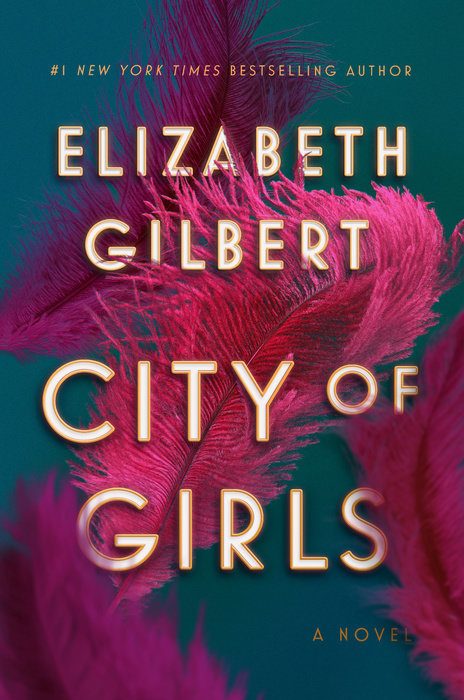
From the # 1 New York Times bestselling author of Eat Pray Love and The Signature of All Things, a delicious novel of glamour, sex, and adventure, about a young woman discovering that you don’t have to be a good girl to be a good person.
Beloved author Elizabeth Gilbert returns to fiction with a unique love story set in the New York City theater world during the 1940s. Told from the perspective of an older woman as she looks back on her youth with both pleasure and regret (but mostly pleasure), City of Girls explores themes of female sexuality and promiscuity, as well as the idiosyncrasies of true love.
In 1940, nineteen-year-old Vivian Morris has just been kicked out of Vassar College, owing to her lackluster freshman-year performance. Her affluent parents send her to Manhattan to live with her Aunt Peg, who owns a flamboyant, crumbling midtown theater called the Lily Playhouse. There Vivian is introduced to an entire cosmos of unconventional and charismatic characters, from the fun-chasing showgirls to a sexy male actor, a grand-dame actress, a lady-killer writer, and no-nonsense stage manager. But when Vivian makes a personal mistake that results in professional scandal, it turns her new world upside down in ways that it will take her years to fully understand. Ultimately, though, it leads her to a new understanding of the kind of life she craves – and the kind of freedom it takes to pursue it. It will also lead to the love of her life, a love that stands out from all the rest.
Now eighty-nine years old and telling her story at last, Vivian recalls how the events of those years altered the course of her life – and the gusto and autonomy with which she approached it. “At some point in a woman’s life, she just gets tired of being ashamed all the time,” she muses. “After that, she is free to become whoever she truly is.” Written with a powerful wisdom about human desire and connection, City of Girls is a love story like no other.
Excerpt
ONE
In the summer of 1940, when I was nineteen years old and an idiot, my parents sent me to live with my Aunt Peg, who owned a theater company in New York City.
I had recently been excused from Vassar College, on account of never having attended classes and thereby failing every single one of my freshman exams. I was not quite as dumb as my grades made me look, but apparently it really doesn't help if you don't study. Looking back on it now, I cannot fully recall what I'd been doing with my time during those many hours that I ought to have spent in class, but-knowing me-I suppose I was terribly preoccupied with my appearance. (I do remember that I was trying to master a "reverse roll" that year-a hairstyling technique that, while infinitely important to me and also quite challenging, was not very Vassar.)
I'd never found my place at Vassar, although there were places to be found there. All different types of girls and cliques existed at the school, but none of them stirred my curiosity, nor did I see myself reflected in any of them. There were political revolutionaries at Vassar that year wearing their serious black trousers and discussing their opinions on international foment, but I wasn't interested in international foment. (I'm still not. Although I did take notice of the black trousers, which I found intriguingly chic-but only if the pockets didn't bulge.) And there were girls at Vassar who were bold academic explorers, destined to become doctors and lawyers long before many women did that sort of thing. I should have been interested in them, but I wasn't. (I couldn't tell any of them apart, for one thing. They all wore the same shapeless wool skirts that looked as though they'd been constructed out of old sweaters, and that just made my spirits low.)
It's not like Vassar was completely devoid of glamour. There were some sentimental, doe-eyed medievalists who were quite pretty, and some artistic girls with long and self-important hair, and some highbred socialite types with profiles like Italian greyhounds-but I didn't befriend any of them. Maybe it's because I sensed that everybody at this school was smarter than me. (This was not entirely youthful paranoia; I uphold to this day that everybody there was smarter than me.)
To be honest, I didn't understand what I was doing at college, aside from fulfilling a destiny whose purpose nobody had bothered explaining to me. From earliest childhood, I'd been told that I would attend Vassar, but nobody had told me why. What was it all for? What was I meant to get out of it, exactly? And why was I living in this cabbagey little dormitory room with an earnest future social reformer?
I was so fed up with learning by that time, anyhow. I'd already studied for years at the Emma Willard School for Girls in Troy, New York, with its brilliant, all-female faculty of Seven Sisters graduates-and wasn't that enough? I'd been at boarding school since I was twelve years old, and maybe I felt that I had done my time. How many more books does a person need to read in order to prove that she can read a book? I already knew who Charlemagne was, so leave me alone, is how I saw it.
Also, not long into my doomed freshman year at Vassar, I had discovered a bar in Poughkeepsie that offered cheap beer and live jazz deep into the night. I'd figured out a way to sneak off campus to patronize this bar (my cunning escape plan involving an unlocked lavatory window and a hidden bicycle-believe me, I was the bane of the house warden), thereby making it difficult for me to absorb Latin conjugations first thing in the morning because I was usually hungover.
There were other obstacles, as well.
I had all those cigarettes to smoke, for instance.
In short: I was busy.
Therefore, out of a class of 362 bright young Vassar women, I ended up ranked at 361-a fact that caused my father to remark in horror, "Dear God, what was that other girl doing?" (Contracting polio as it turned out, the poor thing.) So Vassar sent me home-fair enough-and kindly requested that I not return.
My mother had no idea what to do with me. We didn't have the closest relationship even under the best of circumstances. She was a keen horsewoman, and given that I was neither a horse nor fascinated by horses, we'd never had much to talk about. Now I'd embarrassed her so severely with my failure that she could scarcely stand the sight of me. In contrast to me, my mother had performed quite well at Vassar College, thank you very much. (Class of 1915. History and French.) Her legacy-as well as her generous yearly donations-had secured my admission to that hallowed institution, and now look at me. Whenever she passed me in the hallways of our house, she would nod at me like a career diplomat. Polite, but chilly.
My father didn't know what to do with me, either, though he was busy running his hematite mine and didn't overly concern himself with the problem of his daughter. I had disappointed him, true, but he had bigger worries. He was an industrialist and an isolationist, and the escalating war in Europe was spooking him about the future of his business. So I suppose he was distracted with all that.
As for my older brother, Walter, he was off doing great things at Princeton, and giving no thought to me, other than to disapprove of my irresponsible behavior. Walter had never done an irresponsible thing in his life. He'd been so respected by his peers back in boarding school that his nickname had been-and I am not making this up-the Ambassador. He was now studying engineering because he wanted to build infrastructure that would help people around the world. (Add it to my catalogue of sins that I, by contrast, was not quite sure I even knew what the word "infrastructure" meant.) Although Walter and I were close in age-separated by a mere two years-we had not been playmates since we were quite little. My brother had put away his childish things when he was about nine years old, and among those childish things was me. I wasn't part of his life, and I knew it.
My own friends were moving forward with their lives, too. They were heading off to college, work, marriage, and adulthood-all subjects that I had no interest in or understanding of. So there was nobody around to care about me or entertain me. I was bored and listless. My boredom felt like hunger pains. I spent the first two weeks of June hitting a tennis ball against the side of our garage while whistling "Little Brown Jug" again and again, until finally my parents got sick of me and shipped me off to live with my aunt in the city, and honestly, who could blame them?
Sure, they might have worried that New York would turn me into a communist or a dope fiend, but anything had to be better than listening to your daughter bounce a tennis ball against a wall for the rest of eternity.
So that's how I came to the city, Angela, and that's where it all began.
They sent me to New York on the train-and what a terrific train it was, too. The Empire State Express, straight out of Utica. A gleaming, chrome, delinquent-daughter delivery device. I said my polite farewells to Mother and Dad, and handed my baggage over to a Red Cap, which made me feel important. I sat in the diner car for the whole ride, sipping malted milk, eating pears in syrup, smoking cigarettes, and paging through magazines. I knew I was being banished, but still . . . in style!
Trains were so much better back then, Angela.
I promise that I will try my best in these pages not to go on and on about how much better everything was back in my day. I always hated hearing old people yammering on like this when I was young. (Nobody cares! Nobody cares about your Golden Age, you blathering goat!) And I do want to assure you: I'm aware that many things were not better in the 1940s. Underarm deodorants and air-conditioning were woefully inadequate, for instance, so everybody stank like crazy, especially in the summer, and also we had Hitler. But trains were unquestionably better back then. When was the last time you got to enjoy a malted milk and a cigarette on a train?
I boarded the train wearing a chipper little blue rayon dress with a skylark print, yellow traceries around the neckline, a moderately slim skirt, and deep pockets set in at the hips. I remember this dress so vividly because, first of all, I never forget what anyone is wearing, ever, and also I'd sewn the thing myself. A fine job I'd done with it, too. The swing of it-hitting just at midcalf-was flirty and effective. I remember having stitched extra shoulder pads into that dress, in the desperate hope of resembling Joan Crawford-though I'm not sure the effect worked. With my modest cloche hat and my borrowed-from-Mother plain blue handbag (filled with cosmetics, cigarettes, and not much else), I looked less like a screen siren and mostly like what I actually was: a nineteen-year-old virgin, on her way to visit a relative.
Accompanying this nineteen-year-old virgin to New York City were two large suitcases-one filled with my clothes, all folded neatly in tissue, and the other packed with fabrics, trimmings, and sewing supplies, so that I could make more clothes. Also joining me was a sturdy crate containing my sewing machine-a heavy and unwieldy beast, awkward to transport. But it was my demented, beautiful soul-twin, without which I could not live.
So along with me it came.
That sewing machine-and everything that it subsequently brought to my life-was all thanks to Grandmother Morris, so letÕs talk about her for just a moment.
You may read the word "grandmother," Angela, and perhaps your mind summons up some image of a sweet little old lady with white hair. That wasn't my grandmother. My grandmother was a tall, passionate, aging coquette with dyed mahogany hair who moved through life in a plume of perfume and gossip, and who dressed like a circus show.
She was the most colorful woman in the world-and I mean that in all definitions of the word "colorful." Grandmother wore crushed velvet gowns in elaborate colors-colors that she did not call pink, or burgundy, or blue, like the rest of the imagination-impoverished public, but instead referred to as "ashes of rose" or "cordovan" or "della Robbia." She had pierced ears, which most respectable ladies did not have back then, and she owned several plush jewelry boxes filled with an endless tumble of cheap and expensive chains and earrings and bracelets. She had a motoring costume for her afternoon drives in the country, and her hats were so big they required their own seats at the theater. She enjoyed kittens and mail-order cosmetics; she thrilled over tabloid accounts of sensational murders; and she was known to write romantic verse. But more than anything else, my grandmother loved drama. She went to see every play and performance that came through town, and also adored the moving pictures. I was often her date, as she and I possessed exactly the same taste. (Grandmother Morris and I both gravitated toward stories where innocent girls in airy gowns were abducted by dangerous men with sinister hats, and then rescued by other men with proud chins.)
Obviously, I loved her.
The rest of the family, though, didn't. My grandmother embarrassed everyone but me. She especially embarrassed her daughter-in-law (my mother), who was not a frivolous person, and who never stopped wincing at Grandmother Morris, whom she once referred to as "that swoony perpetual adolescent."
Mother, needless to say, was not known to write romantic verse.
But it was Grandmother Morris who taught me how to sew.
My grandmother was a master seamstress. (She'd been taught by her grandmother, who had managed to rise from Welsh immigrant maidservant to affluent American lady of means in just one generation, thanks in no small part to her cleverness with a needle.) My grandmother wanted me to be a master at sewing, too. So when we weren't eating taffy together at the picture shows, or reading magazine articles aloud to each other about the white slave trade, we were sewing. And that was serious business. Grandmother Morris wasn't afraid to demand excellence from me. She would sew ten stitches on a garment, and then make me sew the next ten-and if mine weren't as perfect as hers, she would rip mine out and make me do it again. She steered me through the handling of such impossible materials as netting and lace, until I wasn't intimidated by any fabric anymore, no matter how temperamental. And structure! And padding! And tailoring! By the time I was twelve, I could sew a corset for you (whalebones and all) just as handily as you please-even though nobody but Grandmother Morris had needed a whalebone corset since about 1910.
Stern as she could be at the sewing machine, I did not chafe under her rule. Her criticisms stung but did not ache. I was fascinated enough by clothing to want to learn, and I knew that she only wished to foster my aptitude.
Her praise was rare, but it fed my fingers. I grew deft.
When I was thirteen, Grandmother Morris bought me the sewing machine that would someday accompany me to New York City by train. It was a sleek, black Singer 201 and it was murderously powerful (you could sew leather with it; I could have upholstered a Bugatti with that thing!). To this day, I've never been given a better gift. I took the Singer with me to boarding school, where it gave me enormous power within that community of privileged girls who all wanted to dress well, but who did not necessarily have the skills to do so. Once word got out around school that I could sew anything-and truly, I could-the other girls at Emma Willard were always knocking at my door, begging me to let out their waists for them, or to fix a seam, or to take their older sister's formal dress from last season and make it fit them right now. I spent those years bent over that Singer like a machine gunner, and it was worth it. I became popular-which is the only thing that matters, really, at boarding school. Or anywhere.
Excerpted from City of Girls by Elizabeth Gilbert. Copyright © 2019 by Elizabeth Gilbert. All rights reserved. No part of this excerpt may be reproduced or reprinted without permission in writing from the publisher.
About the Author
Elizabeth Gilbert is the #1 New York Times bestselling author of Big Magic, Eat Pray Love, and several other internationally bestselling books of fiction and nonfiction. Gilbert began her career writing for Harper’s Bazaar, Spin, the New York Times Magazine, and GQ, and was a three-time finalist for the National Magazine Award. Her story collection Pilgrims was a finalist for the PEN/Hemingway Award; The Last American Man was a finalist for both the National Book Award and the National Book Critics Circle Award. The follow-up memoir Committed became an instant #1 New York Times bestseller. Her novel, The Signature of All Things, was named a Best Book of 2013 by the New York Times, O Magazine, the Washington Post, the Chicago Tribune, and the New Yorker. Gilbert’s short fiction has appeared in Esquire, Story, One Story, and the Paris Review. Her new novel, City of Girls, will be released June 2019.