Read an excerpt from The Stars Are Fire by Anita Shreve

From the New York Times best-selling author of The Weight of Water and The Pilot’s Wife (an Oprah’s Book Club selection): an exquisitely suspenseful new novel about an extraordinary young woman tested by a catastrophic event and its devastating aftermath–based on the true story of the largest fire in Maine’s history 

In October 1947, after a summer long drought, fires break out all along the Maine coast from Bar Harbor to Kittery and are soon racing out of control from town to village. Five months pregnant, Grace Holland is left alone to protect her two toddlers when her husband, Gene, joins the volunteer firefighters. Along with her best friend, Rosie, and Rosie’s two young children, Grace watches helplessly as their houses burn to the ground, the flames finally forcing them all into the ocean as a last resort. The women spend the night frantically protecting their children, and in the morning find their lives forever changed: homeless, penniless, awaiting news of their husbands’ fate, and left to face an uncertain future in a town that no longer exists. In the midst of this devastating loss, Grace discovers glorious new freedoms–joys and triumphs she could never have expected her narrow life with Gene could contain–and her spirit soars. And then the unthinkable happens–and Grace’s bravery is tested as never before.

Excerpt

Hot breath on Grace’s face. Claire is screaming, and Grace is on her feet. As she lifts her daughter, a wall of fire fills the window. Perhaps a quarter of a mile back, if even that. Where’s Gene? Didn’t he come home? She picks Tom up from his crib and feels a wet diaper. No time to change him.
 
She scurries down the stairs carrying both children. She deposits them in the carriage in the hallway and pushes it onto the screened porch. Claire begins to cough in the smoky air. “Sweetie,” Grace croons, “have you saved us all?”
 
She stuffs blankets, diapers, baby food, and water into the carriage behind the children. She loops the kids’ clothes around the upper bits of metal and ties them in knots. She’ll have to leave the mementos.
 
Because she can’t push the now too-heavy carriage over the lip of the porch, she reverses it in order to drag it down the step. Claire is crying, and so is Tom, but Grace has no time to soothe them.
 
As she maneuvers the vehicle to the edge of the grass, a bomb goes off, the explosion one Grace can feel right through her feet and legs. The children are silent, as if awed by the sound.
 
“A fuel tank in a house on Seventh Street,” she hears one man shout to another.
 
Sparks and embers swirl around Grace. There’s chaos in the streets. She hears cars moving, women screaming. Balls of flame seem to leap from treetop to treetop, giving the fire a frightening momentum. A tree catches fire at the top, and the fire races down the trunk and into a house below. Another bomb. The fire turns tree after tree into tall torches.
 
Fields resemble hot coals. For as far as she can see, there’s an unbroken line of fire. Cars are traveling, but where can they go?
 
An ember lands on the hood of the carriage. Grace swipes it off and begins to run. Heat and common sense push her to the seawall. A deer leaps across the street with her, chased by the freight train bearing down on all of them.
 
She takes the children from the carriage and sets them on a blanket on the sand. On another blanket, she lays out what few provisions she has brought. Abandoning the carriage, she begins to drag both blankets away from the fire and closer to the water. When the sand feels wet underfoot, she stops. 
 
 Smoke adds to the confusion. She spots, and then doesn’t, Rosie dragging a canoe.
 
“Rosie!” Grace calls.
 
“Grace, where are you?”
 
“Right at the water. There you are.”
 
Grace helps her friend drag the canoe beside the two blankets. “Where’s Gene and Tim?” Rosie wails.
 
“I have no idea,” Grace says, shaken.
 
“Where are all the people going?” Rosie asks.
 
“To the schoolhouse, I heard.”
 
“That’s crazy. The schoolhouse will burn, if it hasn’t already.”
 
Grace kneels on the blanket to change Tom’s diaper. His sleeper is dry enough to stay on. Grace can feel heat on her face.
 
“Oh, God,” Rosie cries.
 
“What?”
 
“The Hinkel house just went. It’s only one street back from us.”
 
Grace has no words. When she glances up, the fire burning on the ground resembles hot jewels among the rocks and pebbles.
 
“Rosie, take what you can from the canoe and put it near the water’s edge. Then push the canoe out to sea.”
 
“But . . .”
 
“It’s wood. If an ember falls inside, it will bring the fire right to us. Wet your hair and the kids’ hair.”
 
Rosie follows Grace’s instructions. She’s glad that Rosie won’t see her own house go up. Already, roof shingles are burning.
 
“Do my kids, too,” Grace yells to buy more time.
 
The splendid maple next to Grace’s own house turns orange in an instant, as if someone had switched on a light. The tree collapses. Grace can’t see her screened porch, but she knows the fire will consume that next and lead straight into the house. She left the photographs, the papers, the layette, the antique tools.
 
Rosie’s house explodes, the fire having found the fuel tank in the basement. Rosie snaps her head up. 
 
“Rosie, don’t,” Grace commands, and there must be something in her voice that makes her friend obey, because Rosie turns to the water and puts her face in her hands.
 
Grace imagines the fire eating its way through her own home. The kitchen with the wringer washer, the hallway where the carriage is kept, the living room in which Grace made the slipcovers and drapes (an image of the fire climbing the drapes like a squirrel momentarily freezes her), upstairs to the children’s beds, her own marriage bed. All their belongings, gone. Everything she and Gene have worked to have, gone.
 
“Rosie, listen. Go down to the water’s edge so that only your feet are in the water. Lay down facing the sand—make an air pocket—and I’ll bring you Ian and Eddie. Put a child under each arm and hold them close. Make air pockets for them, too. I’m going to soak your blanket and drape it over you. I’m going to cover your heads. Don’t look up and don’t reach out a hand or let your hair out from under the blanket.”
 
Rosie is silent.
 
“Okay?” Grace shouts.
 
“Okay,” Rosie says.
 
Grace races into the sea to wet the blanket. Men in jackets and caps carry children toward the water, as if in a great and horrible sacrificial act. The women, with provisions, follow. She lays the blanket over Rosie and her children just as she said she would. Then she sets her own children in the sand and wets another blanket. Tugging the dripping wool, she fetches Tom and lies down facing up, pulling the blanket to her face and anchoring it with her feet. She beckons for Claire to come to her. When she has the children securely beside her, she lets go for a second and flips onto her stomach, making three air pockets. She rolls the children over so that they are all facedown in the sand. Holding her hair back with one hand, she drapes the blanket up and over their heads. She checks around Claire and Tom to make sure nothing is sticking outside the covering. 
 
She hears screams—not of pain, but of horror, and she guesses that the waterfront houses are about to go. People who have not managed to get out of town are trapped like rats running for the sea. She prays an animal will not step on her or, worse, try to burrow inside.
 
The heat on their heads and backs is just this side of bearable. The blanket won’t stay wet for long.
 
“Rosie!” Grace shouts.
 
Grace can hear nothing.
 
“Rosie!”
 
“Still here!”
 
“Squiggle back into the water till it’s up to your thighs, just short of the kids’ feet.”
 
“Why?”
 
“Do it, please.”
 
Grace follows her own instructions and is in water nearly to her waist. She wishes she had thought to make a cave for her stomach. She creates new air pockets for herself and the children.
 
“Whatever you do, don’t look up. Rosie, did you hear me?”
 
“Yes.”
 
“Did you look up?”
 
“Yes.”
 
 Grace takes shallow breaths, afraid she might inhale sand. She wonders if she and her children will die like this, the fire advancing to the dune grass at the seawall and then igniting Grace’s blanket. Would it be too late by the time she felt the pain, or would she have a few seconds to get Tom and Claire into the water up to their shoulders? She might have to dunk herself and the kids if the fire gets that close. Does sand burn?
 
She can do nothing but wait until the fire exhausts itself. The seawater must be in the mid-sixties, and she has begun to shiver under the blanket. She has on only her cotton nightgown. The children are hardly more dressed than she. She can’t tell if the shivering is simply because of the cold, or if it stems from fear. Heat leaves the body quickly when one is lying on the ground, though the top of her feels as if it might sear at any minute. She would rather suffer the cold until the fire is well and truly out. How long will that take?
 
Around her, she hears timbers crashing, grass crackling. How many people are on the beach now? She doesn’t dare look. She wishes she could calm herself, but it’s impossible with the shivering. She has only one task now, to save her children.
 
And then Rosie’s children and Rosie.
 
The shaking becomes so severe, the children seem to catch it. Nature’s way of keeping them warm inside.
 
 When she can no longer resist peeking, the moon is red. Burned trees fall to the ground amid showers of sparks. The entire town, for as far as Grace can see, is ablaze. Nothing moves but the fire—hungry, angry, relentless.
 
This must be what hell is like, she thinks as she lowers the blanket. 

Excerpted from THE STARS ARE FIRE by Anita Shreve. Copyright © 2017 by Anita Shreve, Inc. All rights reserved. No part of this excerpt may be reproduced or reprinted without permission in writing from the publisher.

Buy on Amazon | Barnes and Noble

About the Author

ANITA SHREVE‘s novels have sold more than six million copies and have been translated into thirty-six languages. She lives with her husband in New Hampshire.


Read an excerpt from The Shadow Land by Elizabeth Kostova

From the #1 bestselling author of The Historian comes a mesmerizing novel that spans the past and the present—and unearths the troubled history of a gorgeous but haunted country.

A young American woman, Alexandra Boyd, has traveled to Sofia, Bulgaria, hoping that life abroad will salve the wounds left by the loss of her beloved brother. Soon after arriving in this elegant East European city, however, she helps an elderly couple into a taxi—and realizes too late that she has accidentally kept one of their bags. Inside she finds an ornately carved wooden box engraved with a name: Stoyan Lazarov. Raising the hinged lid, she discovers that she is holding an urn filled with human ashes.

As Alexandra sets out to locate the family and return this precious item, she will first have to uncover the secrets of a talented musician who was shattered by political oppression—and she will find out all too quickly that this knowledge is fraught with its own danger.

Elizabeth Kostova’s new novel is a tale of immense scope that delves into the horrors of a century and traverses the culture and landscape of this mysterious country. Suspenseful and beautifully written, it explores the power of stories, the pull of the past, and the hope and meaning that can sometimes be found in the aftermath of loss.

Excerpt

One

Sofia, the year 2008. The month of May, impeccable spring weather, and the goddess Capitalism sitting on her long-­since-­tawdry throne. On the top step outside Hotel Forest hovered a young woman, more a girl than a woman, and more a foreigner—­which she also was—­than anything else. The hotel looked out over NDK, the former communist regime’s palace of culture, a giant concrete blossom now patrolled by teenagers; sunlight falling across the plaza glinted off their spiky heads. Alexandra Boyd, exhausted from an endless plane ride, stood watching the Bulgarian kids on their skateboards and trying to tuck her long straight hair behind one ear. To her right rose apartment buildings of ochre and gray stucco, as well as more recent glass-­and-­steel construction and a billboard that showed a woman in a bikini whose breasts surged out toward a bottle of vodka. Stately trees bloomed near the billboard, white and magenta—­horse chestnuts, which Alexandra had seen during a trip to France in college, her only other time on the European continent. Her eyes were gritty, her scalp grimed with the sweat of travel. She needed to eat, shower, sleep—­yes, sleep, after the final flight from Amsterdam, that jerking awake every few minutes into self-­exile across an ocean. She glanced down at her feet to make sure they were still there. Except for a pair of bright red sneakers, her clothes were simple—­thin blouse, blue jeans, a sweater tied around her waist—­so that she felt dowdy next to the tailored skirts and stilettos that made their way past her. On her left wrist, she wore a wide black bracelet; in her ears, spears of obsidian. She gripped the handles of a rolling suitcase and a dark satchel containing a guidebook, a dictionary, extra clothes. Over her shoulder she carried a computer bag and her loose multicolored purse with a notebook and a paperback of Emily Dickinson at the very bottom.

From her plane window, Alexandra had seen a city cradled in mountains and flanked by towering apartment buildings like tombstones. Stepping off the plane with her new camera in her hand, she’d breathed unfamiliar air—­coal and diesel and then a gust that smelled of plowed earth. She had walked across the tarmac and onto the airport bus, observed shiny new customs booths and their taciturn officials, the exotic stamp in her passport. Her taxi had looped around the edges of Sofia and into the heart of the city—­a longer route than necessary, she now suspected—­brushing past outdoor café tables and lampposts that bore political placards or signs for sex shops. From the taxi window, she’d photographed ancient Fords and Opels, new Audis with tinted gangster windows, large slow buses, and trolleys like clanking Megalosauruses that threw sparks from their iron rails. To her amazement, she’d seen that the center of the city was paved with yellow cobblestones.But the driver had somehow misunderstood her request and dropped her here, at Hotel Forest, not at the hostel she’d booked weeks earlier. Alexandra hadn’t understood the situation, either, until he was gone and she had mounted the steps of the hotel to get a closer look. Now she was alone, more thoroughly than she had ever been in her twenty-­six years. In the middle of the city, in the middle of a history about which she had no real idea, among people who went purposefully up and down the steps of the hotel, she stood wondering whether to descend and try to get another taxi. She doubted she could afford the glass and cement monolith that loomed at her back, with its tinted windows, its crow-­like clients in dark suits hustling in and out or smoking on the steps. One thing seemed certain: she was in the wrong place.

Alexandra might have stood this way long minutes more, but suddenly the doors slid open just behind her and she turned to see three people coming out of the hotel. One of them was a white-­haired man in a wheelchair clutching several travel bags against his suit jacket. A tall middle-­aged man held onto the chair with one hand and a cell phone with the other; he was speaking with someone. Beside him stood their companion, an old woman with one hand on the tall man’s elbow and a purse dangling from her wrist, bowlegged beneath her black dress. Her hair was auburn, with streaks of gray that radiated from a painfully bare parting. The middle-­aged man finished his call and hung up. The old lady looked up at him and he bent over to tell her something.

Alexandra moved aside and watched them struggle across the hotel landing to the top of the steps and felt, as she often did, a stab of compassion for other people’s fates. There was no way for them to descend, no ramp or wheelchair access, as there would have been at home. But the dark-­haired tall man appeared to be magically strong; he bent and lifted the older man out of the chair, taking his luggage along. And the woman seemed to come alive inside her empty gaze, long enough to fold the chair with a few practiced motions and carry it slowly down the steps—­she, too, was stronger than she looked.

Alexandra picked up her own satchels and suitcase and followed them, feeling that their sense of purpose might propel her forward. At the bottom of the steps, the tall man put the old man back into the wheelchair. They all rested a moment, Alexandra standing almost next to them at the edge of the taxi lane. She saw that the tall man was dressed in a black vest and an immaculate white shirt, too warm and formal for the day. His trousers were also too shiny, his black shoes too highly polished. His thick dark hair, with its sheen of silver, was brushed firmly back from his forehead. A strong profile. Up close he looked younger than she’d first thought him. He was frowning, his face flushed, glance sharp. It was hard for her to tell whether he was nearer to thirty-­eight or fifty-­five. She realized through her fatigue that he might be one of the handsomest men she’d ever observed, broad-­shouldered and dignified under his somehow out-­of-­date clothes, his nose long and elegant, the cheekbones flowing up toward narrow bright eyes when he turned slightly in her direction. Fine grooves radiated from the edges of his mouth, as if he had a different face that he reserved for smiling. She saw that he was too old for her after all. His hand hung at his side, only a few feet from one of hers. She felt an actual twinge of desire, and took a step away.

Now the tall man went over to the window of the nearest taxi and plunged into some sort of negotiation; the taxi driver’s voice rose in protest; Alexandra wondered if she might learn something from all this. While she was watching, she had a moment of vertigo, so that the traffic receded to an uncomfortable buzz in her ears and then returned louder—­jet lag. The tall man could not seem to come to an agreement with the driver, even when the old woman leaned in and added indignant words of her own. The driver waved a dismissive hand and rolled up his window.

The tall man picked up their luggage again, three or four nylon and canvas bags, and stepped to another taxi, even nearer to where Alexandra stood. She resolved not to try the first driver herself. Then the tall man abruptly concluded his bargaining and opened the back door of this acceptable new cab. He set their luggage down on the sidewalk and helped the crooked figure out of the wheelchair and into the back seat.

Alexandra wouldn’t have moved toward them again if the old woman hadn’t suddenly stumbled, trying to get into the taxi beside the old man. Alexandra reached out and caught the woman’s upper arm in a firm sudden grip she hadn’t known herself capable of. Through the black fabric of the sleeve, she could feel a bone, surprisingly light and warm. The woman turned to stare at her, then righted herself and said something in Bulgarian, and the tall man looked fully around at Alexandra for the first time. Maybe he wasn’t really handsome, she thought; it was just that his eyes were remarkable—­larger than they’d seemed from the side, the irises amber when the sunlight touched them. He and the old lady both smiled at her; he helped his mother carefully into the seat of the taxi, reaching back with his other hand for their bags. It was as if he knew Alexandra would come to their rescue again. And she did, catching the smaller bags up in a tangle and passing them to him. He seemed to be in a hurry now. She kept a grip on her own heavy satchel and laptop, and especially on her purse, just in case.

He straightened up and glanced down at the bags she had handed to him. Then he looked at her again.

“Thank you very much,” he said to her in heavily accented English—­was it so obvious that she was a foreigner?

“Can I help you?” she asked, and felt foolish.

“You already helped me,” he said. Now his face was sad, the momentary smile gone. “Are you in Bulgaria for a vacation?”

“No,” she said. “To teach. Are you visiting Sofia from somewhere else?” After she said this, she realized it might not sound complimentary. It was true that he and his elderly parents did not look cosmopolitan in this setting. But he was the first person she had really spoken to in almost two days, and she didn’t want to stop, although the old man and the old woman were waiting for him in the cab.

He shook his head. She had read in her guidebook that Bulgarians traditionally nodded to mean “no” and shook their heads to mean “yes,” but that not everyone did this anymore. She wondered which category the tall man fell into.

“Our plan—­it was to go to Velin Monastery,” he said. He glanced behind him, as if expecting to see someone else. “It is very pretty and famous. You must visit it.”

She liked his voice. “Yes, I’ll try to do that,” she said.

He did smile then—­slightly, without activating all the grooves. He smelled of soap, and of clean wool. He started to turn away, but paused. “Do you like Bulgaria? People say that it is the place where anything will happen. Can happen,” he corrected himself.

Alexandra hadn’t been even in Sofia long enough to know what she thought of the country.

“It’s beautiful,” she said finally, and saying this reminded her of the mountains she had seen as she flew in. “Really beautiful,” she added with more conviction.

He inclined his head to one side, seemed to bow a little—­polite people, Bulgarians—­and turned toward the cab.

“May I take your picture?” she said quickly. “Would you mind? You’re the first people I’ve talked with here.” She wanted a photograph of him—­the most interesting face she’d ever seen, and now would never see again.

The tall man bent obligingly close to the open cab door, although he looked anxious. She had the impression that he was in a hurry. But the old woman leaned out toward Alexandra with a smile of her own: dentures, too white and regular. The old man did not turn; he sat gazing ahead in the back seat of the taxi. Alexandra pulled her camera out of her purse and took a swift shot. She wondered if she should offer to send the picture to them, later, but she wasn’t sure that elderly people in this country—­or a formal-­looking middle-­aged man—­passed photos around on email, especially with strangers.

“Thank you,” she said. “Mersi.” That was the simple Bulgarian version of thanks; she couldn’t bring herself to attempt the longer, infinitely harder word she’d tried to memorize. The tall man stared at her for a moment, and she thought his face was even sadder. He raised a hand to her and shut his old people quickly into the cab. Then he swung down into the front seat beside the driver. Their conversation had taken only a couple of minutes, but a taxi somewhere along the line had lost patience and was honking. The driver of the little family took off with a rush of tires and moved into the river of traffic, vanishing at once.

Excerpted from The Shadow Land by Elizabeth Kostova. Copyright © 2017 by Elizabeth Kostova. All rights reserved. No part of this excerpt may be reproduced or reprinted without permission in writing from the publisher.

Buy on Amazon | Barnes and Noble

About the Author

Elizabeth Kostova is the #1 New York Times bestselling author of The Historian, for which she won the 2006 Book Sense Award for Best Adult Fiction and the 2005 Quill Award for Debut Author of the Year, and The Swan Thieves. She graduated from Yale and holds an MFA from the University of Michigan, where she won the Hopwood Award for Novel-in-Progress.

Spotlight: Into the Water by Paula Hawkins

The author of the #1 New York Times bestseller and global phenomenon The Girl on the Train returns with Into the Water, her addictive new novel of psychological suspense. 

A single mother turns up dead at the bottom of the river that runs through town. Earlier in the summer, a vulnerable teenage girl met the same fate. They are not the first women lost to these dark waters, but their deaths disturb the river and its history, dredging up secrets long submerged.
 
Left behind is a lonely fifteen-year-old girl. Parentless and friendless, she now finds herself in the care of her mother’s sister, a fearful stranger who has been dragged back to the place she deliberately ran from—a place to which she vowed she’d never return.
 
With the same propulsive writing and acute understanding of human instincts that captivated millions of readers around the world in her explosive debut thriller, The Girl on the Train, Paula Hawkins delivers an urgent, twisting, deeply satisfying read that hinges on the deceptiveness of emotion and memory, as well as the devastating ways that the past can reach a long arm into the present.
 
Beware a calm surface—you never know what lies beneath.

Buy on Amazon  | Barnes and Noble

About the Author

Paula Hawkins worked as a journalist for fifteen years before turning her hand to fiction. She is the author of The Girl on the Train and Into the Water. An international #1 bestseller, The Girl on the Train was published in 50 countries and over 40 languages. It has sold over 19 million copies worldwide and has been adapted into a major motion picture. Hawkins was born in Zimbabwe and now lives in London. 

Spotlight: The Fix by David Baldacci

Amos Decker witnesses a murder just outside FBI headquarters. A man shoots a woman execution-style on a crowded sidewalk, then turns the gun on himself.

Even with Decker's extraordinary powers of observation and deduction, the killing is baffling. Decker and his team can find absolutely no connection between the shooter--a family man with a successful consulting business--and his victim, a schoolteacher. Nor is there a hint of any possible motive for the attack. 

Enter Harper Brown. An agent of the Defense Intelligence Agency, she orders Decker to back off the case. The murder is part of an open DIA investigation, one so classified that Decker and his team aren't cleared for it. 

But they learn that the DIA believes solving the murder is now a matter of urgent national security. Critical information may have been leaked to a hostile government--or worse, an international terrorist group--and an attack may be imminent.

Decker's never been one to follow the rules, especially with the stakes so high. Forced into an uneasy alliance with Agent Brown, Decker remains laser focused on only one goal: solving the case before it's too late.

Buy on Amazon | Barnes and Noble

About the Author

David Baldacci is a global #1 bestselling author, and one of the world's favorite storytellers. His books are published in over 45 languages and in more than 80 countries, with over 110 million copies in print. His works have been adapted for both feature film and television. David Baldacci is also the cofounder, along with his wife, of the Wish You Well Foundation, a nonprofit organization dedicated to supporting literacy efforts across America. He invites you to visit him at www.DavidBaldacci.com and his foundation at www.WishYouWellFoundation.org.

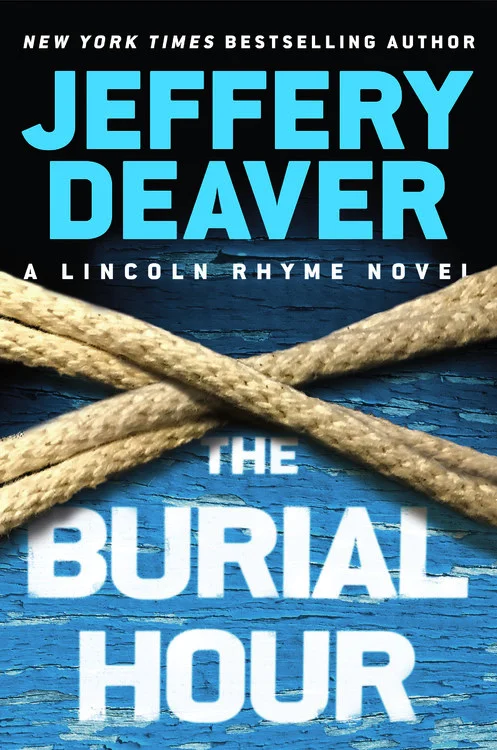
Spotlight: The Burial Hour by Jeffery Deaver

Forensic detective Lincoln Rhyme is back with his most harrowing case yet in this newest installment of Jeffrey Deaver's New York Times bestselling series.

A businessman snatched from an Upper East Side street in broad daylight. A miniature hangman's noose left at the scene. A nine-year-old girl, the only witness to the crime. With a crime scene this puzzling, forensic expertise of the highest order is absolutely essential. Lincoln Rhyme and Amelia Sachs are called in to investigate.

Soon the case takes a stranger turn: a recording surfaces of the victim being slowly hanged, his desperate gasps the backdrop to an eerie piece of music. The video is marked as the work of The Composer...

Despite their best efforts, the suspect gets away. So when a similar kidnapping occurs on a dusty road outside Naples, Italy, Rhyme and Sachs don't hesitate to rejoin the hunt. 

But the search is now a complex case of international cooperation--and not all those involved may be who they seem. Sachs and Rhyme find themselves playing a dangerous game, with lives all across the globe hanging in the balance.

Buy on Amazon | Barnes and Noble

About the Author

Jeffery Deaver is the #1 international bestselling author of over thirty novels and three collections of short stories. His books are sold in 150 countries and translated into 25 languages. His first novel featuring Lincoln Rhyme, The Bone Collector, was made into a major motion picture starring Denzel Washington and Angelina Jolie. He's received or been shortlisted for a number of awards around the world. He lives in North Carolina.

Spotlight: Penance by Kanae Minato

The tense, chilling story of four women haunted by a childhood trauma.

When they were children, Sae, Maki, Akiko and Yuko were tricked into separating from their friend Emili by a mysterious stranger. Then the unthinkable occurs: Emili is found murdered hours later.

Sae, Maki, Akiko and Yuko weren't able to accurately describe the stranger's appearance to the police after the Emili's body was discovered. Asako, Emili's mother, curses the surviving girls, vowing that they will pay for her daughter's murder.

Like Confessions, Kanae Minato's award-winning, internationally bestselling debut novel, PENANCE is a dark and voice-driven tale of revenge and psychological trauma that will leave readers breathless.

Buy on Amazon | Barnes and Noble

About the Author

Kanae Minato is an award-winning, internationally bestselling novelist and former home economics teacher and housewife who wrote her first novel between household chores. Minato lives in Japan.