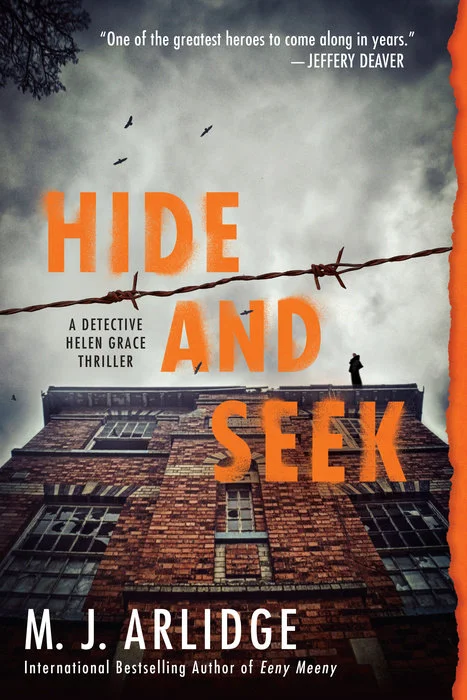
Caught in a wicked game of cat and mouse, Helen Grace finds herself trapped among the hunted in the darkest thriller yet from the international bestselling author of Little Boy Blue and Eeny Meeny.
Framed for a murder she didn’t commit…
As one of HM Prison Holloway’s most high-profile new inmates, Helen Grace has a target on her back and nowhere to hide. She has made a long list of enemies over the course of her career—some are incarcerated within these very walls. When one of Helen’s fellow prisoners is found mutilated and murdered in her own locked cell, it’s clear that the killer is someone on the inside.
But time is running out for Helen as she races to expose the person who framed her, and the body count in the prison starts to climb. Helen will need to draw on all her investigative skills and instincts to catch the serial killer behind these murders and discover the truth—unless the killer finds her first.
Excerpt
***This excerpt is from an advance uncorrected copy proof***
Copyright © 2017 M.J. Arlidge
1
She moved quickly, keeping her head down. The corridor was full of bodies tonight, but she bullied her way past them, never once looking back. Expletives and abuse accompanied her clumsy progress, and as she turned the corner into her wing, she felt a large glob of saliva hit the back of her neck. Normally she would have turned to confront the offender—she loved cracking bones—but there was no question of that tonight.
Lockup was only fifteen minutes away and Leah knew that if she could make it back to her cell, she would be safe. She’d been lying low in the Skills Department, concealing herself in a disused storeroom, but when the bell rang for end of association, she knew she had to move. She was not superstitious by nature, but as she left her hiding place, she kissed her crucifix three times, muttering her boys’ names and praying for luck. She had a feeling she would need it.
They knew. And now they were coming for her. It was just a question of where and when. Holloway Prison is a maze of narrow, ill-lit corridors, with numerous opportunities for ambush. Leah knew the terrain better than most—she’d been there five years already—but that was no guarantee of safety. Not when you were being hunted by the pack.
As she quickened her pace, Leah was suddenly overwhelmed by fear—she had the strong feeling that she would die in there, amid the filth and the misery. She could picture herself bleeding out on the floor as her attackers circled her, their eyes full of hate . . .
“Get yourself together, girl.”
The words came out in a harsh whisper and Leah cut them off abruptly, chiding herself for her weakness and stupidity. She was in deep trouble for sure, but she was nearly home—it would be crazy to mess it up now. Taking a deep breath, she emerged from the corridor and, crossing the gantry, skipped up the stairs to Level 2. She was treading lightly, trying not to make any noise, but her steps beat out a dull metallic rhythm. Her eyes darted left and right, as she expected an attack at any moment, but to her surprise the way remained clear.
In fact, nothing seemed out of the ordinary tonight. As Leah scanned her wing, she saw the same old faces, jawing and laughing before their enforced separation for the night. Everybody seemed relaxed, even happy, and Leah now felt a surge of optimism. Perhaps all her fears had been for nothing. A short dash and she would be back in her cell, safe and sound.
All she had to do now was pick her moment.
2
She felt their eyes boring into her.
It had been like this ever since her arrival. Police officers sit somewhere between snitches and child killers in the prison pecking order, objects of morbid curiosity and derision. So from the gantries, the cell doorways, the serving hatches, they watched her. Former detective inspector Helen Grace was still awaiting trial, but she’d already been convicted by her fellow prisoners, who’d labeled her a murderer and a pervert while doling out some old-fashioned Holloway punishment. At the front of the queue were the handful of violent offenders whom Helen had put away herself—for them, getting even with the disgraced police officer was a duty as well as a pleasure.
Her only respite from the daily grind of petty insults and casual violence came during working hours—inmates knew better than to mess with the smooth running of the prison—but even then there was little cheer. Duties were apportioned by the prison staff, and Helen’s nominated officer—a burly sadist called Campbell—took great delight in allotting her the most unpleasant tasks. Toilets and showers, medical waste, laundry and, worst of all, canteen clear-up.
This was always a painstaking duty, but tonight it had been particularly grueling, thanks to the mess left behind by “Lucy.” Lucy was a woman now living as a man, who’d nevertheless serve her sentence in Holloway, as she was biologically female. She loathed the place and was fighting a tortuous legal battle to be transferred to a male prison. Her fellow inmates knew this and enjoyed provoking her, refusing to call her by her chosen name: Michael. Predictably, things had kicked off again tonight and in the resulting brawl serious blows had been exchanged. Lucy had later vomited while being restrained, making Helen’s cleanup operation even more unpleasant.
Helen was just finishing the job, eking out the last few minutes before lockup, when she heard someone approaching. Even without looking up, she knew who it was. The inmates were all back on their wings and, besides, the slow, measured tread was unmistakable. She looked up to see Cameron Campbell approaching, leaving a steady trail of footprints behind him on her freshly mopped floor.
“You missed a bit,” Campbell said, gesturing to his footprints.
“Sorry, sir,” Helen replied. “Won’t happen again.”
“Make sure it doesn’t. If there is one thing I abhor, it’s . . . sloppy work.”
As he spoke, he raised his right foot, nudging the rim of Helen’s bucket until it toppled over, slewing huge amounts of vomit-flecked water across the floor. Helen watched the water’s progress, then turned back to Campbell, her eyes burning with anger.
“Do it again,” Campbell continued casually, brushing past Helen. “I want this place spick-and-span for the Christmas festivities.”
Furious, Helen bent down to grab her mop, and as she did so she felt a sharp elbow ram into her kidneys. It was so sudden and so violent that it knocked the breath from her and she fell to her knees, clutching the bucket rim for support. Campbell didn’t break stride, didn’t bother to look back, but the girls on the gantries were clearly enjoying the show.
“Look at the pig with her nose in the trough,” one wag shouted, and others soon joined in.
Helen raised her head, refusing to look broken, but all she saw were a hundred mocking faces—laughing, joking, reveling in her misfortune. In her former life, she’d been a respected police officer—she would have dealt with someone like Campbell swiftly and decisively—but now she was powerless to act. In there she was the butt of all jokes, an accident waiting to happen, a handsome trophy for any inmate brave enough to chance an attack.
She had survived thus far, but how long could her luck hold? She was surrounded on all sides by women who’d slit her throat as soon as look at her, yet the authorities seemed determined to turn a blind eye to her predicament. There was nowhere to run to, nowhere to hide, so Helen could never let her guard down, never relax.
In Holloway, danger was only a heartbeat away.
3
The footsteps came to a sudden halt and Leah looked up sharply. But seconds later, her cell door slammed shut and she heard the reassuring sound of the latch bolts deploying. She collapsed back onto her bed, exhausted but relieved.
Luck had been on her side tonight. She’d taken advantage of the scene in the canteen—Campbell enjoying himself at the expense of her neighbor yet again—to race back to her cell. The ten minutes that ensued as she waited for lockup had been agony. But it was over now.
The Judas slit snapped open and a pair of eyes appeared. Leah had come to know the eyes that spied on her and could recognize which prison officer they belonged to. Campbell’s eyes were gray and cold, Sarah Bradshaw’s were a weak light green and Mark Robins’s were chocolate brown and kind. The latter was doing the rounds tonight. Leah smiled to herself as she heard him working his way down the line, chivvying the girls into their cells.
Most of the women hated this part of the day. As night descended they were locked away with only themselves and their dark thoughts for company. Many had been neglected as kids, some had been abused and pretty much everybody in there had self-harmed at one time or another. The night brought back memories of abandonment and loneliness, pushing many girls over the brink. It was no wonder that most suicides happened after dark.
But Leah didn’t mind being locked up. During the day, she had enough on her plate, keeping out of harm’s way, so the night was her time. A time when she could imagine herself elsewhere. When she could make herself believe that she was at home with her boys, Dylan and Caleb. Doing normal things. Being a good person. Being a mum.
She often cried when she thought of them, but the tears somehow made her feel warm. Like their love was with her in the room. Cheered by this, she used her time alone to plot her future, planning how she would get to be with her boys again. She was doing a life stretch and visiting orders were scarce, so she’d had to think around the problem.
She was taking a massive risk, but there was no other way. Her mum and the boys were visiting tomorrow, and while she was in the relatives’ center, she would demand to see the governor. She had earned her transfer to the enhanced wing. From there perhaps she could get moved to an open prison. Was it too much to hope that she might even get early release one day?
Leah lay on the bed and pulled the blanket up to her chin. The sun was setting and this usually made her feel calm and relaxed. But she was jumpy tonight and couldn’t settle. Her mind kept flitting back to the boys. To Dylan’s funny little giggle when he was tickled. To the fineness of Caleb’s hair. To that warm feeling she had when they both lay in bed with her in the morning.
They were only memories, increasingly distant memories, but they were all she had. So snuggling down, she lost herself in the past, hoping that sleep would come.
And as if on cue, the lights suddenly snapped out, plunging Leah into darkness.
4
Helen stood by the window and stared at the moon. It was full and beautiful, its gentle light penetrating the gloom of her cell. It revealed a ten-by-twelve-foot room, painted lime green and furnished with a bed, sink and toilet, all of them screwed to the floor. This was Helen’s world now.
It was long after lockup, but she was often to be found like this, preferring this lonely vigil to the “comfort” of her narrow bed. The bedstead was old, the mattress lumpy, and besides, Helen could never sleep because of the noise. As soon as the lights went out, it started. Inmates calling to one another, calling to their mothers, calling to God. It was as relentless as it was predictable. When the shouting stopped, you heard the moaning. When the moaning stopped, you heard the crying. And when the crying stopped, you heard the vermin.
A large rat had run right over her on her first night, scurrying across her bed, before vanishing into the brickwork. It was one of many who felt they had the run of the place. Bluebottles circled the toilet day and night, sharing the tiny cell with the cockroaches that emerged after dark. The first few times Helen had spotted the latter scuttling across the floor, she’d stamped on them. But as each victim was quickly replaced by another, she’d given up. They were trapped in there too, so she’d decided to live and let live.
She now spent the night hours watching them go about their business, before exhaustion eventually drove her to bed. The hours after lockup were the toughest for Helen, when the horror of her situation made itself felt. It seemed impossible, but there she was in Holloway—the prison that had been her sister’s home after she murdered their parents. A few lifers still remembered Marianne, speaking approvingly of her intelligence and wit, and slightly less warmly of the violence she meted out. Her son, Robert Stonehill, had murdered three people in order to frame Helen, which was why she now spent her days in the company of liars, thieves and killers.
Retrieving a piece of chalk from the window ledge, Helen crossed the room and drew a single line on the wall next to her bed. It was one of many in a long, neat row—Helen religiously chalked off each day of incarceration. She had survived forty-six nights behind bars thus far—if she could make it through another fifty, she would have made it to her trial. It was this, and this alone, that kept her going.
Helen still hoped to prove her innocence in court, though she knew this would be tough. Robert had been thorough—planting her DNA at the murder scenes, killing on nights when Helen had no alibi and tempting her to lie to fellow officers about her personal connection to the victims. Her lies had been exposed, and after that her fall from grace had been swift. With no female Category A prison in Hampshire, she’d ended up there. Her one remaining ally, DS Charlie Brooks, was working to secure her release, but what were her chances? Robert seemed to have disappeared off the face of the earth.
Every day, Helen told herself to be optimistic, to have faith in the criminal justice system. But each night brought fresh doubts, and Helen was starting to fear she’d be stuck in Holloway forever. Was such an injustice possible? Could people really be so badly fooled?
At times like this Helen felt as if the whole world had forsaken her. She was a pariah, starved of company and bereft of sympathy. Helen had always been a private person, but even so the isolation there was crushing. There was no one she could really trust, no one she could confide in, and as the nocturnal parade of rats and bugs proved, the only inmates willing to spend time with her now were the vermin.
5
Leah awoke, breathless and scared. She had been dreaming again. This time she was being chased down a corridor that seemed to go on forever. In her dream, she had no idea where she was going or whom she was running from. All she did know was that, despite her best efforts, she was getting slower and slower. Looking down, she’d been astonished to discover that she had no legs—she was just a floating torso, clawing the air in her desperation to escape her pursuers.
She buried her face in the pillow and breathed out. Her nightmare had been so vivid that her heart was racing and a thin sheen of sweat clung to her forehead. Shrugging off these dark thoughts, she pulled the blanket up around her, determined to snatch a few hours’ sleep before the day began. But as she did so, she froze. The blanket refused to move, and Leah realized that the rhythmic breathing she could hear was not her own.
Someone was sitting at the end of her bed. Leah closed her eyes, praying that she could banish this dark vision, but still the sound of the breathing intruded. In, out, in, out. Leah wanted to scream but instead she remained still. She knew that what she did in the next few minutes would decide if she lived or died.
By playing dead she could buy herself some time, and, turning fitfully as if in half sleep, she tucked her right arm under her body. It was hidden now, and slowly she slid her hand toward her pillow. This was where she kept her shiv—an improvised knife made up of a razor blade and a toothbrush handle. It had saved her life on more than one occasion and she grasped gratefully for it now.
Except it wasn’t there. Abandoning all caution, her fingers groped frantically, covering every inch of the cold mattress. But even as she did so, a measured voice said, “Looking for this?”
Leah didn’t want to, but she couldn’t help herself, turning now to find out who had spoken. The locked cell was gloomy and swathed in shadow—she couldn’t make out the figure sitting at the end of her bed, but she could see her trusty shiv gripped in the intruder’s hand, its lethal blade winking at her in the moonlight.
6
“We’ve got a knife attack. Wounding with intent to kill. Who wants it?”
Detective Inspector Sanderson’s voice filled the MIT office. Despite the early hour, the room was full—with some familiar faces and some new ones. There was a moment’s pause—did anyone need another case?—before DC Lucas stepped forward, just pipping Edwards to the post.
“I’ll take it,” she said cheerfully. “Anything out of the ordinary?”
“Kebab shop confrontation. The perpetrator’s claiming self-defense, but it looks like attempted murder to me.”
“I can’t think of a better case for a vegetarian.”
Lucas’s manner was playful, but the speed with which she scooped up her warrant card and bag belied her tone. Much had changed on the seventh floor since Helen Grace’s incarceration. The whole team had looked up to their inspirational leader—Sanderson included—and her disgrace had affected everybody. She had been in charge of the Major Incident Team for so long that it had taken them a while to get used to the sight of somebody else in her office. Still, Sanderson was getting more comfortable in the role now, and she regarded Lucas’s desire to impress as evidence that progress was being made. Perhaps there was life after Helen Grace.
Sanderson felt she’d done more than enough to earn her promotion, having pushed through the complex investigation into her predecessor’s criminal behavior with rigor and tact. But it had still come as a shock when Detective Superintendent Gardam told her she was going to be the new detective inspector. Jonathan Gardam had been reassuring, however, urging her to reshape the team in her own image. This was partly to encourage her but was also a deliberate attempt to repair some of the damage caused by Helen’s arrest. The reputation of Hampshire Police had taken a terrible battering following the revelation that they’d harbored a killer in their midst, and Gardam seemed determined to rectify this. He knew Sanderson was a by-the-book girl—a fact that no doubt had some bearing on her elevation.
Predictably, the one fly in the ointment was Charlie Brooks. Her loyalty to Helen was unshakable, and the fact that Robert Stonehill had been in Southampton at the time of the infamous S and M murders only reinforced her belief that Helen was innocent. In reality there was not a shred of evidence to connect him with the killings, but this made no difference—Charlie was obsessed with Helen, and on more than one occasion Sanderson had had to reprimand her for her lack of focus.
Scanning the room, Sanderson was depressed to see that Charlie’s chair was empty. She hadn’t called in sick, wasn’t being deployed elsewhere today and knew better than to go absent without leave.
Which begged the question: where was she?
7
“Take a good look and tell me if you recognize him.”
The elderly shopkeeper leaned over the confectionery display and took the photo from Charlie’s outstretched hand.
“What’s he done?”
“Assault, battery, theft. He beat the owner of a carpet shop half to death over the contents of the till. Could happen to anyone, so, please, take your time.”
The lie was so practiced that it tripped off Charlie’s tongue.
“Nasty-looking bloke, isn’t he?”
“You better believe it,” Charlie continued. “We think he lives around here, so perhaps he popped in here for fags or beers?”
He perused the picture in silence. Charlie said nothing, impatient for an answer but determined not to break his concentration. He was probably the fiftieth shop owner she’d canvassed in the last few weeks, and she was beginning to feel that she was clutching at straws.
The man in the photo was real enough—Robert Stonehill—but the crime for which he was being sought was entirely fictional. There was no carpet shop owner, no assault, and Charlie knew that in fabricating a police incident she was breaking every rule in the book. Still, it allowed her to file a crime on the system, buying her some time to follow it up. It wasn’t a deception that could last—she would be found out in the end—but there was nothing else for it.
A short phone conversation with Helen was enough to convince Charlie of her innocence, and since then she’d been searching for evidence to help effect her release. She had scoured the Western Docks—Robert’s nerve center had been there—but the primary evidence she’d hoped to find eluded her. The main investigating team had found the imprint of a size nine Vans trainer in the derelict building in which Helen was arrested, but they had dismissed it as irrelevant. Charlie, however, was convinced it belonged to Stonehill.
“What do you say? Has he been in here? He’s about six foot, quiet sort of guy, ordinary clothes, but expensive trainers . . .”
Stonehill had been working at a remote branch of Wilkinson’s during his killing spree, using the alias Aaron West. Charlie had worked out all possible routes from the murder sites to his nerve center, and, armed with a photo and a recent description of him, she’d been pounding the streets, targeting the minimarkets, newsagents and convenience stores. Stonehill was a canny operator, but he was still human. He had to eat.
“Sorry, love, I don’t recognize him.”
“Look again. It’s really impor—”
“I’d like to help you, but he’s not been in here.”
His tone was harder now, though his manner was not unkind. He could probably sense Charlie’s desperation. Taking the photo, Charlie thanked him and left. There were three more premises on her list to check out. She could probably just about work through them before her absence gave anyone serious cause for suspicion. Whatever the consequences, however depressing this door-to-door drudgery was, there was no question of Charlie giving up.
Not while an innocent woman was behind bars.
8
“Let’s get this party started.”
Sarah Bradshaw’s voice rang out clear and true as she buzzed the cell open. The bolts slid across and she yanked the heavy door toward her. Ignoring the mumbled complaints from within, she moved on, methodically unlocking each cell on the wing. She was making good progress and her charges were starting to emerge. Too groggy to argue, too strung out to resist, they shuffled out of their doorways, waiting for the order to go to breakfast. There was no aggravation, no attitude. Little wonder that roll call was Sarah’s favorite part of the day.
“Get your game faces on, ladies. It’s another day in paradise . . .”
Smiling to herself, Sarah opened the last cell door before crossing the central gantry to the east side. Instinctively, she shot a look back behind her—she was the only officer on duty this morning thanks to staff shortages and knew from experience never to turn her back on her charges. To her satisfaction, however, everyone was behaving themselves. Grace was first out as usual, and the others weren’t far behind. The junkies, schizos and whack jobs who’d spit in your face as soon as look at you at the end of the day were quiet as church mice this morning. It was amazing what hunger could do.
Whistling tunelessly, Sarah continued on her way, swinging her keys as she went. Reaching the end of her round, she turned to survey her kingdom. And now for the first time, she noticed the gap in the line.
Everyone was present and correct, except for Leah Smith. She was housed between Helen Grace and Rosie Burke, an inveterate shoplifter and frequent visitor to Holloway. They were both out on the landing, waiting patiently for instructions, but there was no sign of Leah. She was not someone who usually challenged authority, so—best-case scenario—her absence from the line meant a sick or recalcitrant prisoner. Worst case, it was a code black—prison terminology for an attempted suicide.
“On the landing, Smith. Don’t keep these nice ladies waiting . . .”
It was said confidently, but there was tension in Sarah’s voice now. Suicides were messy and always set the other inmates off, as the inevitable lockdown ensued.
“Don’t make me come in there and get you. Not if you want to eat today . . .”
Still no movement, so turning on her heel Sarah marched back to the western side of the wing. The other inmates were getting in on the act now, offering lurid suggestions for how Sarah might rouse Leah from her slumbers. Sarah ignored them, walking fast along the corridor past Baylis, past Cooke, and eventually past Grace too. Sarah had now arrived at Smith’s cell, and, taking a breath, she heaved the door open and stepped inside.
To her relief, all was quiet. She’d been expecting torn bedsheets, blood on the floor or even a flooded cell. But, no, Smith was lying on her bed, covered from head to toe by her blanket.
“Get your arse up, Smith, or I will put you on report.”
Still Leah didn’t move. Fear started to puncture Sarah Bradshaw’s anger now. For some reason she couldn’t put her finger on, she had the strong feeling that something was very wrong in this cell. It looked ordinary enough, neat and tidy . . . but the silence inside it was strangely suffocating.
Whatever it was, Sarah suddenly had to know. So, stepping forward, she took a firm hold of the corner of the blanket and, after a silent count of three, yanked it off the bed.
9
Cathy Smith peeled back the duvet to reveal Dylan and Caleb hiding underneath. She’d been trying to get the five-year-old twins up for over half an hour, but they were being cheeky this morning. She’d eventually managed to get them out of their bunk beds, but they’d immediately fled, hiding first in her wardrobe, then in her bed.
This time she showed them no mercy. Having located their hiding place, she pulled the duvet off, exposing the giggling fugitives. They tried to make a break for it, but she was ready for them. She pounced, tucking one under each arm, dragging them back onto the bed. For a minute they protested, struggling and kicking; then, seeing that the situation was hopeless, they turned on her, tickling her for all they were worth. Cathy protested—she was a highly ticklish grandmother—but secretly she loved every minute of it. In spite of the tough start these boys had had in life, they were extremely affectionate and loving.
They were only six months old when their mother committed murder. Three, four, five times a day, Cathy cast her mind back to that night, wondering if she might have done something differently. Perhaps if she’d refused to babysit the boys, then Leah wouldn’t have been at that pub, wouldn’t have seen her no-good boyfriend with another girl. Had she been too soft on her? Too accepting of the mood swings, the drinking, the violent flashes of temper? Often Cathy cursed herself for her failings, laying the blame for the ensuing tragedy firmly at her own door. Other times she tried to put it down to sheer bad luck. Leah hadn’t meant to kill the girl, didn’t realize that she was expecting a baby . . .
So many lives destroyed in one moment of madness. The girls’ parents broken by their loss, Leah serving a life sentence and Cathy bringing up two baby boys, despite the lack of a man in the house or a steady income. Each day was a struggle to meet their needs, and yet . . . every day brought little surprises, moments of joy that made it all worthwhile. Cathy was exhausted, but in spite of everything, she never begrudged the boys her role as their carer. After all, if she hadn’t taken them on, they would have ended up in care.
Cathy was keeping the family together. One day Leah would be released and then they could all be together again. Until then she wouldn’t grumble, wouldn’t complain. She would do what needed to be done and make the most of their infrequent visits to Holloway. There were pictures of Leah all around the flat, but in truth nothing could replace one-to-one contact.
With an eye on the clock, Cathy pulled the boys to her, kissed them once on each cheek in turn and said, “Breakfast, then clothes and teeth. Double quick, please.”
The boys groaned but Cathy was prepared.
“I’ve got Coco Pops for good boys who do as they’re told. After all, we don’t want to be late for Mummy, do we?”
Cathy smiled as the boys scampered off. She knew Leah depended on their brief visits. And, if she was honest, so did she.
10
Helen pushed through the crowds, searching for a place of sanctuary. She had never seen the canteen so busy—the unsettled inmates gathering together for moral support—and there was not a seat to be had anywhere. Helen was seldom invited to join anyone’s table, but usually there was an out-of-the-way spot she could claim as her own. This morning, however, the prison gangs and cliques were out in force, seeking safety in numbers. Those who did catch her eye radiated hostility, even suspicion, as if Helen herself might have been responsible for her neighbor’s death.
Clutching her breakfast tray, Helen made another circuit of the room. She was buffeted every step of the way, stray elbows finding their way to her ribs, but finally she got a break. Jordi, a cheerful former prostitute, caught her eye and shuffled up to allow her some room. Helen had helped the illiterate sex worker write her recent parole application—Jordi had teenage daughters whom she missed desperately—and they were now on friendly terms. Hence her act of mercy.
Helen seated herself quickly and cast an eye around the table. Babs, a seventy-year-old lifer with a dodgy hip but a good heart, nodded at Helen, giving her tacit support to Jordi’s generosity of spirit. Noelle, a boisterous drug dealer who’d always been fair to Helen, did likewise, flashing her gold teeth quickly before returning to her cornflakes. The others at the table Helen didn’t know well, and she expected them to object to her sudden arrival, but their mood was subdued today. Hostilities had been suspended following the night’s shocking events—Helen noted that no one was even bothering to bait Lucy this morning.
“You not eating?” Babs asked as Helen toyed with her breakfast.
“Maybe later,” Helen replied, though in truth she couldn’t face anything.
“Have something. You won’t get another chance until lunchtime.”
Relenting, Helen picked up her burned toast, but before she could take a bite, Jordi dived in.
“You hear anything last night?”
“For God’s sake, Jordi,” Noelle interrupted. “Let the woman have her chow in peace.”
“Just asking . . .”
“Nothing . . . ,” Helen answered, to Jordi’s evident disappointment. “I was up half the night, but even so . . .”
“Did you see anything, then? When Bradshaw went in?”
Helen shook her head once more. At roll call, you stand by your cell and don’t move unless you’re told to. It’s part of the deadening routine of prison life, which you flout at your peril, but Helen now regretted her obedience. It was clear from the moment Sarah Bradshaw entered Leah’s cell that something bad had happened. Helen had heard Bradshaw’s half scream, the fast, muttered expletives and then the shrill shriek of the bell as the panicking officer punched the emergency alarm. Campbell, Robins and the rest had scrambled to assist as lockdown kicked in. The hungry inmates were kept inside until Leah’s cell had been properly sealed off, leaving Helen in the dark about what had happened.
Code black. That had been everyone’s first thought, but rumors spread fast in prison, and speculation had now taken a more sinister turn. People were saying that Leah Smith had been murdered.
Helen was no great friend of Leah’s—her neighbor was suspicious, hostile and prone to violence—but the troubled young woman had been the first person Helen met in Holloway and she’d made an effort to show Helen the ropes. Such generosity toward a jailed police officer had surprised Helen, though she later wondered whether Leah’s deep unpopularity had prompted her actions. She’d never fully got to the bottom of why Leah was so reviled. She knew a special kind of hatred was reserved for inmates who’d harmed children or babies, but Leah’s unpopularity was so ingrained that Helen wondered if there was something else at play. Her lack of knowledge—both of Leah’s history and of her fate—gnawed at her. Outside, she could have demanded answers. Inside, she was as clueless as the rest.
“If she was done in, there are plenty of suspects,” Noelle said darkly, casting an eye around the canteen.
“Easy, Noelle. Don’t go throwing stones . . . ,” Babs warned gently.
“True though, innit? A lot of people with guilty consciences in here this morning.”
Helen listened as Noelle continued her dissection of prison politics. Jordi seemed less interested, excusing herself to hunt for more food, but Helen was keen to hear what Noelle had to say—even if most of her “facts” were unsubstantiated rumor and speculation. Leah was a marked woman and would have been a feather in the cap for any inmate. Though she’d recently tried to get clean, she was also a habitual drug user and alcoholic, which often brought her into conflict with the authorities and the prison gangs. To top it off, her temper was legendary—she’d recently threatened to gouge one of the kitchen staff for shortchanging her on baked beans. Such is the stuff of life and death in prison.
Noelle continued to talk, but solid information was hard to come by this morning. Babs had tapped up the “Golden Girls”—the small coterie of pensioners seeing out their days in Holloway—but had come back empty-handed, and to everyone’s surprise it was Jordi, returning breathless and upset from the serving hatch, who finally broke the news to them.
“Sandra knows a girl who works in the governor’s office,” Jordi said, nodding to the burly cook at the serving hatch. “She says an outside unit has already been called in.”
This was not a common or garden suicide, then. Helen didn’t say anything, but she knew that the Prisons and Probation Service would be summoned only if there was something unusual or suspicious about Leah’s death.
“They’re saying that she was murdered in her bed and that . . . they’d done a job on her. They sewed up her mouth. Her eyes too.”
Helen stared at Jordi, barely taking in the words.
“They sewed her eyelids to her bloody cheeks. That’s how they found her—eyes shut, grinning from ear to ear . . .”
Noelle remained silent as Jordi now wept. Even Babs looked shaken, and she had seen more than most. Helen kept her counsel, but her mind was already turning on this macabre development. She had heard unpleasant tales of prison justice before, but this was something else. It made her feel sick to the stomach, and by the looks of it she wasn’t the only one—Sandra’s news was doing the rounds and the atmosphere in the canteen had suddenly changed. Normally the inmates were raucous and excitable at mealtimes. But not today.
Today everybody looked terrified.
11
It was a horrific sight to behold. The tattered blanket lay on the floor where Sarah Bradshaw had dropped it, and just above it on the narrow bed lay the mutilated corpse of Leah Smith.
Celia Bassett had been the governor of Holloway Prison for over five years, but nothing had prepared her for this. Leah’s face was waxy and pale, her body rigid, and there was not a drop of blood anywhere. The normally restless Leah would have looked calm and at peace—were it not for the rictus grin that gripped her brutalized face.
Celia moved forward, the plastic coverings on her shoes making a strange swishing sound against the floor, and forced herself to take a closer look. She was immediately struck by the color of the cotton thread—a pretty powder blue—and the neatness of the stitching. It wasn’t a perfect job, having presumably been carried out quickly and in the dark, but it was an effective one, sealing the mouth tight and tugging it up at the corners. The eyelids had been similarly dispatched, stitched robustly to Leah’s cheeks.
“At least she died with a smile on her face,” said a voice behind her, its Scottish lilt infected with sarcasm.
“Shut the fuck up, Campbell. This isn’t funny.”
“Funny or not, it’s not our problem now . . .”
Celia turned to reprimand her most senior officer, but he was already on his way out the door. He’d been her acting head of security since the previous incumbent departed suddenly, but he couldn’t have been less interested in this sudden tragedy. It made Celia’s blood boil—regardless of his responsibilities, Leah Smith was a human being, for God’s sake—but his weary cynicism came as no surprise to her. Holloway was due to be mothballed at the end of the year, and the prison’s skeleton crew of officers were already beyond exhausted, ground down by the daily stress, abuse and violence. The last thing they needed was a major incident like this, which might reflect badly on them and their chances of a decent relocation when the old prison closed its doors for the final time.
And Campbell was right, of course—this was out of their hands now. She had already alerted the PPS, and an investigator was on his way to take control of what would now be a murder inquiry. Celia knew from experience that the PPS guys were remorseless, thorough and single-minded, paying little heed to context in their desire to ascertain “the facts.” It would disrupt prison life, raise the anxiety level of officers and prisoners alike and perhaps reveal some extremely unpalatable truths.
Celia stared down at the corpse once more, her heart in her boots. Leah’s sufferings were over. But for the rest of them, the nightmare was just beginning.
Excerpted from Hide and Seek by M.j. Arlidge. All rights reserved. No part of this excerpt may be reproduced or reprinted without permission in writing from the publisher.
Buy on Amazon | Barnes and Noble
About the Author
M. J. Arlidge is the international bestselling author of the Detective Helen Grace thrillers. He has worked in television for the past fifteen years.