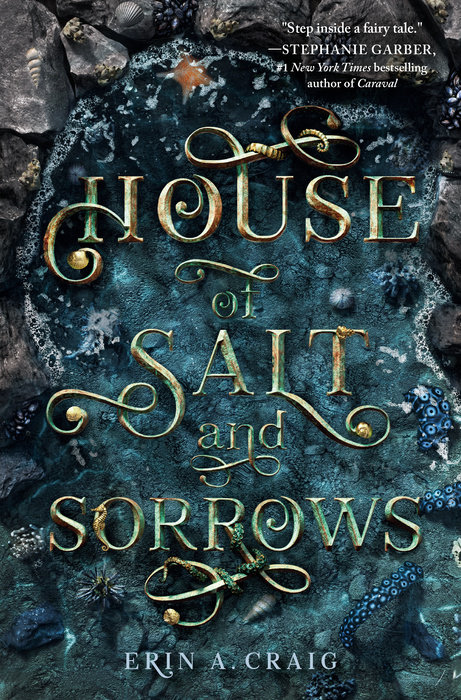
Spotlight: House of Salt and Sorrows by Erin A. Craig

Get swept away in Erin A. Craig’s mesmerizing House of Salt and Sorrows. As one by one her beautiful sisters mysteriously die on their isolated island estate, Annaleigh must unravel the curse that haunts her family. Be careful who you dance with. . . .

In a manor by the sea, twelve sisters are cursed.

Annaleigh lives a sheltered life at Highmoor with her sisters and their father and stepmother. Once there were twelve, but loneliness fills the grand halls now that four of the girls’ lives have been cut short. Each death was more tragic than the last–the plague, a plummeting fall, a drowning, a slippery plunge–and there are whispers throughout the surrounding villages that the family is cursed by the gods.

Disturbed by a series of ghostly visions, Annaleigh becomes increasingly suspicious that her sister’s deaths were no accidents. The girls have been sneaking out every night to attend glittering balls, dancing until dawn in silk gowns and shimmering slippers, and Annaleigh isn’t sure whether to try to stop them or to join their forbidden trysts. Because who–or what–are they really dancing with?

When Annaleigh’s involvement with a mysterious stranger who has secrets of his own intensifies, it’s a race to unravel the darkness that has fallen over her family–before it claims her next. House of Salt and Sorrows is a spellbinding novel filled with magic and the rustle of gossamer skirts down long, dark hallways. Get ready to be swept away.

Excerpt

CANDLELIGHT REFLECTED OFF THE SILVER ANCHOR etched onto my sister’s necklace. It was an ugly piece of jewelry and something Eulalie would never have picked out for herself. She loved simple strands of gold, extravagant collars of diamonds. Not . . . that. Papa must have selected it for her. I fumbled at my own necklace of black pearls, wanting to offer her something more stylish, but the battalion of pallbearers shut the coffin lid before I could undo the clasp.

“We, the People of the Salt, commit this body back to the sea,” the High Mariner intoned as the wooden box slid deep into the waiting crypt.

I tried not to notice the smattering of lichens growing inside the gaping mouth, drawn wide to swallow her whole. Tried not to think of my sister—who was alive, and warm, and breathing just days before—being laid to rest. Tried not to imagine the thin bottom of the coffin growing fat with condensation and salt water before splitting asunder and spilling Eulalie’s body into the watery depths beneath our family mausoleum.

I tried, instead, to cry.

I knew it would be expected of me, just as I knew the tears were unlikely to come. They would later on, probably this evening when I passed her bedroom and saw the black shrouds covering her wall of mirrors. Eulalie had had so many mirrors.
Eulalie.

She’d been the prettiest of all my sisters. Her rosy lips were forever turned in a smile. She loved a good joke, her bright green eyes always ready for a quick wink. Scores of suitors vied for her attention, even before she became the eldest Thaumas daughter, the one set to inherit all of Papa’s fortune.

“We are born of the Salt, we live by the Salt, and to the Salt we return,” the High Mariner continued.

“To the Salt,” the mourners repeated.

As Papa stepped forward to place two gold pieces at the foot of the crypt—payment to Pontus for easing my sister back into the Brine—I dared to sweep my eyes around the mausoleum. It was overflowing with guests bedecked in their finest black wools and crepes, many of them once would-be beaus of Eulalie. She would have been pleased to see so many brokenhearted young men openly lamenting her.

“Annaleigh,” Camille whispered, nudging me.

“To the Salt,” I murmured. I pressed a handkerchief to my eyes, feigning tears.
Papa’s keen disapproval burned in my heart. His own eyes were soggy and his proud nose was red as the High Mariner stepped forward with a chalice lined with abalone shell and filled with seawater. He thrust it into the crypt and poured the water onto Eulalie’s coffin, ceremonially beginning its decomposition. Once he doused the candles flanking the stony opening, the service was over.

Papa turned to the gathered mass, a wide shock of white streaked through his dark hair. Was it there yesterday?

“Thank you for coming to remember my daughter Eulalie.” His voice, usually so big and bold, accustomed to addressing lords at court, creaked with uncertainty. “My family and I invite you to join us now at Highmoor for a celebration of her life. There will be food and drink and . . .” He cleared his throat, sounding more like a stammering clerk than the nineteenth Duke of the Salann Islands. “I know how much it would have meant to Eulalie to have you there.”

He nodded once, speech over, his face a blank facade. I longed to reach out to ease his grief, but Morella, my stepmother, was already at his side, her hand knotted around his. They’d been married just months before and should have still been in the heady, blissful days of their joined life.

This was Morella’s first trip to the Thaumas mausoleum. Did she feel uneasy under the watchful scrutiny of my mother’s memorial statue? The sculptor used Mama’s bridal portrait as reference, transmitting youthful radiance into the cool gray marble. Though her body returned to the sea many years ago, I still visited her shrine nearly every week, telling her about my days and pretending she listened.

Mama’s statue towered over everything else in the mausoleum, including my sisters’ shrines. Ava’s was bordered in roses, her favorite flower. They grew fat and pink in the summer months, like the plague pustules that claimed her life at only eighteen.

Octavia followed a year later. Her body was discovered at the bottom of a tall library ladder, her limbs tangled in a heap of unnatural angles. An open book adorned her resting place, along with a quote etched in Vaipanian, which I’d never learned to read.

With so much tragedy compressed into our family, it seemed inevitable when Elizabeth died. She was found floating in the bathtub like a piece of driftwood at sea, waterlogged and bleached of all color. Rumors ran from Highmoor to the villages on neighboring islands, whispered by scullery maids to stable boys, passed from fishmongers to their wives, who spread them as warnings to impish children. Some said it was suicide. Even more believed we were cursed.
Elizabeth’s statue was a bird. It was meant to be a dove, but its proportions were all wrong and it looked more like a seagull. A fitting tribute for Elizabeth, who always so badly wanted to soar away.

What would Eulalie’s be?

Once there were twelve of us: the Thaumas Dozen. Now we stood in a small line, my seven sisters and I, and I couldn’t help but wonder if there was a ring of truth to the grim speculations. Had we somehow angered the gods? Had a darkness branded itself on our family, taking us out one by one? Or was it simply a series of terrible and unlucky coincidences?

After the service, the crowd broke up and began milling around us. As they whispered their strained condolences, I noticed the guests were careful not to get too close. Was it in deference to our station, or were they worried something might rub off? I wanted to chalk it up to lowbrow superstition, but as a distant aunt approached me, a thin smile on her thin lips, the same question flickered in her eyes, just below the surface, impossible to miss:
Which one of us would be next?

Excerpted from House of Salt and Sorrows by Erin A. Craig. Copyright © 2019 by Erin A. Craig. All rights reserved. No part of this excerpt may be reproduced or reprinted without permission in writing from the publisher.

Buy on Amazon | Barnes and Noble

About the Author

Erin A. Craig has always loved telling stories. After getting her BFA in Theatre Design and Production from the University of Michigan, she stage managed tragic operas filled with hunchbacks, séances, and murderous clowns, then decided she wanted to write books that were just as spooky. An avid reader, decent quilter, rabid basketball fan, and collector of typewriters, Erin makes her home in Memphis with her husband and daughter.
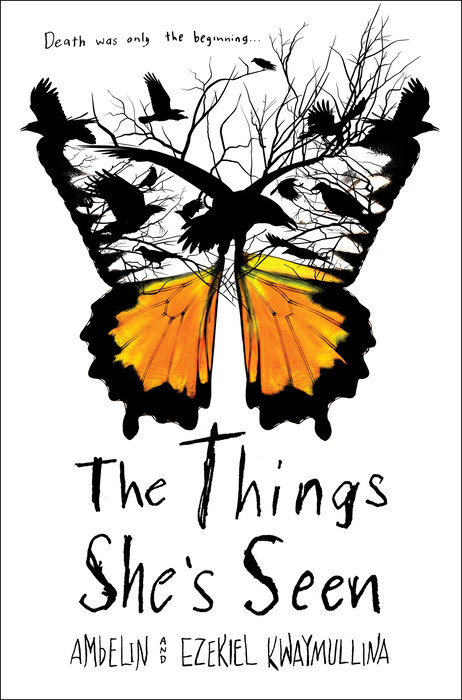
Spotlight: The Things She's Seen by Ambelin Kwaymullina and Ezekiel Kwaymullina

This brilliantly written thriller explores the lives–and deaths–of two girls, and what they will do to win justice. Sure to be one of the most talked-about books of the year!

Nothing’s been the same for Beth Teller since the day she died.

Her dad is drowning in grief. He’s also the only one who has been able to see and hear her since the accident. But now she’s got a mystery to solve, a mystery that will hopefully remind her detective father that he needs to reconnect with the living.

The case takes them to a remote Australian town, where there’s been a suspicious fire. All that remains are an unidentifiable body and an unreliable witness found wandering nearby. This witness speaks in riddles. Isobel Catching has a story to tell, and it’s a tale to haunt your dreams–but does it even connect to the case at hand?

As Beth and her father unravel the mystery, they find a shocking and heartbreaking story lurking beneath the surface of a small town.

Excerpt

My dad looked like crap.

His blond hair was flat and grubby, and his skin seemed too big for his bones. The muscly, tanned guy who’d built me a two-story tree house when I was a kid had been replaced by a pale shell of a man who didn’t build anything. You’d think it would be me who looked different. Dad said I didn’t. I couldn’t tell, since I didn’t cast a reflection anymore. But if I looked the same, then the face smiling out from the pictures on the walls of our house must still be my face: curly dark hair, round cheeks, brown skin like Mum’s, and blue eyes like Dad’s. Only I didn’t smile as much now.

Dad barely smiled at all.

He pressed his hand to his chest, out of breath from climbing up this rocky hill. There were a bunch of rock formations like this one around here, rising up from a flat red plain that was dotted with trees. I liked the trees. They were old and white and twisty, spiraling upward to fling out their leaves as if they were hoping to touch the sky. I liked the sky too; there seemed to be more of it here than in the city. There were no buildings to block it out. No big ones, anyway. We could see much of the town from where we stood: a sprawl of houses surrounded by the scattered trees, with a long river to the north. The town was covered in the same dust that coated everything, including our car and my dad’s rumpled shirt and pants. The dust hadn’t touched my clothes, of course. My dress would always be as yellow and crisp as it had been on the day Aunty Viv drove me to the birthday party.

Dad took a step closer to the edge of the hill, gazing outward.

“I don’t think you’re going to solve the case from up here,” I told him.

His gaze shifted in my direction. His eyes were bright with tears. Sometimes he couldn’t even look at me without sobbing. Today the tears didn’t fall. But I could hear them in his voice when he said, “I miss you, Beth.”

“I’m right here, Dad.”

Except we both knew I wasn’t. At least, not in the way he wanted me to be.

The accident had happened so fast. One minute I’d been sitting in Aunty Viv’s sedan, everything normal. Then I’d heard the four-wheel drive plowing through the bushes as it tore down the embankment. I’d looked up to see it hurtling at me, and . . . nothing.
I didn’t remember the actual dying part.

In fact, I felt as if I was still a living, breathing girl. Right now, for instance, I could see the town, hear the wind, smell the eucalyptus from the trees, and taste the gritty dust. I just couldn’t touch any of it.

This wasn’t how I’d imagined being dead, not that I’d ever spent much time thinking about it. But Mum had died when I was just a baby, and her two sisters—Aunty Viv and Aunty June—had always told me I’d see her again. Aunty June reckoned that Mum was “on another side.” Her husky voice echoed through my memory: This world’s got a lot of sides, like those crystals your Aunty Viv hangs in her window, and your mum’s just on a different side to us. So I’d always figured that when I passed over to another side, Mum would be there to meet me.

She hadn’t been. But I sometimes had a sense that she was waiting somewhere ahead—I’d be seeing her, I knew it. What I didn’t know was exactly when. The when didn’t matter so much, though, since I didn’t count minutes or hours anymore. Days began when the sun rose and ended when it set. In between, the connections I made—like the ways I helped my dad, or didn’t help him—were what told me if I was moving forward or backward. As my Grandpa Jim had once said to me, Life doesn’t move through time, Bethie. Time moves through life.

Dad was staring at me with the lost expression I’d come to hate. I waved encouragingly at the town. “Why don’t you go investigate?”

He stared for a moment longer. Then he turned away and wiped at his eyes, focusing his attention on the houses below us.

“I am investigating. I’m getting a sense of the place.” His voice was raspy. He drew in a deep breath, and added in a more even tone, “It reminds me of where your mum and I grew up.” His mouth twisted as if he’d tasted something bad. “Local police officers can have a lot of power in a place like this.”

He was thinking about his father. My grandpa on Dad’s side—who I’d never actually met—had been a cop for thirty years, and he wasn’t a good guy. Dad said his old man thought the law was there to protect some people and punish others. And Aboriginal people were the “others.”

Grandpa and Grandma Teller had thrown Dad out when he started seeing Mum, and they’d never wanted anything to do with me, their Aboriginal granddaughter.
“Do you think there are police like your dad in this town?” I asked.

“Maybe. Maybe not. Places like this are changing. Places everywhere are changing. Slowly, but it’s happening.” He sighed and shook his head. “I’m just not sure there’s anything here to investigate.”

I didn’t like the sound of that. I needed Dad to be interested in this case. My father was stuck in grief like a man caught in a muddy swamp. I had to get him to walk forward until he’d left the mire behind. Otherwise he’d just keep sinking until the water swallowed him.

“Someone did die in that fire,” I pointed out.

That was why Dad was here, because an inferno had engulfed a children’s home and killed . . . well, somebody. The body had been burned too badly to identify, so the cops were working on getting DNA or dental records to find out who it was. But at least it wasn’t one of the kids.

They’d all escaped, which I was glad about; the littlest was only ten, same age as my cousin Sophie.

“You can’t give up on this case before you even know who’s dead,” I told him.

“The only people living in that place besides the kids were the home’s director and the nurse. So it’s likely one of them,” Dad replied. “Probably the nurse, because he was tall, and so is our corpse.”

“Then what happened to the director?” I demanded. “There were no other bodies, so he can’t be dead. Which means he’s vanished. Very mysteriously.”

“The local police might have found him in the time it took us to drive here,” Dad said. “Don’t go overcomplicating this, Beth. The fire was likely accidental, remember.”

“You don’t know that for certain! The faulty wiring is only a . . . What did they call it? ‘Preliminary assessment’?”

Dad snorted. “Preliminary or not, the local cops could’ve handled all of this. At least until there was more information.” He gave a frustrated shake of his head. “I’ve only been sent here because of Oversight.”

Oversight was the name of an initiative the government had introduced after a series of bungled murder investigations. Whenever there was a possible homicide, an experienced senior detective had to look things over to make sure it was all being done right. Dad had lots to say about how the money put into Oversight should’ve been spent on more resources and better training instead.

Except Oversight wasn’t really why he was here. Dad’s boss, Rachel, thought Dad was still grieving and not ready for anything too difficult yet. I knew because I’d followed Dad around the police station and listened to what people were saying after he’d left a room. Rachel had figured she was doing him a favor by giving him an easy assignment. She was wrong. My father needed a real mystery. Something to solve. Something to do.

Excerpted from The Things She's Seen by Ambelin Kwaymullina and Ezekiel Kwaymullina. Copyright © 2019 by Ambelin and Ezekiel Kwaymullina. All rights reserved. No part of this excerpt may be reproduced or reprinted without permission in writing from the publisher.

Buy on Amazon | Barnes and Noble | Audible

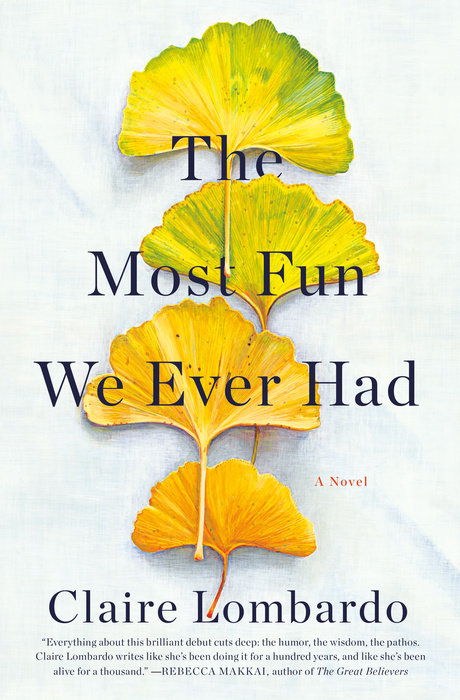
Spotlight: The Most Fun We Ever Had by Claire Lombardo

When Marilyn Connolly and David Sorenson fall in love in the 1970s, they are blithely ignorant of all that’s to come. By 2016, their four radically different daughters are each in a state of unrest: Wendy, widowed young, soothes herself with booze and younger men; Violet, a litigator-turned-stay-at-home-mom, battles anxiety and self-doubt when the darkest part of her past resurfaces; Liza, a neurotic and newly tenured professor, finds herself pregnant with a baby she’s not sure she wants by a man she’s not sure she loves; and Grace, the dawdling youngest daughter, begins living a lie that no one in her family even suspects. Above it all, the daughters share the lingering fear that they will never find a love quite like their parents’. 

As the novel moves through the tumultuous year following the arrival of Jonah Bendt–given up by one of the daughters in a closed adoption fifteen years before–we are shown the rich and varied tapestry of the Sorensons’ past: years marred by adolescence, infidelity, and resentment, but also the transcendent moments of joy that make everything else worthwhile.

Spanning nearly half a century, and set against the quintessential American backdrop of Chicago and its prospering suburbs, Lombardo’s debut explores the triumphs and burdens of love, the fraught tethers of parenthood and sisterhood, and the baffling mixture of affection, abhorrence, resistance, and submission we feel for those closest to us. In painting this luminous portrait of a family’s becoming, Lombardo joins the ranks of writers such as Celeste Ng, Elizabeth Strout, and Jonathan Franzen as visionary chroniclers of our modern lives.

Excerpt

The Offspring

April 15, 2000
Sixteen years earlier

Other people overwhelmed her. Strange, perhaps, for a woman who’d added four beings to the universe of her own reluctant volition, but a fact nonetheless: Marilyn rued the inconvenient presence of bod­ies, bodies beyond her control, her understanding; bodies beyond her favor. She rued them now, from her shielded spot beneath the ginkgo tree, where she was hiding from her guests. She’d always had that knack for entertaining, but it drained her, fully, time and time again, decades of her father’s wealthy clients and her husband’s humorless colleagues; of her children’s temperamental friends; of her transitory neighbors and ever-shifting roster of customers. And yet, today: a hundred-odd near strangers in her backyard, humans in motion, staying in motion, formally clad; tipsy celebrants of the union of her eldest daughter, Wendy, people who were her responsibility for this evening, when she already had so much on her plate—not literally, for she’d neglected to take advantage of the farm-fresh menu spread over three extra-long card tables, but elementally—four girls for whose presences she was biologically and socially responsible, polka-dotting the lawn in their summer pastels. The fruits of her womb, implanted repeatedly by the sweetness of her husband, who was currently nowhere to be found. She’d fallen into motherhood without intent, producing a series of daughters with varying shades of hair and varying degrees of unease. She, Marilyn Sorenson, née Connolly—a resilient product of money and tragedy, from dubious socioemotional Irish-Catholic lineage but now, for all intents and purposes, as functional as they come: an admirably natural head of dirty-blond hair, marginally conversant in both literary criticism and the lives of her children, wearing a fitted forest green sheath that exposed the athletic curve of her calves and the freckled landscape of her shoulders. People kept referring to her with great drama as the mother of the bride, and she was trying to act the part, trying to pretend that she wasn’t focused almost exclusively on the well-being of her children, none of whom, that particular evening, seemed to be thriving.

Maybe normalcy skipped a generation, like baldness. Violet, her second-born, a striking brunette in silk chiffon, had uncharacteristi­cally reeked of booze since breakfast. Wendy was always cause for concern, despite seeming less beleaguered today, owing either to the fact that she’d just married a man who had bank accounts in the Cay­mans or to the fact that this man was, as she vocally professed, “the love of her life.” And Grace and Liza, nine years apart but both mal­adjusted, the former a shy, stunted soon-to‑be second-grader and the latter about to friendlessly finish her sophomore year of high school. How could you grow people inside your own body, sprout them from your own extant materials, and suddenly be unable to recognize them?

Normalcy: it bore a second look, sociologically speaking.

Gracie had found her beneath the ginkgo. Her youngest was almost seven, an insufferable age, aeons from leaving the household, still childish enough that she’d tried to slip into their bed in the mid­dle of the previous night, which wouldn’t have beenthatbig of a deal had her parents been clothed at the time. Anxiety did something to Marilyn, always had, drew her magnetically to the animal comfort of her husband.

“Sweetheart, why don’t you go find—” She hesitated. The only other children at the wedding were toddlers and she didn’t specifi­cally want to encourage Grace’s already-burgeoning antisocial love of dogs by suggesting that she go play with Goethe, but she wanted a moment to herself, just a few seconds to breathe in the cooling air of early evening. “Go find Daddy, love.”

“Ican’tfind him,” Grace said, the hint of a baby voice blunting her vowels.

“Well, look harder.” She bent to kiss her daughter’s hair. “I need a minute, Goose.”

*

Grace moved off. She’d already checked on Wendy. Already swung on the porch swing with Liza until her sister had been distracted by a boy wearing sneakers with his wedding suit; already convinced Violet to share four sips of champagne from her fancy glass flute. She was out of people to check on.

It was strange to have to share her parents with others this week­end, to have her sisters back around the house on Fair Oaks. Her father sometimes called her the “only only-child in the world who has three sisters.” She resented, slightly, her sisters homing in on her territory. She soothed herself as she always did, with the company of Goethe, curling up with him beneath the purple flower bushes and running her hand through his bristly fur, the part of his butt that looked like it had been permed.

*

Liza felt a little bad, seeing her younger sister finding solace in the dog while she herself was finding solace inside a stranger’s mouth, but the groomsman emanated a smoky vapor of whiskey and arugula and he was doing something with his fingers to the inside of her thigh that made her turn her head away, deciding that Grace could fend for herself, that it wasn’t possible to learn that skill too early.

“Tell me about you,” the groomsman said, his knuckles grazing the lacy insignificance of the thong she’d worn in the hopes of exactly such an occasion.

“What do you want to know?” she asked. It came out sounding kind of hostile. She’d never quite mastered being flirtatious.

“There’s four of you?” he asked. “What’s that like?”

“It’s a vast hormonal hellscape. A marathon of instability and hair products.”

He smiled, confused, and she leaned forward boldly and kissed him.

*

Violet had never been quite so drunk, sitting slumped, alone, at one of the tables, from which she supposed she’d driven the other guests. The previous night came to her in fizzy episodic sunbursts: the bar that used to be a bowling alley; her blue-eyed companion with his double-jointed elbows, the athletic clasp of his thighs, the back of his mother’s station wagon; how she’d made sounds she did not recog­nize at first as coming from her own throat, porn star sounds, primal groans. How he came first—she’d later felt him dripping out of her, when they climbed back into the front seat—and then made her, with a deft attention to detail, come as well, for the first time in her life. And how she’d made him drop her a block away from her parents’ house lest Wendy be still awake.

She watched Wendy, wearing sweetheart-neck Gucci at her back­yard wedding to an old-money academic, being spun in circles by her new husband to “You Can’t Hurry Love.” Her sister had, for the first time, surpassed her, success-wise. She was blithe and beautiful and twirling in circles while Violet was drunk past the point of physical comfort, gnawing at a full loaf of catered focaccia, rubbing the oil on the underside of her skirt. But she felt herself smiling a little at Wendy, at oblivious Wendy getting grass stains on her satin train. Imagined going over to her sister and whispering in her ear,You’d die if you knew where I was last night.

*

Wendy watched as Miles, throwing an apologetic smile at her over his shoulder, was pulled away from her by his toddler cousin, their ringbearer, who had solicited his accompaniment to the cake table.

“There’s some good daddy training happening over there,” some­one said, taking her by the elbow. It was a guest from Miles’s side, possibly someone’s real estate broker, a silicone goblin of a woman. The people on the lawn at present were probably collectively worth more than the GDP of a midsize country. “It’s good you’re so young. Plenty of time to flesh out the family tree.”

It seemed a crass thing to say for a variety of reasons, so Wendy responded in kind: “Who says I want to split up my share among a bunch of kids?”

The woman looked horrified, but Wendy and Miles lived for these jokes, were allowed tomakethese jokes because neither of them gave a fuck if people thought Wendy was a gold digger; all that mattered was what they knew to be true, which was that she’d never loved another person as fiercely as she did Miles Eisenberg, and he, by some grand cosmic miracle, loved her back. She was anEisenbergnow. In the top thirty, at least, of the wealthiest families in Chicago. She could fuck with whomever she wanted.

“It’s my plan to outlive everyone and spend my days reveling in a disgusting level of opulence,” she said. And she rose from her seat and went to straighten her new husband’s tie.

*

The trees, David noted, were at burgeoning that day, big prodigious leaves making dancing shadows across the grass, which they’d tried to keep the dog off of for the sake of aesthetic preservation, David and Marilyn rising early in the mornings and pulling on raincoats over their pajamas to walk him instead of just opening the back door like they normally did. David watched as the rented tables and chairs wore their grooves into the pristine lawn, legs melon-balling the expensively fertilized sod in a way that made his gut churn. Goethe was now roaming around the yard like a recently released convict, traversing the verdant grounds with the proprietary confidence of a horticulturist. David took a breath of damp air—was rain coming? It might make the guests leave sooner—and marveled over the sheer number of people that could accumulate in a lifetime, the number of faces in his yard that he didn’t recognize. He thought of Wendy as a toddler, when they lived in Iowa, creeping onto the porch where he and Marilyn rocked together in the rickety cedar swing, fitting herself neatly between them and murmuring, already drifting back to sleep,You’re my friends.He was nearly overcome, standing there, feel­ing as out-of-place as he had a quarter of a century ago, before they’d married, a chilly December night when Marilyn had lain against his chest beneath the ginkgo. He did a visual sweep, eyes blurring the sea of pale spring colors until he found his wife, a tiny ballast of forest green: hiding beneath that very same ginkgo. He slipped along the fence until he came to her, and reached out an imploring hand to the small of her back. She leaned instinctively into it.

“Come with me,” he said, and led her around the trunk, into the shade, where he pulled her to him and buried his face in her hair.

“Sweetheart,” she said, worried. “What is it?”

He pressed his face into the crook of her neck, breathing in the faint dry warmth of her scent, lilacs and Irish Spring. “I missed you,” he said into her clavicle.

“Oh, love.” She tightened her embrace, tilted his chin until he met her eyes. He kissed her mouth, and then her cheekbone and her forehead and the inlet of her jaw where he could feel her pulse, and then her mouth again. She was smiling, lips a flushed feverish plum, and then she was kissing him back, the periphery blurring away. The thing that would always mean more than everything else: the goldish warmth of his wife, the heat of their mutual desperation; two bodies finding solace in the only way they knew how, through the language of lips, his hands along her spine, her spine against the tree trunk, the resultant quiet that occurred when they came together, until she pulled away, smiled up at him and said, “Just don’t let the girls catch us,” before she buried herself once again against him.

*

But of course they saw. All four of the girls watched their parents from disparate vantage points across the lawn, each alerted initially to their absence from the reception by that pull, a vestigial holdover from childhood, seeking the cognitive comfort that came from the knowing, the geolocation, the proximity of those who’d created you, those who would always feel beholden to you, no matter what; each of their four daughters paused what she was doing in order to watch them, the shining unfathomable orb of their parents, two people who emanated more love than it seemed like the universe would sanction.

Excerpted from The Most Fun We Ever Hadby Claire Lombardo. Copyright © 2019 by Claire Lombardo. All rights reserved. No part of this excerpt may be reproduced or reprinted without permission in writing from the publisher.

Buy on Amazon | Barnes and Noble | Audible

About the Author

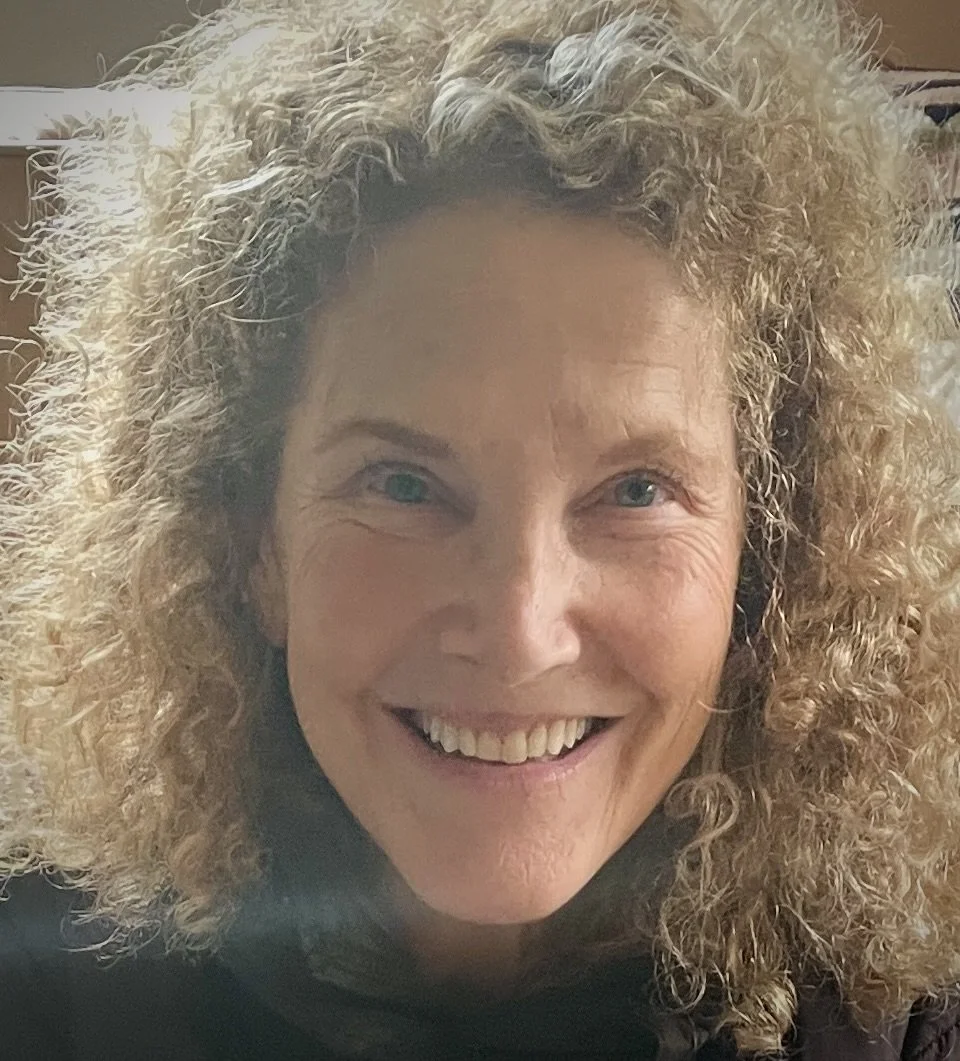
CLAIRE LOMBARDO earned her MFA in fiction at the Iowa Writers’ Workshop. She was born and raised in Oak Park, Illinois. A former social worker, she now teaches fiction writing and is at work on a second novel.

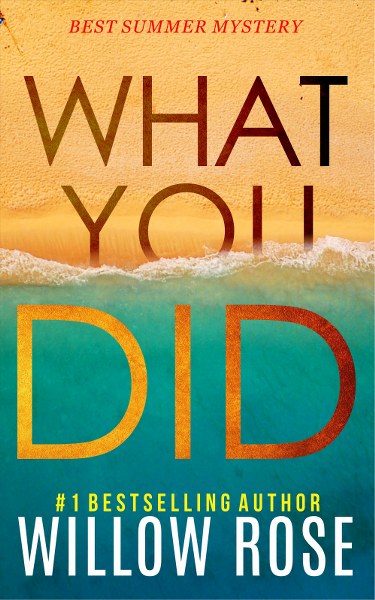
Spotlight: What You Did by Willow Rose


What You Did
Eva Rae Thomas Mystery Book 2
by Willow Rose
Genre: Thriller, Suspense

Former FBI-profiler, Eva Rae Thomas, faces the most personal case in her career, as bestselling author Willow Rose’s new hit series continues.

Three girls disappear on prom night at the local high school. One of them is the prom queen.
FBI profiler Eva Rae Thomas is chasing her long-lost sister when detective—and boyfriend—Matt Miller asks her to join the investigation of the three girls’ disappearance. They were last seen walking home together after the dance.
When the body of a young girl shows up in her backyard, Eva Rae knows she can no longer watch from the sidelines, and soon she realizes not only is she involved in this investigation, she’s also this killer’s target.
WHAT YOU DID is the second book in the Eva Rae Thomas Mystery Series and can be read as a standalone.


**Only 99 cents!!**


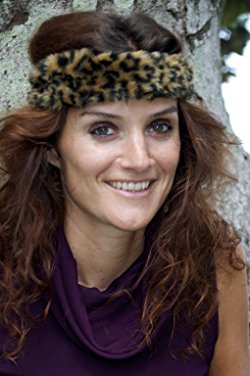
The Queen of Scream aka Willow Rose is a #1 Amazon Best-selling Author and an Amazon ALL-star Author of more than 60 novels.

She writes Mystery, Thriller, Paranormal, Romance, Suspense, Horror, Supernatural thrillers, and Fantasy.

Willow's books are fast-paced, nail-biting pageturners with twists you won't see coming. Several of her books have reached the Kindle top 10 of ALL books in the US, UK, and Canada. She has sold more than three million books.

Willow lives on Florida's Space Coast with her husband and two daughters. When she is not writing or reading, you will find her surfing and watch the dolphins play in the waves of the Atlantic Ocean.


Follow the tour HERE for exclusive content and a giveaway!


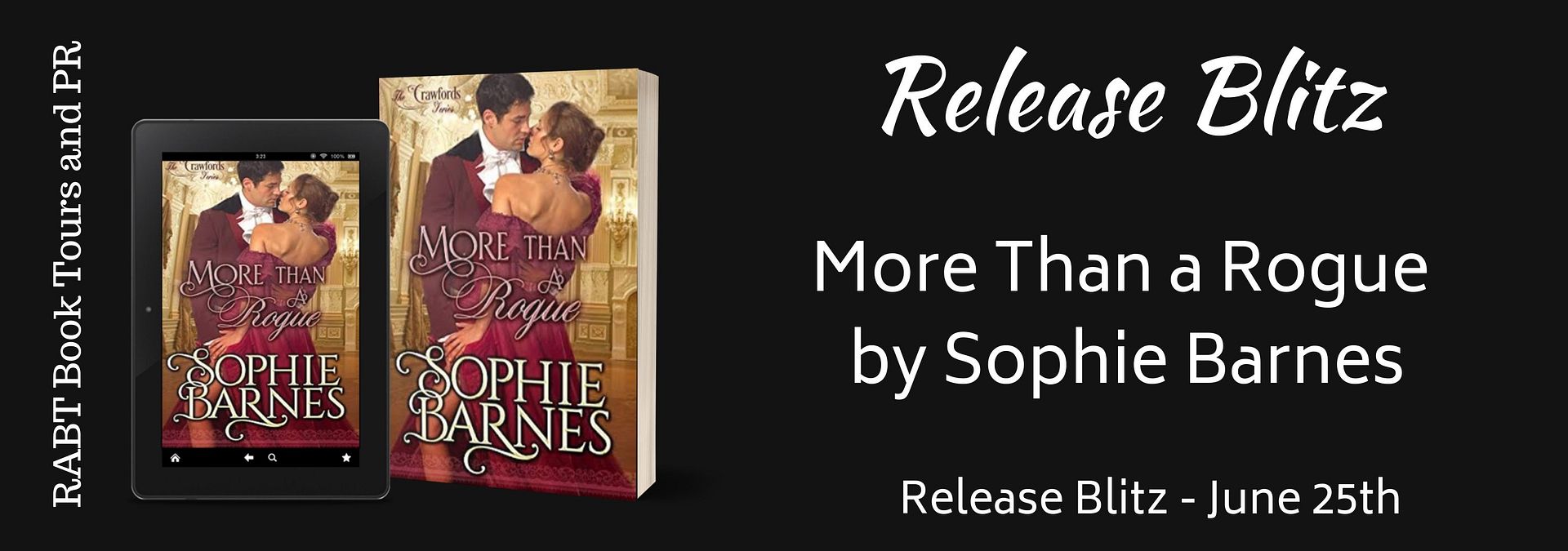
Spotlight: More Than a Rogue by Sophie Barnes


 photo More Than A Rogue_zpsfncgwphb.jpg
 The Crawfords, Book 2
 Historical Romance
 Release Date: June 25, 2019

 photo add-to-goodreads-button_zpsc7b3c634.png

All she wanted was a kiss…

What she got, was fiery passion…

Emily Howard knows she is destined to be a spinster. She has accepted this fate, but that doesn't stop her from wanting to experience kissing. What she doesn't expect, is for Griffin Crawford, the handsomest man in the world, to do the honors. Or for all her female relations to discover her in his embrace. Naturally, marriage is instantly mentioned, but since Emily knows this is not what Griffin wants, she tries to escape him, her family and the ensuing scandal.

When Emily flees the Camberly ball in the wake of their kiss, Griffin goes in pursuit. He will not allow his sister-in-law's determined friend to risk her safety for any reason. And risk it she will if she means to return to her countryside home by herself. But the longer he remains in her company, the more he is tempted to kiss her again. If only he could risk falling in love and remain in England forever.



Other Books in The Crawfords Series:


 photo No Ordinary Duke Book One_zps2h99zdyh.jpg
No Ordinary Duke
The Crawfords, Book 1
Release Date: August 2018


He’s everything she’s trying to avoid…But somehow precisely what she needs…

Caleb Crawford doesn’t want to be a duke. He’d much rather build houses for a living. So when fate disrupts his peaceful life and burdens him with the responsibilities of a newly inherited title, he does what any sensible man would do by fleeing London, disguising himself as a laborer, and seeking refuge with three young spinsters who need his help with a leaky roof.

Ruined by a marquess who promised her the world, Mary Clemens has sworn to avoid marriage forever. Instead, she intends to live out her days with her friends and the orphaned children they’ve taken into their care. But when Mr. Crawford comes knocking, Mary finds herself in real danger of risking heartbreak all over again. Especially when she discovers that he’s not at all what he seems.


About the Author

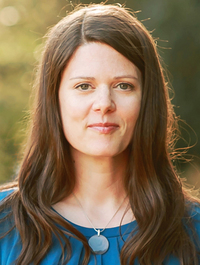
 photo More Than A Rogue Author Sophie Barnes_zpsf43ajvw5.jpg
Born in Denmark, Sophie has spent her youth traveling with her parents to wonderful places all around the world and has lived in five different countries on three different continents.

She has studied design in Paris and New York and has a bachelor's degree from Parson's School of design, but most impressive of all - she's been married to the same man three times, in three different countries and in three different dresses.

While living in Africa, Sophie turned to her lifelong passion - writing.

When she's not busy, dreaming up her next romance novel, Sophie enjoys spending time with her family, swimming, cooking, gardening, watching romantic comedies and, of course, reading. She currently lives on the East Coast.


Contact Links

Website  
Twitter  


Purchase Links

B&N 
Kobo 
iBooks  

RABT Book Tours & PR

Spotlight: Love at Lakewood Med by T.J. Amberson

Love at Lakewood Med
T.J. Amberson
Publication date: June 9th 2019
Genres: Adult, Comedy, Contemporary, Romance

Savannah Drake would be thrilled about starting her final year of medical school if it weren’t for one thing: she has to spend a month working in the emergency room with cold, aloof Dr. Wesley Kent as her mentor. When her first day in the ER proves to be a humiliating disaster, Savannah is ready to swear off emergency medicine forever. Gradually, though, she finds that the unpredictable, emotional experience of caring for patients in the emergency room is affecting her far differently than she expected – and Dr. Kent turns out to be anything but the arrogant attending physician that she assumed him to be. But just when Savannah finally admits to herself that she is falling for Dr. Kent, she learns that things at the hospital are not all what they seem. Faced with a seemingly impossible choice, Savannah must decide between her future career and everything that she has come to care so much about.

Goodreads / Amazon

EXCERPT:

“Do you know what you just did?” Doctor Kent puts his eyes on mine.

I stare back at him, my body going cold. I screwed up somehow. That baby might die because of me. I may—

“You ran that resuscitation as well as, or better than, any resident in this hospital would have.” Doctor Kent’s gaze drifts toward Room Fourteen. “Most physicians—even experienced ones—would have understandably panicked around a sick newborn. You didn’t.”

I follow his gaze to the now-vacant room, and remain quiet, letting his words soak in. Once I gather my thoughts, I debate for a second or two before I get up the courage to admit to him:

“This sounds stupid, but I was so focused during that whole encounter that I almost didn’t realize what I was doing while it was happening. It was like I had an invisible shield around me, blocking out distraction and not letting my emotions affect me. Only after the baby was gone did I start feeling it all.”

Doctor Kent doesn’t reply. I blush and reluctantly turn to him again, feeling ridiculous. But Doctor Kent isn’t about to laugh at me. Instead, he has his eyes fixed even more intensely on mine.

“Welcome to emergency medicine,” he says.

I catch my breath as something powerful stirs within me. There’s a moment of unspoken communication between Doctor Kent and me, and then I glance around Fast Track once more. I think that I understand it all a little better now.

Author Bio:

TJ Amberson hails from the Pacific Northwest. With a love of writing in several genres, TJ strives to provide well-written, age-appropriate, & original novels for tweens, teens, and new adults.

Website / Goodreads / Facebook


GIVEAWAY!
a Rafflecopter giveaway

XBTBanner1