Spotlight: The Fall of the Readers by Django Wexler
/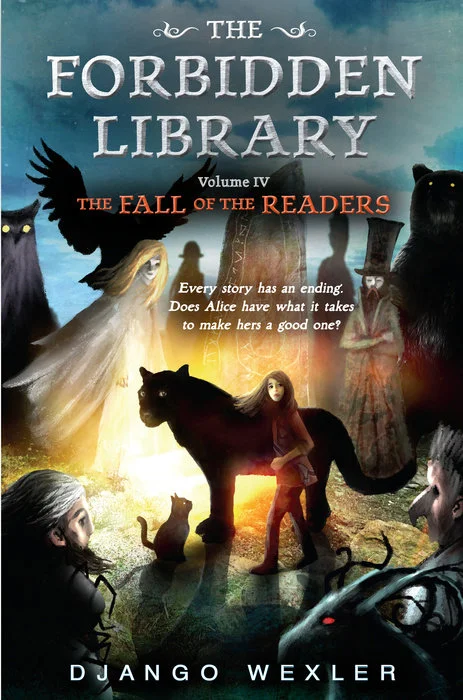
In this thrilling conclusion to Alice’s adventures in The Forbidden Library she must lead her band of friends, magical beings, and creatures against the collected might of the Old Readers—perfect for fans of Story Thieves, Inkheart, Coraline, and Harry Potter.
When Alice defeated her uncle Geryon and declared war on the totalitarian ways of the Old Readers, she knew she would have a hard fight ahead. What she didn’t anticipate was the ruthlessness of the Old Reader—who can control magic and enter worlds through books. All the creatures she promised to liberate and protect are being threatened, and slowly all of Alice’s defenses are being worn away. So when Ending (the giant cat-like creature who guards the magical labyrinth in Geryon’s library) hints at a dangerous final solution, Alice jumps at the chance, no matter the cost to her life. She and her friends—a fire sprite, Ashes the cat, and the other apprentice Readers she met during her previous adventures—go on a quest to free the one creature possibly strong enough to overturn the Old Readers once and for all.
But before it’s all over, Alice will be betrayed, her true identity will be revealed, and she’ll have to be willing to give up the person she loves the most.
This is beautifully written, classic, bold historical fantasy—brave, bloody, action-packed and adventurous—with a girl at the center.
Excerpt
CHAPTER ONE: MIDNIGHT SNACK
In the darkness behind the mirror, something stirred.
It was an eye, cat-slitted and silver. Though it hung alone in the emptiness, Alice knew it was enormous, as big across as she was tall. It focused on her, the great pupil narrowing, and in its gaze she felt something inscrutable and alien.
And yet she felt no fear. Instead, staring back into the abyss, she felt . . . warmth. Kindness. Love.
A voice in her mind, strange and familiar all at once.
Alice.
She sat bolt upright in bed, sheets tangled around her feet. Her cheeks were slick with sweat, and her heart pounded.
She was in the room that her master Geryon had given her when she’d first arrived on his estate, a dingy third-floor bedroom fit for a servant. It felt like home, now, if anywhere did. She knew every crack of the peeling paint, the smell of old wood and freshly laundered sheets, and the endless creaks and groans of the ancient building. Two stuffed rabbits, all that she’d been allowed to carry away from her father’s old house, sat on the windowsill like sentinels.
She didn’t have to stay in this room if she didn’t want to. Geryon was right where Alice had put him—bound inside The Infinite Prison, lost in an endless sea of mirror images. There was no one to tell Alice where to sleep, where to go, what to do. It should have been freeing, but she felt more hemmed in than ever. Instead of Geryon’s orders restraining her, now an iron cage of responsibility squeezed her ever more tightly.
There was no chance of getting back to sleep. Alice waited until her heart slowed, then swung out of bed and stretched her aching legs. A surprisingly loud growl from her stomach reminded her that she’d missed dinner, again.
If I’m going to be awake, I might as well get something to eat. It was still hours before dawn, but in Geryon’s house the kitchen never closed. Alice shuffled into her slippers and opened the door to her room, carefully.
The house, which had felt empty for so long, now had several dozen inhabitants. The rooms immediately around hers were taken by the other apprentices, the friends who’d thrown in their lot with her after facing the Ouroborean. She passed their doors quietly: Isaac, her oldest friend, who’d once stolen the Dragon’s book for his master. Dex, inveterate optimist, who’d fought beside her in Esau’s fortress. Jen and Michael, younger than Alice, devoted to each other, the former fierce and the latter cautious.
Down the corridors were others, magical creatures from Geryon’s library who’d begged her for shelter. As the labyrinthine Ending, the library’s guardian, fought back the attacks of the old Readers, the once-peaceful library had become a war zone. Some of the inhabitants had retreated to their books, but many creatures in the library didn’t have that option because their own worlds had become hostile, and had nowhere else to go. These refugees—sprites, the mushroom-people called Enoki, and stranger things—had taken up residence in the empty bedrooms of Geryon’s manor house.
The kitchen was built on the same massive scale as the rest of the house, with acres of long wooden tables and ovens big enough to roast an ox. It was normally empty, since all the work was done by efficient, invisible servants who moved only when you turned your back. Tonight, though, Alice wasn’t the only nocturnal visitor. Isaac sat at one of the long tables, in front of a jug of milk and a plate piled high with pastries.
“Knock-knock,” Alice said, coming through the open doorway. Isaac looked up with exactly the guilty expression she’d pictured, which made her grin.
“Oh,” he said. “It’s you.”
“Who were you expecting?”
“I honestly don’t know.” Isaac sighed. “Half the time I still wake up expecting to find my master—my former master looking down at me.”
Alice’s grin faded. He looked tired and pale, worn out, the same things she saw in her own face when she looked in the mirror. Wearing only a nightshirt and trousers, without his voluminous trench coat, he seemed smaller than usual, more vulnerable. His brown hair was growing out, flopping in unruly curls down the back of his neck.
“Are you going to eat all of those,” she said, “or can you spare a few?”
“Please.” He pushed the plate toward her. “I can’t seem to get this place to understand that I just want a snack.”
Alice sat beside him. Another cup had appeared on the table the moment she looked away, and a fresh jug of ice-cold milk. She poured, and took a pastry. They were flaky and warm, filled with raspberry jam.
If Geryon had died, all of this—everything that made the house work, the hidden creatures who fixed the food and did the laundry—would have ground to a halt, like a watch with its mainspring removed. She’d seen that in Esau’s fortress, the gradual unraveling of a Reader’s domain after their power vanished. By trapping her old master alive, she’d kept the house running. She’d also hoped to conceal what had happened from the other old Readers.
That part, unfortunately, hadn’t worked.
“You look like you’ve had a long day,” Alice said as Isaac drained his cup and reached for another pastry.
“You might say that.” Isaac yawned. “Michael and I were working with the swamp sprites on our plan to evacuate the house in an emergency.”
“It’s not going well?”
“They don’t seem to be able to grasp the concept of moving in a straight line,” Isaac said. “And they kept turning the ground underneath me to mud, which isn’t as funny the fourth or fifth time.”
Alice winced. “Sorry.”
“I thought they were getting it by the end,” Isaac said, staring at the pastry. “But I just . . . I don’t know.”
“What is it?”
“Is it really going to make a difference?” He looked pained, as though the words were a betrayal. “It’s all well and good to make plans to keep people safe, but in the end what is it going to actually accomplish? It won’t keep the old Readers from coming to squash us flat. It won’t—” He broke off, shaking his head, and looked up at Alice. “I’m sorry. I’m just tired.”
Alice’s stomach churned. The problem, of course, was that Isaac was right.
A month ago, she’d trapped Geryon in The Infinite Prison, hoping the old Readers wouldn’t find out. But they had. Alarmed, they had unleashed the Ouroborean, an ancient weapon, in an attempt to destroy her. With the help of her friends, she’d defeated it, and afterward, she’d told the apprentices and magical creatures that she intended to stand up to the old Readers, to pull down their whole poisonous order once and for all. Only days later, the attacks had begun. The other labyrinthine forced open some portals into the library to bring the creatures of the old Readers through.
Since then, defending against these attacks had occupied all of Alice’s attention. The refugees from the library had to be protected, and she’d organized them to help as much they were able. Ending did her best, but the other labyrinthine assaulted her constantly, and she had to conserve her strength. The task of hunting down attackers —beast-like monsters, for the most part, driven into a rage by cruel magic—fell to Alice and her friends. She’d worked hard to make sure everyone knew what to do when an assault came, and so far they’d had only a few injuries among the library creatures.
But it couldn’t last. It’s not like the old Readers are going to run out of monsters. They would keep coming until Ending’s strength failed, and something really nasty managed to get through, or until Alice and her little squad of defenders were worn down and tired out. We’re not going to win.
She’d hoped . . . I hoped for a lot of things. More time, first and foremost. There has to be a way to take the fight to them, but it’s no good if we can barely protect ourselves.
Some of her thoughts must have shown on her face, because Isaac put his hand on the table between them, stretching toward her.
“Hey,” he said. “It’ll be okay. We’re holding our own.”
Alice put her hand on his, and their fingers interlocked. She made herself smile. “I know.”
“I didn’t mean to complain,” Isaac said. “It’s—”
There was a thump from the doorway. They both looked up, and Alice’s mental grasp automatically went to the threads of magic at the back of her mind, which linked her to her bound creatures. The Swarm for toughness, Spike for strength, and—
“Soranna!” she said, letting the power slip away.
The girl was leaning heavily on the door frame. When she pushed away from it and took a stumbling step forward, Alice could see she was filthy, her rough clothes caked with dirt and sweat. A bandage was wound around her thigh, and one side of her shirt was brown and crusty with dried blood.
Alice was vaulting the table before she knew it, sweeping past the stunned Isaac and hurrying to the girl’s side. As Alice took hold of her arm, all the strength seemed to go out of Soranna. Alice half carried her to one of the benches, and Soranna leaned back against the table, eyes closed and breathing hard.
Soranna was another of the apprentices who’d been with Alice in Esau’s fortress and the fight against his labyrinthine, Torment. Alice hadn’t seen her since—she hadn’t been among the group that had come after Geryon’s imprisonment, and Alice hadn’t figured out how to contact her. Now she was here, and hurt badly.
“Soranna, what happened?”
“I’ll get . . . someone,” Isaac said, lurching to his feet.
“Dex,” Alice said. “No, get Magda the bone witch, if you can find her.”
“Got it.” Isaac looked relieved to be given a task. Before he could leave, though, Soranna opened her eyes.
“They’re coming,” she said, her voice a croak. “Have to . . . tell Alice.”
“I’m here,” Alice said. “Who’s coming?”
Soranna blinked and turned to look at her, a smile spreading across her face. She coughed, and winced as if in pain.
“Sunhawks,” she said. “My master . . . sent. Sunhawks.”
“Ending would have called us if something got into the labyrinth—” Alice began.
“No!” Soranna grabbed the collar of her shirt. “Not through the labyrinth. They’re coming through thereal world. Take you . . . by surprise . . .”
Her eyes rolled up in her head, and she slumped back. Alice hastily checked her breathing and found it steady.
“They can’t send monsters through the real world,” Isaac said.
“Why not?” Alice said, looking down at Soranna.
“The humans would see them,” Isaac said. “It’s the oldest rule of the Readers, not to draw attention.”
“I think the Readers have thrown away the rulebook,” Alice said. “Go find Magda, and then sound the alarm. We need to get everyone into the library.”
“But—”
Alice looked through the window to the back garden. Above the brooding bulk of the library and the dense mass of trees that surrounded it, the night sky was a field of stars streaked with irregular clouds. But underneath those clouds, moving fast, were two points of bright orange light.
“Now, Isaac!” Alice shouted, and he ran.
CHAPTER TWO: EVACUATION
Deep in the house, a gong began to sound. It might once have been used to call the residents of the house to dinner. Now it served to raise the alarm, rousing all the creatures who’d taken shelter.
It was time. The plan was the same one Michael and Isaac had been practicing with the swamp sprites: Get everyone to the library. They’d rehearsed it a couple of times, or tried to. The idea of training was foreign to the sprites and the Enoki, while Lool, the clockwork spider, had insisted on computing the best route instead of actually following the group.
Alice was miserably aware that even their best performance had taken fifteen or twenty minutes to get everyone out of danger. Given how fast the sunhawks were moving, they might not even have ten. She could hear clattering footsteps and muffled voices upstairs. Soranna still slumped on the bench, unconscious, and Alice wavered, wanting to direct the evacuation but not willing to leave her friend hurt and alone.
Fortunately, at that moment there was a hollow clatter in the doorway, and Magda the bone witch arrived. She was a large woman, covered head to toe in bones: She wore them around her neck, woven into the elaborate bun of her hair, and threaded onto wires as a long, trailing cloak. They clicked and rattled continuously as she moved. Since Alice had declared war on the old Readers, Magda had been one of her most dedicated supporters, and her impressive presence had done a great deal to keep the other creatures in line.
More importantly, for the moment, she was close enough to human to know something about medicine. Alice beckoned her over, and Magda’s breath caught at the sight of Soranna.
“By Ushbar!” she said. “Isaac said you needed help. She’s had a hard time.”
“Something’s coming,” Alice said, gesturing to the window. “I need to be out there. Please take her to the library and do what you can for her?”
Magda nodded and clapped her hands together, like a teacher calling a class to attention. The bones on her cloak shivered, then rose up with a tremendous rattle, long strings of them stretching out like multi-jointed limbs. Hands unfolded at the ends, bony fingers opening to slip under Soranna with surprising gentleness.
“I’ve got her,” Magda said. “Go! They need your help. Send old man Coryptus to me if you can.”
Alice nodded and raced from the kitchen. In the main hall, creatures of all kinds were already heading to the back door, where Isaac was waiting to hurry them across the lawn toward the library. Several different varieties of sprites, elfin humanoids with eyes and hair in a rainbow of colors, were pushing and shoving at the base of the stairs, while a clutch of wide-eyed Enoki children were backed up behind them.
“That’s enough!” Alice shouted, wading into the fray.
She wrapped herself in Spike’s thread for strength, picking up the sprites and forcing them apart where she had to. Mostly they separated themselves at the sight of her. There was awe in their eyes, and they rushed to obey when she directed them to the exit.
“Thank you,” said one of the Enoki women. Like all her kind, she looked mostly human, except for the mushrooms that grew up from her hair, back, and shoulders. The fungi came in as many varieties as human hair or skin color, and this one was a pretty red with white spots.
“I thought they would never move,” the woman went on. “Do you know what’s happening? Is it safe to go outside?”
Alice sighed inwardly. The mushroom people were friendly, but timid to a fault, refusing to fight or even argue.
“You’ll be safe once you get to the library,” Alice said. “Hurry!”
The younger women nodded and began herding their charges out. Another trio of sprites came down the stairs, swamp sprites whose muddy forms made a mess of the carpet, followed by the harpy girl Ephraster and her two young siblings. Alice waved them past, then charged up the stairs while they were clear for a moment.
At the top, she met Coryptus, a bent-backed old man who walked with a cane and was practically covered in luxuriant purple mushrooms.
“What are you waiting for?” Alice said.
“Just making sure nobody gets left behind,” he said in a voice like a badly greased hinge. “Got to see to the little ones.”
Alice nodded. “When you get to the library, find Magda. One of the apprentices is hurt, and she asked for your help.”
“Nosy old biddy.” Coryptus sniffed. “Well, if she asked, I suppose I might be willing.”
Alice didn’t have time for their rivalry. She ran up the stairs, while a few more creatures ran, slid, or flew past her before she got close to her own room. The other three apprentices were waiting, ushering the last of their charges toward the stairs.
Dex—a little older than Alice, and tall with dark skin and frizzy hair that she tied back into a messy tail—was grinning broadly, in spite of the panic all around. As far as Alice could tell, Dex was utterly fearless, a trait that occasionally got her into serious trouble.
Michael and Jen—who had served their master as a team and remained inseparable even after turning against him— made a good pair; Jen was ragged and wild, prone to rage, while Michael was prim and careful, with round metal glasses that made him look a bit like an owl.
“Sister Alice!” Dex said. “We heard the alarm. Has something escaped the library?”
Alice shook her head. “They’re coming overland, not through the portals. Is everyone off this floor?”
Michael nodded. “One hundred three, I counted.”
“It’s going to be a pain sorting them all out again when this is over,” Jen griped.
“We can worry about that later,” Alice said. “You two go help Isaac get them into the library. I’m going to get a better look at what we’re up against.” She grimaced. “Find Emma too, and bring her with you.” The servant girl would stand by calmly as the house burned down, if no one ordered her to do otherwise.
“I will accompany you,” Dex said. “To the balcony?”
Alice nodded. Michael was already headed downstairs, and Jen followed. It was gratifying, in a way, that even the most headstrong of the apprentices was willing to follow Alice’s orders. I just wish I knew the right orders to give.
She and Dex ran to the end of the hall, where a pair of double doors opened onto a seldom-used balcony facing the back garden and the library. The latch squealed as Alice tugged on it. With Spike’s strength, the rusty hinges moved with a reluctant groan, revealing a few feet of water-stained tile rimmed by a dangerously rotten wooden railing.
Down below, a multicolored throng was streaming across the lawn. Alice saw Lool, the clockwork spider, her eight brass legs working like pistons and letting off frantic bursts of steam. Sprites, Enoki, and stranger creatures hurried across the grass.
The two sunhawks were much larger now. She could see that they were bird-like—broad-winged and hook-beaked—with feathers ranging from pale yellow to dark red, covering them in rippling patterns that looked like flames. Their eyes glowed like the sun, and they were huge, the size of an elephant, each easily big enough to grab a human in its beak.
One of them dove, wings folded tight, plummeting in silence toward the caravan of creatures on the lawn. Isaac was there, waving the line forward, and he hadn’t looked up. Alice gripped the railing and screamed a warning.
Isaac spun and saw the danger just as the sunhawk leveled out of its dive. The light from its eyes flared to unbearable intensity and slashed out toward the ground, twin crackling beams of orange that traced a path through the surrounding forest toward the lawn. Everything they touched burst into flame as though it had been doused in gasoline, leaving a trail of trees blazing like torches. The line of destruction broke out onto the lawn, angling toward Isaac.
Isaac stood his ground, even as the creatures behind him started to panic and flee. He brought his hand up and summoned a wall of swirling white snow out of thin air, which solidified rapidly into a frozen barrier. The flames met Isaac’s sheet of ice in a tremendous cloud of steam. When it cleared, Isaac and the fleeing creatures behind him were unharmed, the path of devastation continuing some distance beyond them and into the forest on the other side of the lawn.
“Sister Alice!” Dex said. “They’ve seen us!”
The second sunhawk dipped one wing, changing its angle, then went into a dive like the first. Lances of burning energy slashed from its eyes, cutting across the forest and aiming straight for the house. Grass exploded upward in great gouts of flame and flying earth.
Nowhere to dodge up here. Alice grabbed Dex around the waist, concentrated Spike’s power, and jumped. With the dinosaur’s strength in her legs, she cleared the railing easily, describing a lazy arc toward the still-steaming turf where Isaac stood. Before impact, Alice wrapped herself in the Swarm thread, which lent her flesh a tough, rubbery quality that made her very hard to hurt. The combined strength and durability let her absorb the landing with a crouch. Dex, under her arm, gave a delighted laugh.
Behind her there was a splintering crash and a roar of flame. The energy beams raked across the house, searing a dark track up one wall and along the shingles of the roof. The building was mostly stone, but small fires had started here and there.
“Are you all right, Isaac?” Alice asked, while she set Dex back on her feet. “That was good thinking.”
“Thanks,” Isaac said. His face was pale, and he looked a little shaky. “I wasn’t sure it was going to work.”
Alice eyed the sunhawks, which were beating their wings hard over the forest to gain altitude for another dive. “Any chance you can do it again?”
Isaac blew out a breath. “Maybe once more, but I’m not going to be good for much else. It takes a lot of power.”
Alice nodded. “Better get everyone into the library, then. They’re not going to be able to burn that.” In addition to whatever magical protections Geryon had provided, the library was a stone fortress of a building with only a single small door.
Isaac took a deep breath and ran across the blasted turf, pursuing a pack of panicky sprites who’d broken away from the line. Michael and Jen were still by the house, trying to convince a cowering group of Enoki to make the run across open ground to the safety of the library.
“There’s still too many in the open,” Alice said. “We’re going to have to draw the sunhawks after us.”
“I agree,” Dex said. Alice felt her tugging on her threads, and she was suddenly wrapped head to toe in silver armor, the power of the creature she called the caryatid. “How shall we get their attention?”
CHAPTER THREE: SUNHAWK DOWN
Alice stood on the library lawn, a five-foot spear in one hand, and stared up at the giant bird diving toward her faster than a freight locomotive. This may not be the best plan I’ve ever come up with . . .
The spear was made of what Dex called moon-stuff, the product of one of her creatures. She could shape it into simple objects, and it was marvelously light and practically indestructible. With Spike’s strength behind her, Alice figured she could throw the thing quite a long way. Whether it would be far enough, she had no idea.
The light from the sunhawk’s eyes, crackling and snapping like fireworks, turned the lawn into a morass of torn grass and flash-baked mud as it sliced toward the hurrying mob of creatures. The sunhawk was still several hundred feet off the ground, but Alice thought this was the best chance she was going to get. She pushed off, sprinting in huge, bounding steps, bringing the spear forward as hard as her magical strength could drive it. The silvery weapon left her hand at a fantastic speed, screaming through the air in a high, fast arc.
Too high, Alice saw, a pit opening in her stomach. The spear peaked above and behind the enormous bird before falling toward the forest. It got the sunhawk’s attention, however, and the creature swung around, beams of fire slashing toward Alice. Which means this worked, sort of.
She wrapped the Swarm thread tightly around herself, and her body dissolved into a mass of furry black balls, each with two legs and a long, thin beak. It took a moment to adjust to her new point of view, seeing out of a hundred pairs of eyes two inches off the ground. But Alice’s control had improved enormously since her first tentative experiments, and it was no trouble at all for her to spread the swarmers out like an expanding starburst, depriving the sunhawk of its intended target.
The sunhawk’s fire washed over where she’d been standing, and she felt a sharp burst of pain as several of the little creatures that made up her body were incinerated. I was right not to stand my ground. The sunhawks were fast, and the swarmers’ toughness offered little protection. She brought her myriad bodies back together, re-forming into human shape beside Dex and Isaac.
“Ow.” She put her hand to her side. Damage to her transformed self didn’t leave wounds, but it took its toll in energy and pain. “That didn’t work.” And she was in her bare feet, as usual. Her shoes had probably just gone up in smoke.
“You kept it away from the others,” Dex said as the sunhawk glided back out over the forest and began flapping upward again.
“And I think you made the other one angry,” Isaac said. “Here it comes!”
The second bird stooped in, ignoring the fleeing sprites and Enoki and coming straight for Alice. Isaac raised his hand, and once again snow fountained out of the ground, forming itself into a semi-circular shield around the three of them. The fiery rays sizzled across it, then passed overhead and on toward the house, where crackling explosions marked their progress. The snow burst outward into wisps and steam, and Isaac groaned and dropped to one knee.
“I’m fine!” he said as Alice bent beside him. “Just . . . used up.” He gasped for breath. “Sorry.”
Alice found her hands clenched in frustration as she watched the second sunhawk positioning itself for another attack. “We can’t get up to them! Dex, do you have anything that can fly?”
Dex shook her armored head. “Sister Jennifer has a bird of prey, I believe, but it may not be large enough to harm these creatures.”
Jen’s hawk! Alice had almost forgotten. She hadn’t seen the girl fight much, but she’d summoned a large bird when they’d gone up against the Ouroborean. The sunhawks were a lot larger. But maybe . . .
“Dex, can you make a net out of moon-stuff?”
Dex clapped her hands. “Brilliant as always, Sister Alice! I can. But it will take some time.”
“Do it. I’ll find a way to distract them.”
Alice sprinted toward the house, where Jen and Michael had finally coaxed the last of the refugee creatures out the door and were herding them across the lawn. Fire had taken hold, and even some of the stones had cracked. Part of the roof had caved in, and Alice could see tongues of flame licking up from underneath.
Everything she owned was in there. Everything she’d brought from her former life, the rabbits and a few clothes and books, mementos that seemed almost alien to her now. Everything she’d been given or made for herself since coming here—
Enough.The Infinite Prison and the other magical books were in Geryon’s suite, protected by powerful magical wards. Nothing that was really important would burn. Alice tore her eyes away from the growing conflagration and grabbed Jen.
“Alice?” Jen looked over her shoulder at the sunhawks, who were coming around for another pass. “Is Isaac going to be able to keep them off—”
“He can’t,” Alice said shortly. “Dex is working on something, but she needs time. If you transform into Avia, can you fly?”
“Of course,” Jen said, then paled. “You want me to—”
“Not to fight them,” Alice said. “They’re too big. How much can you carry?”
“Not a lot,” Jen said. “Flying’s tricky.”
She ought to be able to lift the net. The moon-stuff was lighter than silk. But it won’t be ready . . .
“Can you carry me?” Alice blurted.
Jen shook her head. “Avia’s a big bird, but you’re still way too heavy.”
Alice ran through her alternate forms. Spike weighed a ton, the devilfish was big and couldn’t breathe air, and she couldn’t turn herself into fewer than fifty or sixty swarmers. The Dragon still wouldn’t respond, and—
The tree-sprite! She ordinarily used its power to control plants, but the creature itself, without its bark armor, was a tiny thing. Alice wrapped its thread tight around herself and began to change, shrinking into the tiny, stick-limbed sprite, her skin turning the bright green of new growth.
“How about this?” Alice said. As the sprite, her voice was high and mouse-like.
“Maybe. Even if I can, what do you want me to do?”
“The closer one! Get me onto its back,” Alice squeaked. “Then go over to Dex and help her with the other sunhawk. Hurry!”
The sunhawks were both closing for another attack. Jen looked like she wanted to argue, but they were out of time. She took a deep breath and closed her eyes, her body shifting and flowing like water. Her arms lengthened, becoming mighty wings, with a brown-and-gray pattern on their feathers. She flapped once, then settled on the ground, raptor’s eyes regarding Alice inquisitively.
From the tree-sprite’s perspective, Alice was lookingup at the bird, and she had a sudden empathy for a rabbit under the gaze of an eagle. At a motion of Jen’s beak, she stepped forward and grabbed one leg, the soft, downy feathers of the bird’s underbelly all around her. Alice’s stomach lurched as huge wings chopped the air, pulling them skyward.
The first sunhawk’s blistering gaze licked out, blasting through the trees and cutting a swath across the lawn. The magical creatures fled before it, looking like scurrying ants from Alice’s increasingly elevated point of view. As the sunhawk shifted its fire from point to point, those ants began to vanish in the blaze of light, one by one. Alice’s throat went tight.
“Jen!”
She wasn’t sure if Jen heard her tiny voice, but she could see what was happening, and she redoubled her efforts. She pulled above the sunhawk and matched its dive. Soon she was directly over it, and Alice could see the long feathers of its wings, the huge muscles shifting underneath with every wingbeat.
Convincing herself to let go, to fall, was harder than she’d expected. It was all well and good to know that she could probably use the Swarm to protect herself, but probably wasn’t definitely, and in any case the blurred, distant landscape triggered a primal terror that wasn’t susceptible to rational arguments. Grimly, Alice forced her tiny hands to open, and let the tree-sprite thread go as she tumbled toward the sunhawk.
Excerpted from The Fall of the Readers by Django Wexler. Copyright © 2017 by Django Wexler. All rights reserved. No part of this excerpt may be reproduced or reprinted without permission in writing from the publisher.
Buy on Amazon | Barnes and Noble
About the Author

Django Wexler is a self-proclaimed computer/fantasy/sci-fi geek. He graduated from Carnegie Mellon University with degrees in creative writing and computer science, worked in artificial intelligence research and as a programmer/writer for Microsoft, and is now a full-time fantasy writer. Django is the author of the Shadow Campaigns, an epic fantasy series for adults published by Roc (an imprint of Penguin), and the Forbidden Library, a classic fantasy series for young readers published by Kathy Dawson Books (an imprint of Penguin Young Readers Group).