Spotlight: Winter's Season by R.J. Koreto
/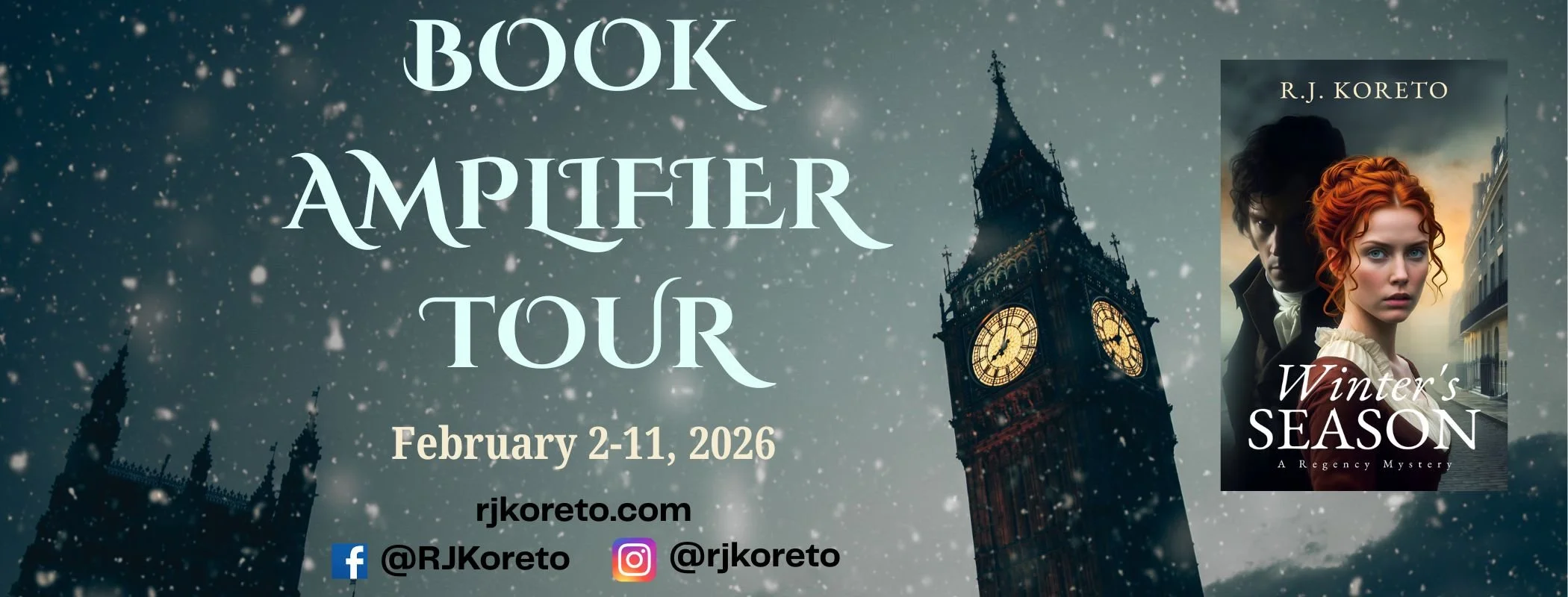

Captain Winter stands at the center of Winter’s Season by R.J. Koreto, defined as much by restraint as by experience. His work requires him to balance loyalty, memory, and survival in situations where no clear authority exists.
Set in the years following the Napoleonic Wars, the story unfolds in a city without formal mechanisms of justice. Captain Winter serves as Whitehall’s unofficial emissary, navigating both elite society and dangerous streets. When a young woman is murdered, his investigation exposes how deeply fear and privilege shape accountability.
Winter’s progress depends on fragile alliances. A nobleman connected to his past offers influence, while a wise Jewish physician provides clarity grounded in observation. The return of Barbara Lightwood, a former lover with intelligence and social reach, alters the course of the investigation. Her selective cooperation reopens unresolved history and clouds Winter’s judgment.
As the truth sharpens, Winter must confront the limits of his moral code.
Excerpt
The captain said goodbye to his colonel and a few other officers, and the butler saw him out. He walked to the nearest stand and engaged a hackney cab to Bow Street Court. A few heads turned as he entered the building, but no one accosted him. A clerk gave him the barest nod but said nothing as he entered a room.
A few minutes later, the captain came out. He was no longer in his regimentals, but in rather shabby outfit, almost rural, with a slouch hat. Down the hall, he entered another room, where a squad of Bow Street Runners awaited—constables, employed by the local court at Bow Street, to keep order and seize felons. Winter suppressed a grimace. They were poorly trained and poorly paid, but it was pretty much all London had for law enforcement. Many still thought the idea of a formal professional constabulary too much government interference—too un-English. So, the Runners would have to do. At least they were willing and obedient.
“We have already gone over where you should be standing,” said the captain. “You know how important it is you aren’t seen.” There was more than instruction in his voice—there was menace.
“Yes, sir,” said the most senior constable present.
“Then take your places. I’ll be along shortly.”
Moving quickly, he left the building and walked along dark streets that became progressively dirtier and more dangerous. He saw men hiding in the shadows, those who preyed on the weak and unaware, but nothing happened to him.
Eventually he came to a building that was well-lit, at least by the neighborhood standards. It was certainly the noisiest venue in the street. The cracked and faded sign marked it as The Three Bells.
The Captain entered—a few were eating off dirty plates, and almost everyone was drinking beer, or something stronger. Slatternly women laughed and tried to slip away from the half-drunk men who loudly pursued them. Some allowed them- selves to be caught, and there was more laughter and then a talk of money. The whole room smelled of smoke and grease, and the floor was sticky from weeks of spilled ale.
Few paid attention to the captain, but a fat man walked up to him surprisingly quickly for someone of his bulk.
“Oh captain, I am so pleased, do you think—”
“Shut up. Where’s Sally? She was suitable last night, and she’ll be suitable tonight.”
“Sally—oh there she is.” He pointed to a tallish girl wearing more makeup than an actress. A large man in worker’s clothes, probably a stevedore, thought the cap- tain, had grabbed her and placed her on his lap. She didn’t seem to mind.
The captain strode over, grabbed the woman by her wrist, and pulled her off the man’s lap.
“Come, my girl, we have an appointment as you well know.”
She yelped with surprise, then gave a shrug and followed. The large man stood up.
“See here—I saw her first,” he said. His accent wasn’t London, which explained everything.
“Good for you,” said the Captain, and pulled the girl across the room. The big man started to follow, but two of his friends grabbed him.
“Now Jake, no need to cause trouble,” said the first, who was clearly local.
“Cause trouble? I’ll flatten him—” “No, you won’t. You don’t know, you’re new here. For God’s sake, that’s the Captain, a soldier, they say he was, and you don’t want to start something with him—I’ve seen what happens to those who do—”
“That’s right,” chimed in the other friend, also a Londoner. “Remember Big Nick—used to be here, no one stood up to him, but he challenged the Captain...” he shuddered.
“And what happened?” asked a skeptical Jake. Both men look their heads.
“We never saw him again. He wasn’t arrested. They didn’t find his body—he was just...gone. So just stop thinking about it. There are plenty of other girls.”
But Jake still felt he had to make a show of standing up for himself. “So, you’re telling me it would be a mistake to call him out?”
“Your last mistake,” said the first man. Then very softly, as if he was afraid of his words, he said, “He’s called Winter. If you’re thinking of staying in this part of London, you would do well to remember that name.”
Buy on Amazon Kindle | Paperback

About the Author
R.J. Koreto has been a merchant seaman, book editor, journalist and novelist. He was born and raised in New York City and decided to be a writer after reading “The Naked and the Dead.” He and his wife have two grown daughters and divide their time between Rockland County, N.Y., and Martha’s Vineyard, Mass. Visit R.J. at his website and on Facebook and Instagram.