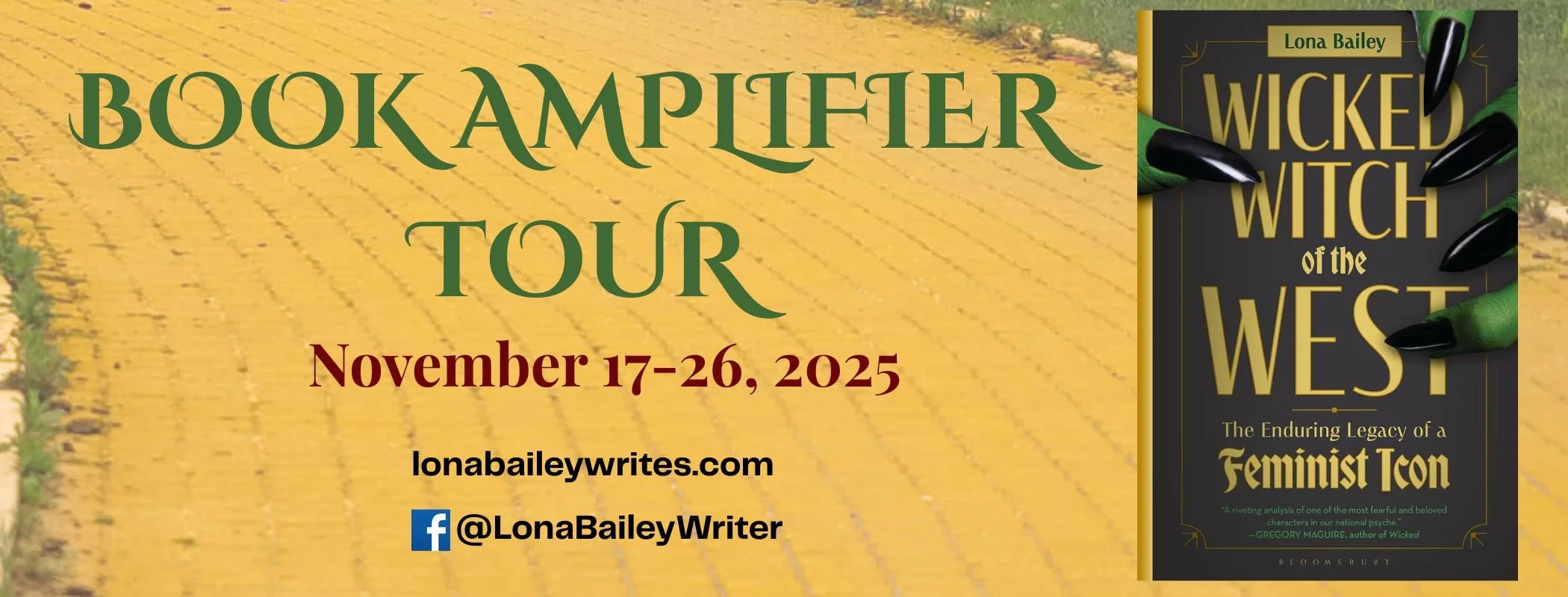
Spotlight: Wicked Witch of the West by Lona Bailey
/
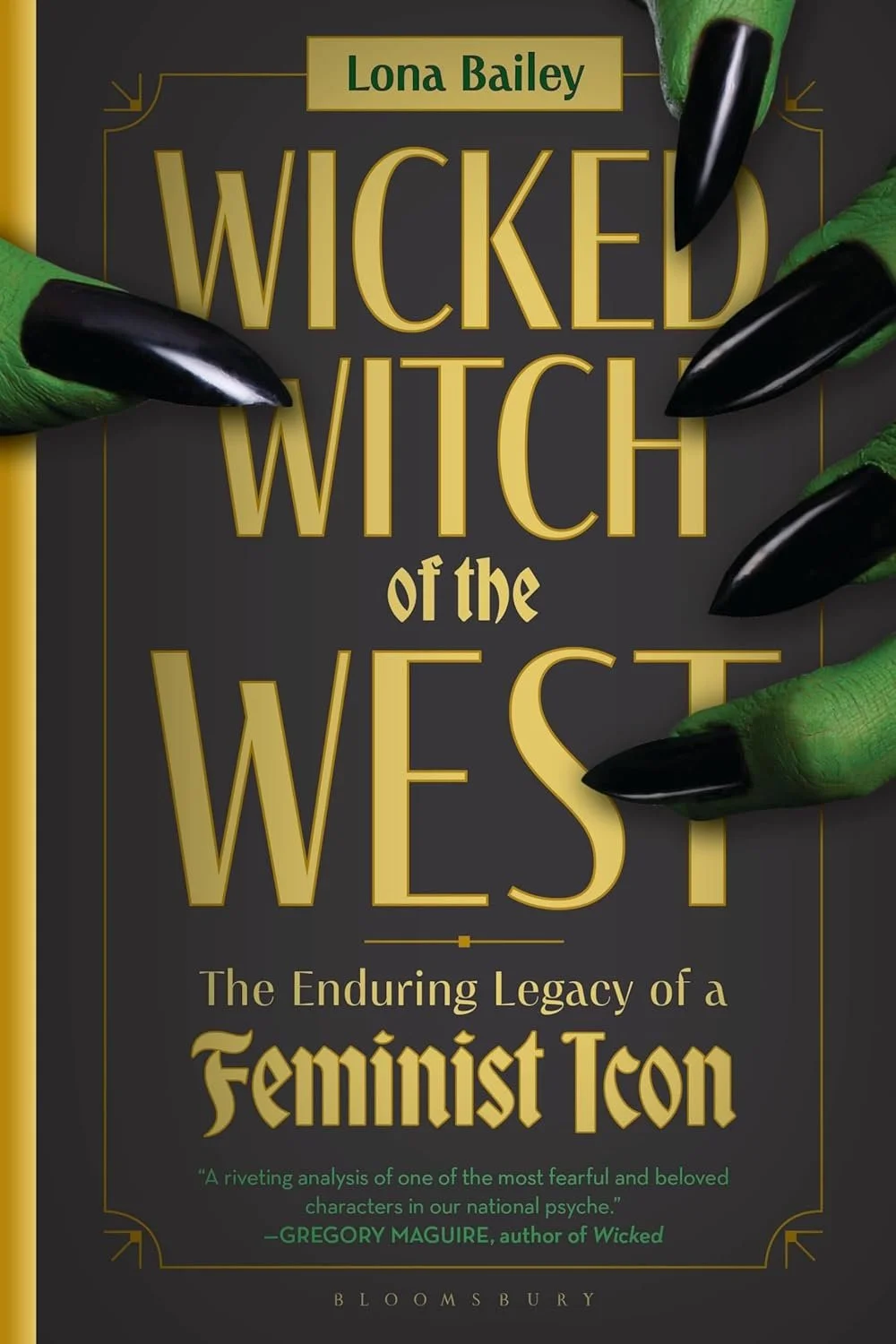
Icons rarely stand still, and few have shifted the cultural landscape like the Wicked Witch of the West. In The Wicked Witch of the West: The Enduring Legacy of a Feminist Icon, Dr. Lona Bailey traces how one woman’s “wickedness” became a rallying cry for generations of women determined to claim their power.
Bailey approaches the Witch’s century-long legacy with a scholar’s eye and a storyteller’s touch, weaving together history, myth, and feminist theory. From L. Frank Baum’s original narrative to today’s modern interpretations, she explores how the Witch’s evolution parallels the broader transformation of women’s roles in society. Her analysis reaches beyond the yellow brick road to consider the deeper question of why women who seek autonomy are so often demonized—and why, despite that, they endure. Through this lens, the Witch becomes both a product of her time and a timeless symbol of defiance, proving that even in fiction, resistance leaves a legacy.
Excerpt
It’s quite impossible to explore the icon of the Wicked Witch without acknowledging Margaret Hamilton’s unforgettable portrayal of the character, as she is widely credited with introducing her to the world in a way that has captivated audiences ever since. Was it the green skin, broom, cackling laughter, exaggerated hook to her nose, or sharp-tongued quips that embedded her into cultural consciousness? Perhaps all of those things and more initially made the world fall fast and hard for the fiendish character, but only in the context of Margaret Hamilton’s simply splendid portrayal.
“I was walking down Fifth Avenue in New York not long ago when a nice-looking young man called to me. ‘Miss Hamilton,’ he said, ‘you don’t know me, but I know you. You scared the pants off me when I was a little boy,’” Margaret Hamilton recalled.1 The barely five-foot-tall Margaret “Maggie” Hamilton has managed to terrify millions for more than eighty-five years in her characterization of L. Frank Baum’s Wicked Witch of the West. What began as a fairly one-dimensional antagonist with few descriptives beyond her general reputation for wickedness, was suddenly and frighteningly brought to life thirty-nine years after she was penned in Baum’s book and the legend of The Wizard of Oz truly began. In following suit with what “that little animation company” Walt Disney did in the successful film adaptation of the children’s fantasy story Snow White and the Seven Dwarfs, MGM bought the rights to adapt Baum’s novel The Wonderful Wizard of Oz to brilliant Technicolor in 1938. The demigod of MGM, Louis B. Mayer, purchased the book’s rights in the fall of 1937 upon the suggestion of Mervyn LeRoy. Mayer saw grand potential in a musical version of the children’s novel and with LeRoy and Arthur Freed on board, revisions toward final production were initially promising. The script went through a merry-go-round of revisions from its initial draft to its on-screen presentation with cuts, edits, rewrites, and additions from legions of hired, fired, and rehired writers.
The only mainstays were the leading cast—well, sort of. Judy Garland was cast as Dorothy, Frank Morgan as the Wizard (and several other supporting roles), Ray Bolger as the Scarecrow/Hunk, Bert Lahr as the Lion/Zeke, Jack Haley as the Tin Man/Hickory, Billie Burke as Glinda, and Hamilton as the Wicked Witch of the West/Miss Gulch.
Originally, actress Gale Sondergaard was cast as the Wicked Witch, but being a bit too glamorous for such a haggy and undesirable part, Sondergaard withdrew from the production and Hamilton was offered the role just three days before filming began. Hamilton had appeared in several films for MGM by 1938, and with her distinct features and knack for spinster supports, Director Victor Fleming thought she was a natural choice for the queen of mean.
Whether or not Hamilton knew of Matilda Joslyn Gage as “the woman behind the curtain” of Baum’s novel, in her portrayal, she creatively matched the feministic intentions of the original story’s creator. While the Technicolor Wizard of Oz fostered the stereotypical image of what “witches” were believed to look like in the 1930s.
Witches were generally considered sallow, sexless figures whose rebellious and/or peculiar behavior had caused them to be ostracized by the general public. One early exception to this is Edmund Spenser’s The Faerie Queene (1590) with the character of Acrasia, the enchantress who uses her beauty to seduce and corrupt knights. Unlike the longstanding, older, and malevolent image of witches, Acrasia is described as physically alluring and beguiling, using her appearance and charm as weapons to achieve her goals. Though still a nonconformist in Spenser’s story, Acrasia’s beauty masks her dangerous nature, a theme that has been echoed in later depictions of witches in literature and folklore, though most classic literature purports “witch” to be synonymous with “ugly.”
Nonconformist characteristics (described in horrid terms) usually included degrees of unsightly yellow or red complexions, unkempt, stringy hair, exaggerated facial features, and of course, warts. For example, William Shakespeare’s witches, the “Weird Sisters” in Macbeth, are described as dirty, haggish rebels who live separately from society and possess not only mystical powers but also distinctively masculine features such as beards. Any beauty that was ascribed to a witch before the postmodern reinvention of her image was usually only a magical cover for her “true” haggish nature, which she ruthlessly used to further her evil agenda. For better or for worse, MGM began the reinvention process of the witch, and Margaret Hamilton’s face was the canvas on which they painted—literally. With a hooked nose, green skin, pointy chin, crystal ball to spy on her enemies, and dressed all in black with a flying broom, Hamilton herself subtly fostered a more progressive approach to villainy in that inch of redemption she gifted the character through her own touch of feministic essence despite her convincing malevolence on screen.
Contrary to most villainesses in early literature, film, and television, the Wicked Witch was not a masculine character. Perhaps we wouldn’t call her “pretty” in the green paint and prosthetics, but still Hamilton brought a subtle, yet undeniable femininity to the role that changed the “look” of a “witch” in the general sense. The paradox of Hamilton’s portrayal in such a traditional era was that she brought both femininity and feminism to the characterization. Billie Burke, on the other hand, certainly brought femininity to “Good Witch Glinda,” and her delicate, docile characterization stuck closely by Baum’s original non-feministic “Good Witch.” Burke seemed to naturally exude a dainty energy and sense of glamour as Glinda, which is also what the role required, but as far as MGM was concerned, Margaret Hamilton’s subtle artistic strokes of feminism weren’t of importance just so long as she, as the “bad one” was scary and not too “pretty.”
Buy on Amazon Kindle | Audible | Hardcover | Bookshop.org

About the Author
Dr. Lona Bailey is an award-winning feminist biographer and Golden Age researcher who writes to restore women’s voices to the cultural record. Her acclaimed titles—Voice of Villainy, Uncredited, Mrs. Radio, and The Wasp Woman—bridge the worlds of historical documentation and narrative art. Bailey’s combination of academic discipline and psychological depth allows her to reveal her subjects as fully human—complex, brilliant, and flawed. Her work has earned international accolades and media recognition for its contribution to feminist biography. Discover her writing on her website or connect via Facebook.