Spotlight: The Unravelling of Ou by Hollay Ghadery
/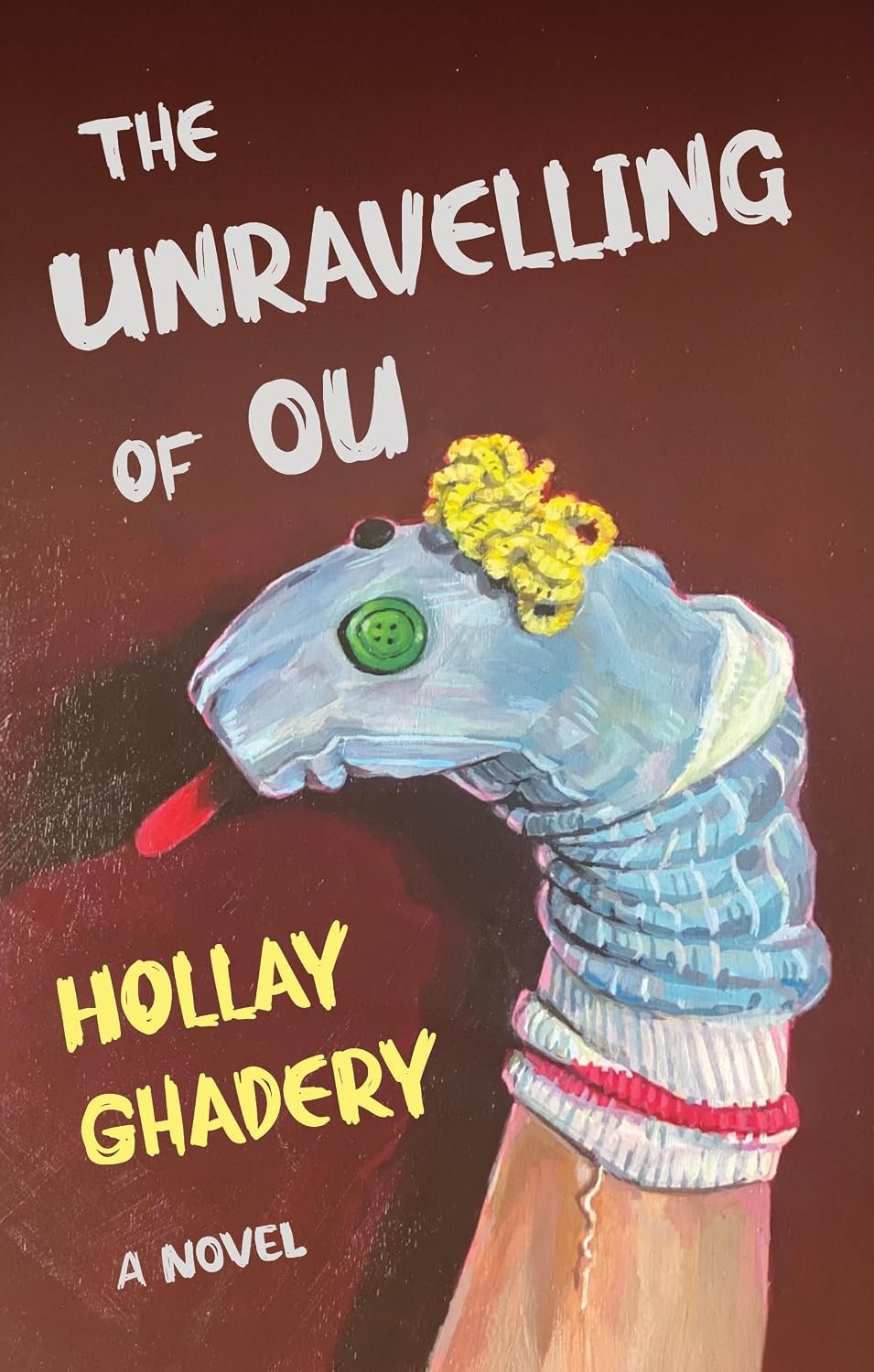
Moving on is hard. Even harder when it’s from a make-believe friend—someone, or in this instance, some thing—who’s been your strongest source of support. On what should be one of the happiest days ever, the day her granddaughter is born, Minoo is faced with a terrible choice: make a clean break from her constant companion, a sock puppet named Ecology Paul, or lose her daughter and granddaughter, and maybe all of the people she loves. On an emotional drive home from the hospital, Ecology Paul shares the story of how Minoo got to this point, recalling Minoo’s early teenage pregnancy in Iran, her exile to Canada, her questions about her sexuality, and how a ragtag sock puppet came to her when she desperately needed to be seen. Full of imagination, whimsy and heart, The Unravelling of Ou follows Minoo’s struggles to justify the puppet’s existence and untangle herself from her dependence on it and reconnect with the people she loves.
Excerpt
THERE ARE NO LOOSE ENDS; ONLY OUTCOMES WE DON’T LIKE
Minoo’s mother took her to Gilan in the summer of 1992. The province hugged the southwest shores of the Caspian Sea in northern Iran and was home to Parvin, one of her mother’s best friends from her school days. Parvin lived in Talesh County with her fifteen-year-old son, Darius, an infant daughter whose name Minoo can’t recall, and a husband who Minoo only encountered signs of around the house—an ashtray of freshly crushed cigarette butts, embers scattered and smoldering, the urgent wallop of Kouros aftershave in the bathroom each morning, a pair of worn brown loafers at the back door—but Minoo does not recall ever actually meeting him. Though she must have. She’s aware that in the three months she spent at that house, she must have met him at least once. But in the absence of a credible memory, in her mind, he’s taken on the form of Freddie Mercury: abundant mustache, elfin overbite, lithe form, and always just leaving the room.
She remembers clearly what was intangible. This is what I’m trying to say. Minoo had never heard of Freddie Mercury until she moved here, to Canada. Until she met Kit at the Immigrant Welcome Centre, and Kit—with her baby-elephant eyelashes and her gentle, clipped way of speaking, as if she were holding in some big secret—turned up the car radio and sang.
How she took Minoo’s hand in hers and held tight. But that was a different summer…
Not the summer in Gilan, with the ephemeral husband. With the bombination of bees around the cherry tree in the garden and a humming radiance that began in Minoo’s limbs and blossomed from her chest, freely. It’s what she remembers most, even though she knows—she’s been told—there are far more important things she should have remembered. There were far more serious matters at hand, if only she could be serious for one moment.
Minoo was slouched on her bed, sucking on the end of her thick braid, when her mother stormed into the room and slapped the hair out of her mouth. Spit flew and splattered against the wall. Minoo’s cheek burned and when she touched the heat with the cool tips of her fingers, she smiled: the relief. The thrill of that comfort.
“How did it happen?” her mother demanded to know.
“Stop smiling like a donkey and explain yourself!”
But at the time, Minoo couldn’t, the explanation being rooted in her body and her body being as it had always been: a distant, devious entity she was reluctantly, constantly, tied to. Mere hours earlier that day, her mother had reminded her that her body was offensive.
“I don’t care how hot it is. Cover your forearms, Minoo.”
“A bottom like that like two big balls of dough! It’s indecent for your age! At any age!”
And a few weeks before that night, that slap, shortly after they’d arrived in Gilan, Minoo’s period had materialized, and her mother had been dumbfounded to learn her daughter hadn’t brought any sanitary supplies.
“How does this happen?” her mother snapped, digging to the bottom of her own still unpacked suitcase for the box of pads she had remembered to bring. Her mother’s pads were wrapped in purple and looked thicker. When Minoo slipped one into her underwear, she felt like she had a sandwich between her legs. Hungry chuchul, she’d thought to herself and tittered as she walked through the kitchen to the backyard, and her mother, who was in the kitchen, and who never seemed to be far enough away to miss an opportunity to disapprove, furrowed her brows and tsked at the unknown, but undoubtedly, inappropriate source of Minoo’s mirth.
So, how does this happen? This is a serious question, hungry chuchuls aside. How did Minoo not realize she was going to have a period while she was away for an entire summer? She had started menstruating the year before, so she should have known it was coming, and yes, she would have if she’d paid attention to such things. But recall, her body wasn’t something that bore attention. Her period arrived every so often, and she didn’t concern herself with the where or why, remembering what her mother said the night she had gotten her first: menstruation may be natural, but that didn’t stop it from being vulgar.
“Aa-miane, Minoo,” her mother whispered to her in the darkness of Minoo’s bedroom that night, sucking air between her teeth. “Couldn’t you have waited for your father to leave in the morning?”
The way she’d stripped Minoo’s bed and rolled her sheets, underwear, and pajama bottoms into a tight bundle, her teeth bared in her smileless smile, nose twitching, alerted Minoo to the fact that she—the she still standing there, bare-bottomed and backed into the window, head and shoulders silhouetted by the streetlight as a sticky warmth dripped down her legs—was made invisible by the inconvenience of her body.
“Borro,” her mother said without looking up. “Clean yourself.”
In the morning, after her father left for work, her mother took Minoo to the bathroom and showed her how to conceal her pad with the wrapper of the next napkin before putting it in the garbage.
“If it’s very bloody, wrap it in toilet paper too. Do you understand?”
Minoo nodded. Her mother sighed, and for a brief moment, her eyes pooled. It only took that moment for Minoo’s mind to splinter with a memory: her mother sing-ming, taking Minoo’s small hands in hers and clapping them together.
Atal matal tootoole!
Govee Hasan che joore?
Na shir dare na pestoon!
Shiresho bordan hendestoon…
A silly nursery rhyme. Her mother pressing Minoo’s still baby-fat palm against her own cheeks and cooing the nonsense words to her. Giggling. Once, they’d giggled together.
Atal matal tootoole!
How is Hasan’s cow?
It has neither milk nor breast!
Its milk is shipped to India…
Minoo could still remember her mother singing, the trill of her own small voice joining in. They sang as they walked through the market. As they tended the roses in the courtyard. The roses her mother loved because, she said, “They are beautiful, but they also know how to protect themselves.” She pointed to a thorn. Minoo raised her tiny fists and widened her stance, in her childish approximation of a fighting stance. Minoo’s mother laughed lightly, then guided her daughter’s hands back down to her sides.
“No, jigaram,” she said. “Girls are not the same as roses.
Roses naturally grow thorns. Girls don’t. We are forced to grow those, as we get older, but it’s not natural. Mifahmi?”
Minoo nodded yes, even though she didn’t understand at all. What she knew was her elation at the appearance of her mother’s dimples, crescent moons carved into her cheeks, and how when her mother laughed, she often pressed her mouth into one of her shoulders, like she was trying to stifle her joy. Minoo wanted to take her mother’s face in her hands and lift it to the sun, let her laughter fill the sky.
Minoo couldn’t remember the sound of her mother’s laughter anymore. It grew small as Minoo grew big.
“Minoo!” her mother barked, bringing her back into the bathroom. “Do you understand? If it is too bloody, wrap it in toilet paper!” Minoo nodded. Nodded at the small garbage bin with tiny pink flowers on it. The oily black of her mother’s pupils dilating. Minoo nodded and kept nodding. “No one,” her mother repeated, “should be able to tell.” Her mother took Minoo’s head between her hands and brought its bobbing to stillness. She held her daughter’s gaze for a moment longer and moved as if to touch Minoo’s cheek. Instead, she pulled her in for a brief, spine-crushing embrace, and then pushed her away.
“Now go to school.”
Buy on Amazon | Bookshop.org
About the Author
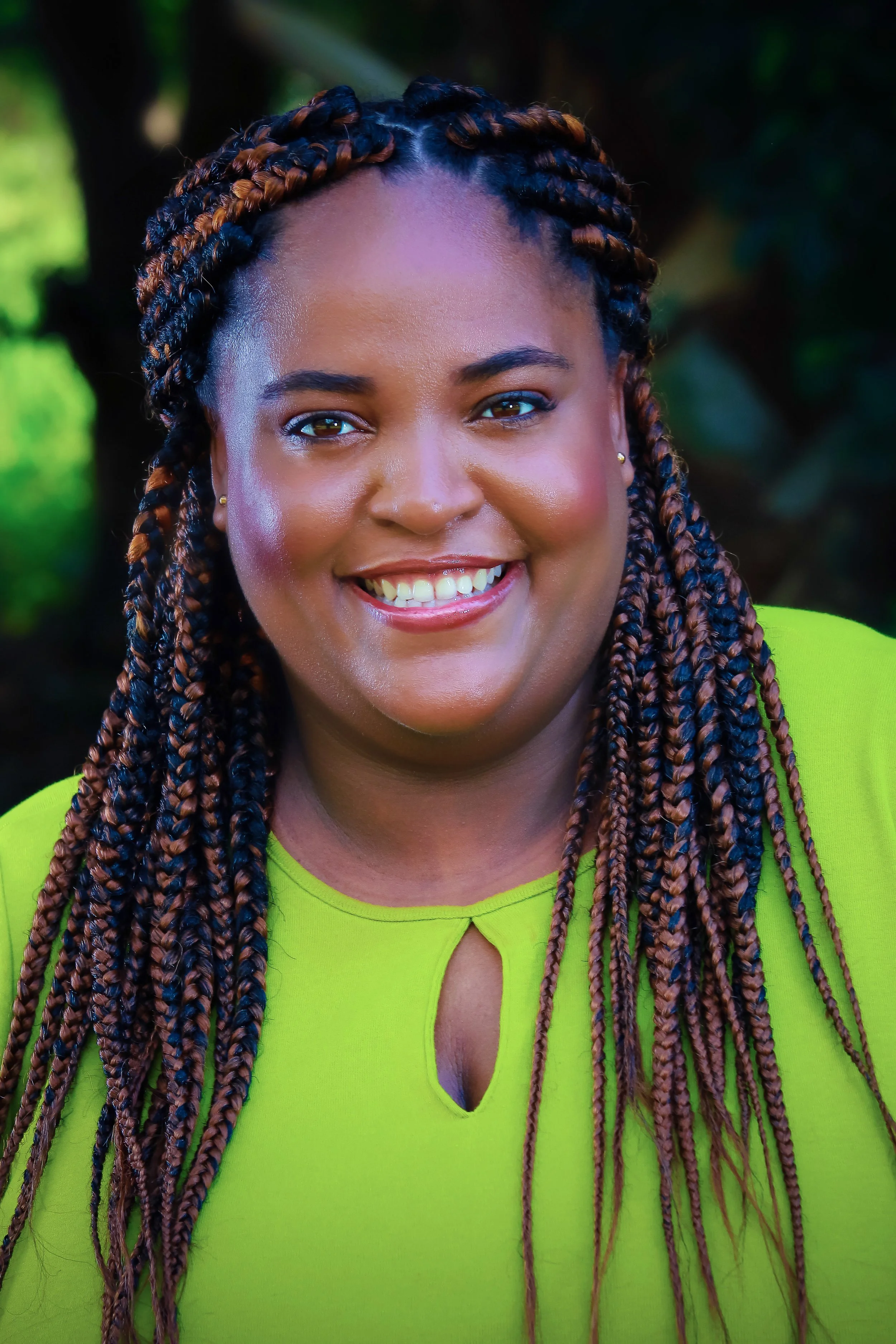
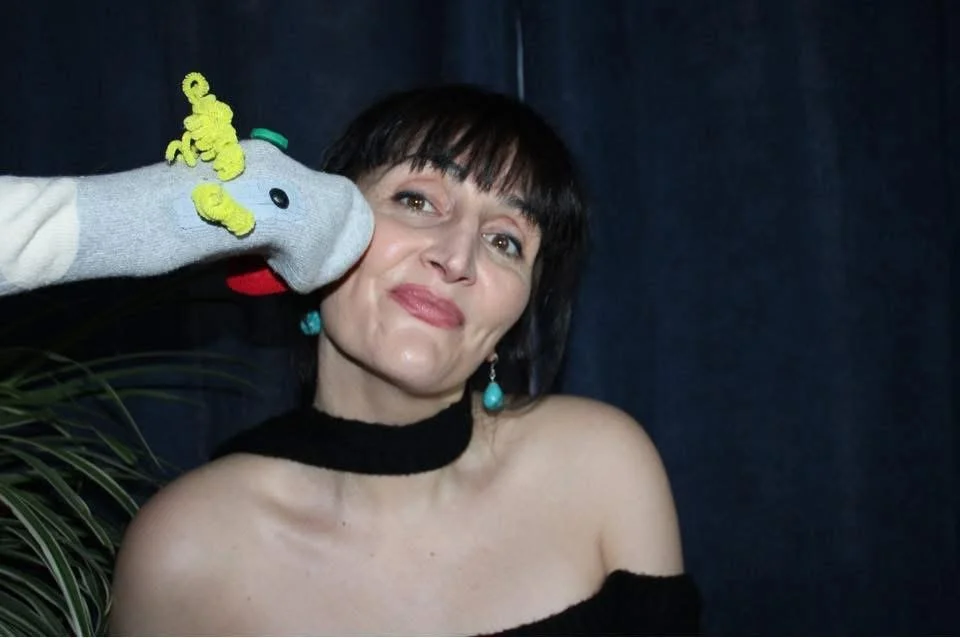
Hollay Ghadery is a multi-genre writer living in Ontario on Anishinaabe land. She has her MFA in Creative Writing from the University of Guelph. Fuse, her memoir of mixed-race identity and mental health, was released by Guernica Editions in 2021 and won the 2023 Canadian Bookclub Award for Nonfiction/Memoir. Her collection of poetry, Rebellion Box was released by Radiant Press in 2023, and her collection of short fiction, Widow Fantasies, was released with Gordon Hill Press in fall 2024 and was longlisted for the Toronto Book Award. Her debut novel, The Unraveling of Ou, was released with Palimpsest Press in 2026, and her children’s book, Being with the Birds, with Guernica Editions in 2027. Hollay is a host on The New Books Network, as well as a co-host on HOWL on CIUT 89.5 FM. She is also a book publicist, the co-chair of the League of Canadian Poets BIPOC committee, as well as the Poet Laureate of Scugog Township. Learn more about Hollay at www.hollayghadery.com.