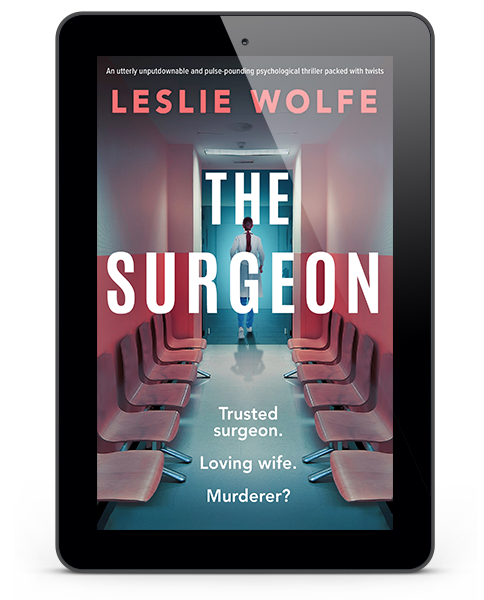
Spotlight: The Surgeon by Leslie Wolfe

Genre: Psychological Thriller 

Trusted surgeon. Loving wife. Murderer?

Before my world came crashing down, I had it all. The successful career I dreamed of. The beautiful red-brick home where I could relax in front of the fire. The handsome, devoted husband whose blue eyes and charming smile always made me feel safe.

As I call time of death, my voice is steady. My colleagues stand hushed around me, their eyes on me, confused, concerned.

I have never lost a patient until today.

My hands tremble inside their gloves. I slide down the cold tiled walls, my heart racing in my chest.

I have never hated a patient until today.

But what choice did I have, once I recognized him?

And what will I do to protect myself, if someone learns the truth?

A totally gripping psychological thriller that will have you racing through the pages, gasping for breath until the final jaw-dropping twist. If you love Freida McFadden, Shari Lapena and The Girl on the Train, you won’t be able to put this down.

Excerpt

The Patient 

What have I done? 

The thought races through my mind, searing and weakening my body. The rush of adrenaline fills my muscles with the urge to run, to escape, but there’s nowhere to go. Shaky and weak, I let myself slide to the floor; the cold, tiled wall against my back the only support I have. For a moment, I stare at my hands, barely recognizing them, as if I’d never before seen them sheathed in surgical gloves covered with blood. They feel foreign to me: a stranger’s hands attached to my body by some inexplicable mistake. 

A faint, steady beep is sounding incessantly over the constant whoosh of air conditioning. I wish I could summon the strength to ask them to turn it off. The operating room is at a standstill, all eyes riveted on me, widened and tense above face masks. 

Only one pair of eyes is glaring, drilling into mine whenever there’s a chance, the steel-blue irises deathly cold behind thick lenses and a face shield. Dr. Robert Bolger, still seated by the anesthesia machine, doesn’t need to say anything. We’ve said to each other everything that needed to be said. Too much, even. 

“Turn that thing off,” Madison whispers. Lee Chen presses a button, and the ghastly sound is muted. Then she approaches me and crouches by my side. Her hand reaches for my shoulder but stops short of touching me. 

“Dr. Wiley?” she whispers, her hand still hovering. “Anne? Come on, let’s go.” 

I shake my head slowly, staring at the floor. I remember with perfect accuracy the properties of the polymer coating they apply on all the operating room floors. Useless information taking space in my brain for no reason, since I’m the surgeon, the end user of these blue mosaic floors, not someone who decides what coating should be used. 

“Anne?” Madison says my name again, her voice reassuring, filled with warmth. 

“No,” I whisper back. “I can’t.” 

A bloody lap sponge has fallen from the table, staining the pristine floor inches away from the tip of my right foot. I fold my leg underneath me, staring at the sponge as if the bloodstain on it could come after me. 

Madison withdraws under the fuming glare of Dr. Bolger. 

He sighs and turns off his equipment, deepening the silence of the tense room. “Well, I guess we’re done here.” He stands with a frustrated groan and throws the echocardiologist Dr. Dean a loaded look. “Let’s grab a cup of coffee to rinse off the memory of this disaster.” 

Dr. Dean throws me a quick glance as if asking for my approval. He probably feels guilty for being singled out by Bolger. I barely notice. 

I don’t react. I can’t. 

My mind is elsewhere, reliving moment by moment what has happened since this morning. 


*****

The day started well for me, without a sign of what was to come. A capricious, windy spring morning that made my daily jog more of an exercise in willpower than in physical endurance. Chicago has a way of showing its residents some tough love, with chilly wind gusts that cut to the bone, so to speak—there’s no surgery involved; just weather and people’s perceptions of it. 

Like the past couple of weeks, I ran the usual three-mile loop through Lincoln Park looking at elms and buckthorns with renewed hope that I’d find a budding leaf, no matter how small. I was ready for spring and flowering gardens and warmer sunshine. Nothing else was on my mind; at six thirty in the morning, it seemed to be just an ordinary Thursday. Deceptively so. 

At about seven thirty, I drove into the hospital employee parking level, taking my reserved numbered spot. 

I had reviewed the details about the day’s surgery a final time the night before from the comfort of my home office, another set routine I have. 

The procedure on schedule was an ascending aortic aneurysm. The patient, a fifty-nine-year-old male by the name of Caleb Donaghy. We were scheduled to start at ten sharp. 

I’d met Caleb Donaghy twice before. The first time was during a consult. His cardiologist had found a large aneurysm and referred him to us for surgical repair. I remembered that consult clearly. The patient was understandably scared by the findings, and became more so with every word I said. He kept his arms crossed firmly at his chest as if protecting his heart from my scalpel. His unkempt beard had streaks of yellowish gray, and the same gray adorned his temples, as much as I could see from under the ball cap he had refused to take off. 

I let him keep it. 

He was morose and argumentative for a while, disputing everything I said. What had he done to deserve the aneurysm? His parents had only recently died, and not of any heart-related issues. Only after spending a good fifteen minutes managing his anxiety was I able to evaluate him. 

That was the first time we met. 

Then I saw him again last night, after completing the surgical planning session with my team. Caleb Donaghy had been admitted two days before and had all his blood tests redrawn. He was sitting upright in his bed, stained Cubs ball cap on his head, arms folded, leaning against the pillows doing absolutely nothing when I came in. The TV was off, there were no magazines on his bed, his phone was placed face-down on his night table. 

The room smelled faintly of stale tobacco and boozy sweat. He was brooding, miserable and alone. And he was pissed. He’d just learned they were going to shave his beard and chest in pre-op. To add insult to injury, someone in hospital administration had swung by and asked him if he was a registered organ donor. For seven long minutes, he told me in various ways he wasn’t going to let himself be sold for parts. He knew what we, doctors, did to people like him, who had no family left to sue us and no money to matter. We took their organs and transplanted 

them into the highest bidders. Why else would entire buildings in our hospital be named after Chicago’s wealthiest? 

I promised him that wasn’t the case. He wouldn’t listen. Then I told him that all he had to do was say no and organ transplant stopped being a possibility in case of a negative surgery outcome. Which is surgeon lingo for death on the table. That silenced him in an instant. 

But that was yesterday. 

*****

This morning, Madison had my coffee ready for me when I got to the office. She’s the best surgical nurse I’ve worked with, and my personal assistant when she’s not scrubbed in. 

Madison; Lee Chen, the talented second surgical nurse on my team; Tim Crosley, the cardiovascular perfusionist who operates the heart and lung machine we call the pump; and Dr. Francis Dean, the echocardiologist, are part of my permanent surgical team. Then it’s the luck of the draw with anesthesiologists, and I drew the short and very annoying straw with Dr. Bolger. There’s something off-putting about him. Could be his undisguised misogyny. Rumors have it he’s been written up twice by the hospital administration for sexist diatribes insisting women don’t belong in a clinical setting anywhere above the nursing profession. Contempt for women seeps through his pores, although recently he’s grown more careful about letting it show. He’s also an arrogant son of a bitch, albeit an excellent anesthesiologist. His professional achievements fuel his hubris and dilute the resolve of the hospital administration when dealing with his behavioral issues. That’s who Dr. Bolger is. 

When we’re in surgery together, I always try to make it work as well as possible, for the good of the patient and the surgical team. 

It never works. It takes two to dance in harmony. 

I remember swearing under my breath when I saw his name on the schedule, then pushed the issue out of my mind. 

Dr. Bolger was already in the operating room when I came in. “Good morning,” I said, not expecting an answer. None came, just a quick nod and a side glance from behind the surgical drape that separates his world from mine, before he turned his attention back to the equipment cart at his right. The anesthesia machine helps him deliver precise doses. He controls the patient’s airway from behind that protective drape. During surgery, I rarely, if ever, get to see my patients’ faces. 

My focus is on their hearts. 

I’m forty-one and I’ve been doing this for twelve years, since I finished my general surgery residency. I moved to cardiothoracic right after that, and I never looked back. It’s what I’ve always wanted to do. And I’ve never lost a patient on the table. 

Not until today. 

The thought of that hits me in the stomach like a fist. 

For an instant, pulled back into the grim present moment, I look around me and try to register what I’m seeing. The surgical lights are off. Madison is still there, looking at me with concern. Lee Chen is sitting on his stool, ready to spring to his feet when needed. Tim Crosley is seated by the pump, his back hunched, his head hung low. If he could, he’d probably rest his forehead against his hands, but he’s still working, still keeping sterile. 

As long as that pump’s whirring, he’s on duty. 

My thoughts race back to the surgery. The operating room was filled with excited chatter, like normal. 

Virginia Gonzales, the semi-scrubbed nurse who runs back and forth, keeping us all organized and bringing us what we need, was sharing her experience with online dating. She’s just been through a terrible divorce. She’d recently decided she could still go out there and meet people. I admired that resilience in her, and secretly hoped it wasn’t desperation at the thought of living an entirely lonely life. But her first Tinder match had proven to be a man who’d misrepresented himself dramatically, and everyone on the team was laughing as she shared the details. 

He’d said he was a transportation executive, when he was in fact a truck driver. Nothing wrong with that, Ginny was quick to say, but the man had never heard of flossing, and during the twenty-five-minute encounter he’d let it slip he used hookers while he was on the road. Cheap ones, he immediately reassured a stunned Ginny. 

A quick bout of laughter erupted in the operating room when Ginny added, “I just ran out of there.” 

Dr. Bolger glared at her. “Let’s try to have some professionalism in here, if at all possible,” he said, speaking slowly, pacing his words for impact. “If I’m not asking for too much.” 

I refrained from arguing with him. Everyone was working, doing their jobs. Surgical teams perform best when they have a way to let off some steam. If there’s silence in an operating room, if no one’s sharing a story, if the music isn’t playing, then something’s going terribly wrong. 

I’d rather have them laughing all day long. That’s how you keep death at bay. It’s worked for me anyway. 

So far. 

“What will you have?” Madison asked me, standing by the stereo. 

“Um, let me think.” The early morning jog had me thinking of The Beatles. “Do you have ‘Here Comes the Sun’?” 

Madison grinned from behind her mask; I could see it in her eyes. She loved them. “I got the entire greatest hits collection right here.” 

“Punch it,” I said, moving between equipment and the operating table until I reached my station, by the patient’s chest. Music filled the room. 

Humming along, I held out my hand and the scalpel landed firmly in it. No need for me to ask; Madison knows how I work. I’m sure she can read my mind, although that possibility isn’t scientifically proven. 

From the first incision—a vertical line at the center of his breastbone—every step of the procedure was routine. 

The sternotomy to expose the heart. 

Opening the pericardium, the thin wrapping around the heart, and exposing the aneurysm. 

It was big, one of the biggest I’d seen. But I knew that already from prior imaging studies. We were prepared for it. 

“On pump,” I said, instructing Tim to start circulating the patient’s blood through the heart and lung machine. 

“Cross clamp in position,” I announced. “Cold flush,” I asked. A cold solution of potassium was administered into the chambers of the heart. I flushed the exterior of the heart generously with the solution, knowing the cold fluid preserved the heart tissue while we worked. Within seconds, the heart stopped, its death-like stillness announced by the droning sound we were waiting for. The sound of flatline, or the absence of a heartbeat. 

With the heart perfectly still, I started working to replace the aortic aneurysm with a graft. It took me almost an entire Beatles album to finish sewing it in. 

It feels strange how I remember the cold above all else. It’s always cold in the operating room. The air conditioning system blows air at sixty-two degrees. The cold flush that lowers the heart temperature and renders it still is delivered at forty degrees, barely above freezing. My fingers become numb after a while, but I move as fast as I can. Yet today it seemed colder than usual, the only premonition I can say I had. 

I don’t believe in them. I have my reasons. 

When I was done with the sewing of the graft, I examined my work closely, checking if the stitching was tight enough. The final test would be when the blood started rushing through that graft. Then I’d see if there were any leaks and fix them. Usually there weren’t. For now, I was satisfied. 

“Warm saline,” I asked. Those two words marked the end of the cardioplegia stage of the surgery, when the heart is perfectly still. I flushed the organ generously with warm saline solution, relishing the feeling of warmth on my frozen fingers, then used suction to get rid of the excess solution. “Releasing clamp.” 

The clamp clattered when it landed on the pile of used instruments. I held my breath, knowing this was the moment of truth. 

The heart remained perfectly still. 

Not fibrillating, not barely beating. Nothing. Just perfectly still. 

And that almost never happens. 

“Starting resuscitation,” I announced. Madison gestured toward the stereo and Ginny turned it off, then started a second timer with large, red digital numbers. Silence filled the room, an ominous, unwanted silence underlined by the flatline droning of the heart monitor. “Epinephrine, stat.” 

“Epi in,” Dr. Bolger confirmed. 

The shot of epi should’ve done something. It didn’t. I massaged the heart quickly, feeling it completely unresponsive under the pressure. 

“Paddles,” I asked, my voice tense, impatient. Madison put the paddles in my hands. Placing them carefully on opposing sides of the heart, I called, “Clear,” and pushed the button. A brief interruption in the steady droning, then the sound of bad news was back. 

I tried that a few more times, then returned to massaging the heart with my hands. “I need another shot of epi. Time?” 

“Seventeen minutes,” Madison announced, grimly. 

“Damn it to hell,” I mumbled under my breath. “Come on, Caleb, stay with me.” 

For a couple more minutes, I kept on with the massage, but nothing happened. The pump still kept his blood oxygenated and delivered to his organs, but the heart was another issue. Its tissue was no longer preserved by the cold potassium solution. With every passing minute, it was deteriorating, its chances of ever beating again waning fast. 

“Come on, already! Live!” I snapped. “Come back.” 

I felt the urge to look at the patient’s face as if it could hold some answers. I took a small step past the surgical drape—and froze, mouth agape under the mask, hand stuck in mid-air. I believe I gasped, but I don’t think anyone noticed under the hum of air conditioning, the whirring of the pump, and the blaring of the monitor. 

I recognized that man. 

My blood turned to ice. 

The face I’d seen yesterday and hadn’t recognized was now clean-shaven. The ball cap was gone, his bald forehead marked by a port-wine stain on the right side. The birthmark was an irregular shape of red splashed across his forehead as if someone had spilled some wine there. 

It took all my willpower to step back behind the drape. Breathing deeply, thankful for the cool air that kept my mind from going crazy, I abandoned the paddles on the table and stared at the heart that refused to beat. 

“Time?” I asked again, this time my voice choked. 

“Twenty-one minutes,” Madison replied. 

I slipped my hands into the chest and massaged the heart, knowing very well the heart compressions I was delivering wouldn’t work. 

I forced one more breath of air out of my chest, then said, “I’m calling it.” 

“What?” Dr. Bolger sprang to his feet. “Are you insane? Keep going.” 

I was expecting that. “I could do that, but he won’t come back, Robert. We tried everything. The heart’s not even giving me the tiniest flutter.” 

His steely eyes threw poisonous darts at me. “Giving up already? Why? Are your pretty little hands tired, sweetheart?” 

I let that one go. It wouldn’t help anyone if we argued over the open chest of Caleb Donaghy. “My case, my call.” I held his seething gaze steadily for a moment. “Time of death, 1:47 p.m.” 

Heavy silence took over the room. Then people started shifting around, collecting instruments, peeling off gloves, turning off equipment. Only Tim stayed in place, the pump still working, still preserving Caleb’s organs and tissues. 

“It’s unbelievable what happened here today,” Dr. Bolger said. “You’re unbelievable. Pathetic even. You didn’t just lose your cherry… you threw it away.” 

The sexualized reference to the fact that I’d never lost a patient before left me wondering how much of his disdain was in fact envy. But that thought went away quickly. 

Then reality hit me like a freight train. 

What have I done? Have I just killed a man?

Buy on Amazon | Audible

About the Author

Leslie Wolfe is a bestselling author whose novels break the mold of traditional thrillers. She creates unforgettable, brilliant, strong women heroes who deliver fast-paced, satisfying suspense, backed up by extensive background research in technology and psychology.

Leslie released the first novel, Executive, in October 2011. Since then, she has written many more, continuing to break down barriers of traditional thrillers. Her style of fast-paced suspense, backed up by extensive background research in technology and psychology, has made Leslie one of the most read authors in the genre.

Reminiscent of the television drama Criminal Minds, her series of books featuring the fierce and relentless FBI Agent Tess Winnett would be of great interest to readers of James Patterson, Melinda Leigh, and David Baldacci crime thrillers. Fans of Kendra Elliot and Robert Dugoni suspenseful mysteries would love the Las Vegas Crime series, featuring the tension-filled relationship between Baxter and Holt. Finally, her Alex Hoffmann series of political and espionage action adventure will enthrall readers of Tom Clancy, Brad Thor, and Lee Child.

Leslie enjoys engaging with readers every day and would love to hear from you. Become an insider: gain early access to previews of Leslie’s new novels.

Website * Facebook * Twitter * Instagram * Bookbub * Amazon * Goodreads

Spotlight: Limitless Roads Cafe by Samantha Picaro

Genre: YA Contemporary

Release Date: May 15, 2023

Blurb:

Kinsey Fontana relies on lists to navigate the world as an autistic teen. #Goals list: win her dream event planning internship (she knows it’s an ironic dream); master the art of masking; and gain Mom’s approval. Instead, she works at a café hiring teens with disabilities. Although she loves the café and discounted macchiatos, she dreams of more than planning open mic nights.

She has an opportunity to shine by throwing a fundraiser to save the café. The catch: allow her ex-best friend Melissa Castillo to be her assistant and pretend they are friends again so Melissa’s parents respect her.

To-do list: plan the fundraiser with zero fundraising experience; work with the intimidating hotel planner who rejected her for the internship; and use every masking technique to charm rather than repel people from sponsors to a boy band. Although she needs unhealthy amounts of caffeine to handle autistic burnout, Kinsey reconsiders her #Goals list and realizes self-doubt belongs down the drain like incorrect orders.

Buy on Amazon

About the Author

Samantha Picaro is the author of LIMITLESS ROADS CAFE. Her identity as #ActuallyAutistic informs her writing, where the heroines are determined, and comedy is balanced with drama. She has a B.A. in Psychology and a Master's in Social Work, and she has put those degrees to use in the nonprofit sector. When not writing or at her non-writing job, you can find her trying new coffee flavors, reading (of course), and volunteering for various causes. She lives in New Jersey.

Connect:

Website: www.samanthapicarowrites.com

Instagram: @author.samantha.picaro

Facebook: Author Samantha Picaro

TikTok: @authorsamanthap

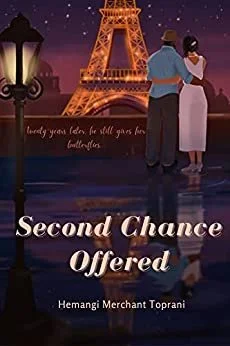
Spotlight: Second Chance Offered by Hemangi Merchant Toprani

Genre: Contemporary Romance 

About Second Chance Offered:

Fans of second-chance romances, gear up for a hot new read! Debut author Hemangi Merchant Toprani brings together the charm of Nora Roberts & Christina Lauren in her fluffy feel good romance!

Solo trip to Europe ☑️
Seeing the Eiffel Tower ☑️
Playing in the snow in Switzerland ☑️
Reconnecting with an old friend ☑️
Creating memories of a lifetime ☑️
Falling in love…?

At thirty-eight, Margaret Hill was set in her routine life. Married to her high school sweetheart, mother of one and grandmom-to-be, her days were filled with grocery runs, errands and ensuring that everyone in the house was fed. But when ugly truths about her marriage come to light, her happily-ever-after comes crashing down.

Now, after twenty years, Margo finds herself single and unsure of who she is. Emboldened by her best friend Kathleen and daughter Anna, Margaret decides to embark go on a solo Europe trip. The last thing she expects is for another person to be added to her solo adventure. But it’s not just someone new she just met, it’s someone she has a history with—two decades worth of history.

The years have been easy on Richard Dale, and it's like no time has passed. He's caring, understanding, respectful, and a valuable friend to Margo. He's also easy on the eyes, so that's a nice bonus! Falling in love with him would be the easiest thing Margo ever had to do.

But she's just leaving the deep trenches after a tumultuous marriage and a long-term relationship is the last thing on her mind. Margaret tries to keep Richard at an arm's length, but falling in love is not something you can control, is it?

Buy on Amazon

About the Author

Hemangi, an avid reader whom you would never see without a book in hand, is a native of Mumbai, India, and is an introvert by nature, teacher by profession and writer by love, having started writing since the past few years, discovering a new, sudden love for it. She is a firm believer in happily ever after, fiction being that window of escape that everyone requires at some point of time in life!

Connect with the Author:  Facebook | Instagram 

Spotlight: Three Rivers by Sarah Stusek

This isn’t happening. It’s only a nightmare, only a stupid dream. Just wake up, Stella!

But it isn’t a dream. Two strangers take Stella from her bedroom in the middle of the night and haul her off to Three Rivers, a wilderness therapy program for troubled teens. At the program, Stella puts up as much resistance to participating as she can. She’s not an “at-risk youth”— she’s not a felon or a druggie or an arsonist like the rest of the kids in her group. She’s a normal teenager who happens to star on a hit TV show. But slowly, despite herself, she starts to open up, make friends, and confront why she was really sent there.

Buy on Amazon | Bookshop.org

About the Author

Sarah Stusek got her start in the film and television industry as a child actor when she was five years old. She was born and raised in Annapolis, MD and attended Coastal Carolina University, where she fell in love with being on the other side of the camera. After graduation she worked her way up on hit programs like HBO's, VEEP and Netflix's House of Cards. She has since started her own production company, Stusek Studios, producing commercials, films and digital content. Sarah has been searching for a way to tell the story of her experience as a child actor sent to a wilderness therapy program in Montana (by two people her parents hired to take her in the middle of the night!) for the past ten years. The result was THREE RIVERS, her debut novel. She currently lives in Alexandria, VA with her boyfriend and their boxer dog, Beau.

Spotlight: A Seasonal Song by Dan Shaskin & Deb Wesloh

Publication date: March 21st 2023
Genres: Adult, Contemporary, Romance

Synopsis:

Discover love and music in the sultry streets of Miami with “A Seasonal Song.”

Clarissa Bianchi, a talented violinist, lands her dream internship with the Miami Orchestra, but little does she know that she will also discover the love of her life. Jack Williams, a rugged rock guitarist with a broken heart, meets Clarissa and is instantly drawn to her beauty and passion for music. Despite their different musical backgrounds, their mutual love for music brings them together on a journey filled with passion, growth, and unforgettable memories.

As the summer draws to a close, Clarissa and Jack must navigate their intense feelings for each other and determine if their love is strong enough to withstand the distance between Miami and Boston. Will their hearts play a different song, or will the romance come to an end?

“A Seasonal Song” is a love story that will leave you humming a sweet tune long after you turn the last page.

Excerpt

Current Year

Clarissa gazed at the horizon as she sat on the beach. The breeze provided little relief from the oppressive heat and humidity. Her cotton shirt clung to the contours of her body as sweat dripped down the back of her neck. The wind and humidity disheveled her long brunette hair.

She paused and whispered under her breath. “Here I am, again. Back in Miami.”

They say history repeats itself. From her perspective, she concurred.

So much heartache, so much love, and such beautiful memories. The smell of the ocean brought a tear to her eye. The tear slowly trickled down her cheek, dropping from her chin into the ocean.

She smiled as she thought of her last summer in Miami. Some would categorize it as a summer fling, but the passion and intense emotions they shared were real. 

Jack was twenty-seven and designed custom yachts. She was twenty-one, a sophomore at Berklee College of Music. An unlikely pair, but perhaps their paths collided for a reason.

She strolled to the water’s edge. The sand stuck to her feet, leaving deep imprints on the beach. The waves crashed against her legs, throwing her slightly off balance. She steadied herself as she walked back to her towel. 

Her mind drifted back to her job last summer at the Purple Penguin Café. Where it all began.

As she remembered when she first met Jack, her heart pounded in her chest and her breathing became slightly labored.

Last summer at 6:30 p.m. on June 25th Jack walked into The Purple Penguin. She chided her silliness for remembering the exact date and time, but she did, and the memory was as crisp as if it had happened yesterday.

Last year

All teal chairs and tables were occupied at the eclectic-furnished café. Loud conversations inundated the room.

Several people waved, trying to get her attention. She was exhausted, and her feet ached. She wished her shift would end.

As she served a table, he entered the café and waited to be seated.

A table soon opened, and the hostess assigned him to her section. She finished serving her current table and approached him, greeting him warmly.

“Hi. My name is Clarissa. What can I get for you?”

His warm brown eyes glanced up from the menu and met hers. “Hi, nice to meet you, Clarissa.”

It surprised her to hear her name. Although she always introduced herself, the customers rarely repeated her name.

“What’s in that silver penguin shaker thing I saw you take to the other table?”

“Shake Your Penguin, our signature cocktail. It’s a mix of Absolut Vodka, pomegranate juice, lime soda, and berries. It’s very popular and tastes great. I should know. I’ve sampled a few of them.” She winked and laughed.

He smiled. “I’ll take your word for it. Let’s start with one of those Shaky Penguin things.”

She returned a few minutes later with his drink.

He took a sip. “Wow, this is good!” Jack continued. “Listening to your accent, you don’t seem to be from around here. Sorry, I don’t mean to pry. You don’t have to tell me anything if you don’t want.”

Clarissa laughed, “It’s okay. The short answer is, I’m from everywhere.

“I’m sorry, I don’t understand.”

“Well, when I was growing up, I was an Army brat. Between the ages of two and nineteen, I lived in eight states, and three years in Stuttgart, Germany.”

Jack smiled at her. “Sie müssen dann fließend Deutsch sprechen?

Clarissa smiled. “Yes, I speak German, but fluent is an exceptionally strong word. Let’s just say I can converse in German with few errors.”

She found him intriguing. Perhaps it was the warm manner he talked to her. She calculated he was slightly older than her, maybe in his late twenties. He had a sincere smile and kind eyes.

“Most of our clientele are tourists and stay at the Purple Penguin Hotel next door,” she said. “We don’t get many locals. Are you from around here?”

“I’m originally from Boerne, Texas, just northwest of San Antonio. I’ve lived in Miami for five years. A business client is staying at the Penguin Hotel. I just dropped him off, saw the restaurant, and here I am. Never been here before.”

“How’d you get from Texas to Miami Beach?” she asked.

“I’ve always loved the ocean. Growing up, I spent my weekends in Aransas Pass hanging out on the beach. I’m experienced in construction, saw an opening in Miami, and here I am.”

Buy on Amazon

Spotlight: Where Waters Meet by Zhang Ling

A daughter discovers the dramatic history that shaped her mother's secret life in an emotional and immersive novel by Zhang Ling, the bestselling author of A Single Swallow.

There was rarely a time when Phoenix Yuan-Whyller's mother, Rain, didn't live with her. Even when Phoenix got married, Rain, who followed her from China to Toronto, came to share Phoenix's life. Now at the age of eighty-three, Rain's unexpected death ushers in a heartrending separation.

Struggling with the loss, Phoenix comes across her mother's suitcase--a memory box Rain had brought from home. Inside, Phoenix finds two old photographs and a decorative bottle holding a crystallized powder. Her auntie Mei tells her these missing pieces of her mother's early life can only be explained when they meet, and so, clutching her mother's ashes, Phoenix boards a plane for China. What at first seems like a daughter's quest to uncover a mother's secrets becomes a startling journey of self-discovery.

Told across decades and continents, Zhang Ling's exquisite novel is a tale of extraordinary courage and survival. It illuminates the resilience of humanity, the brutalities of life, the secrets we keep and those we share, and the driving forces it takes to survive.

Excerpt

Pp. 17 - 24

The suitcase retrieved from Pinewoods had remained in Rain’s old bedroom, untouched for two days. Phoenix waited till George left town for a clinical seminar to open it. The time had come, she realized, for her to have the conversation with Mother. Alone, face to face, soul to soul. 

Mother’s room was kept exactly the same, as if she had never left. The last rays of the sun raged through the half-rolled curtains like a mad bull, smashing themselves against the wall, leaving behind a trail of angry dust. It was probably new dust, dust that had never seen Mother. The bed was neatly made, every corner of the quilt stretched out smooth and flat. Phoenix noticed a hair on the pillow slip, a fine thread of silver against the dark blue fabric, left there before Rain’s departure for Pinewoods. Still breathing, it seemed. 

Can a hair live on when its root has expired? 

Kneeling on the floor, Phoenix buried her face in the pillow, astonished at the dogged lifespan of someone’s smell. It was nearly three years since Mother had moved to Pinewoods. A faint mixture of sugar and sweat, like some overripe fruit. It was the smell, it suddenly hit her, of age and decay. 

She felt strangely connected to Mother, though fully aware that they, the hair and the smell, were just what Mother had left behind, like the skin shed by a snake. The real Mother was lying on the dresser, inside the metallic urn glittering with a detached coolness made absolute by death, mocking the futile efforts of all the mortals who, regardless of how far they had fled, would all inevitably return to it in the end. 

Rain’s initial signs of dementia had been minor and harmless, an occasional mixing up of dates, a rare instance of a door left unlocked, or a pill-time missed. Then, one day, Phoenix found a shoe in the fridge. Standing before the fridge with its door open and cool air blowing at her, she began to shudder. She had finally found herself face to face with the beast. 

Then George came along. 

They shared everything, or he thought they did, the bumps and bruises in life. He let her into his memory of Jane, who had died of pancreatic cancer ten years ago, and spoke to her about their daughter Kate, now teaching English in Japan, and of his father, a political science professor in Cincinnati, too liberal for his time, who taught him to read beyond what was taught in school. 

Father’s bold ideas had nearly cost him his teaching position at the university, when one day the FBI made a surprise call to his office, inquiring about a box of propaganda mailed to his home from the Soviet embassy, at the request of his son George, then an eighth grader. In a letter addressed to the ambassador, George had written that he didn’t “quite believe what the history teacher says in class about your country.” Father was astounded by George’s reckless naiveté́, but never, in any way, discouraged or prohibited it. 

Several years later, when Vietnam started to drain the cream of the crop from America, Father helped George plan the move to Canada as a draft dodger. That was the last time they had seen each other. When the pardon finally came a decade later, Father had been dead for years. 

Phoenix shared her story with him too. Her childhood in Wenzhou, a little town about five hundred kilometers south of Shanghai, the things her mother had endured while bringing her up, “three lifetimes’ dose,” in Rain’s words, her father’s experience fighting three wars, still winning no peace on his deathbed, and the heartbreaking spring night in 1970 when Mirs Bay, the body of water between Hong Kong and mainland China, took away the man she loved and left her a sudden adult. 

She told him about everything but her fear. 

She was driven to him by that fear. The fear of taking care of an ailing parent all by herself. The prospect of being a part of Mother’s aging process, a realm totally alien to her, horrified her to her core. She had never witnessed a close relative growing senile before her eyes, as her father hadn’t made it to his golden years and she never met any of her grandparents. 

When they moved into George’s house, Rain’s symptoms had, for a while, seemed a little alleviated. It had done Mother good, Phoenix thought, this new living environment; Mother’s every muscle had to tense up to adapt, as she had done for every major change in her life. It kept her alert and sharp. 

Then, when they had finally settled in, over the course of a year or so, Rain’s defense system gradually relaxed. Dementia, having ground its teeth impatiently, now launched a full-scale attack, leaving ruthless bite marks, first on her memory, then on her emotions, reducing her to a sodden wreck, forgetful, unpredictable, and impossible to reason with. 

The first major incident, to be followed by many more, happened on a night close to Thanksgiving, during the second year of their marriage. After dinner, when Phoenix was marking student assignments in the kitchen, she heard a string of odd cries, more like the muffled wail of an injured animal, from Rain’s room. Pushing open the door, she found Mother on the floor, curled into a tight ball, hands cupping her ears, shoulder blades sticking out sharp as blades. The TV was blasting, showing a miniseries drama about the Second Sino-Japanese War, on a new Chinese language channel Phoenix had subscribed to for Rain to view in the privacy of her room. 

The first thought shooting through Phoenix’s mind was a heart attack. “George!” she screamed frantically, blood rushing to her head, pounding it like a mad war drum. Hovering over Mother, she shook uncontrollably with fear, unsure whether it was safe to move her. Then the tight ball on the floor relaxed, squirming slowly towards her, cradling itself on her lap. 

“Liars.” Rain lifted a fist, feebly, in the direction of the TV, now showing a deafening battle scene. Something white and fluffy caught Phoenix’s eyes: they were cotton balls stuffed in Rain’s ears. 

It suddenly hit Phoenix that this was one of Mother’s little tricks, to wring the nerves of the household to extract attention. She remembered countless evenings of heated discussions hurled across the dinner table, between her and George, two damned gullible fools, about Mother’s enigmatic hearing loss and the need for hearing aids, while Mother sat next to them, quietly listening, with an innocent smile and the occasional timid interjection of “me no English, not understanding.” 

“Ma, are you playing some sort of prank on me?” bawled Phoenix in exasperation, while reaching for the remote from the nightstand to kill the TV. 

“What’s up?” Hearing the commotion, George had rushed upstairs from the basement where he was doing his laundry. 

Startled at the sight of George, as if he were a complete stranger, Rain became agitated again. Pointing to the door, she growled, in a strange tongue, “Get the hell out of the house, you!” 

During the last few months, Rain had largely abandoned whatever little English she had picked up over the years in Canada, reverting, almost exclusively, to her local dialect. Dementia, like a plaster trowel, had scraped off the top layer of her memory, leaving only a base coat, the language of her birth, intact. 

“Ma, it’s his house,” Phoenix reminded Rain, wearily, also in dialect. “Out, him,” insisted Rain, ignoring Phoenix’s attempt at reasoning. 

“She wants to be alone with me, for a few moments.” Phoenix motioned George to leave, carefully picking out the barbs from Rain’s tone. 

“Tell them, you, tell them . . .” As soon as George had left the room, Rain clutched at Phoenix, sobbing like a child terribly wronged by some unreasonable adult. 

“Tell whom what?” 

“Them, the soldiers, on TV. They should have saved their bullets, not wasted them like this. They should save the last one, always, for . . .” Rain suddenly stopped, with a petrified look, as if she had just seen a ghost drifting around. 

“For what?” Phoenix finally managed to get Rain up from the floor and sat her down on the bed. A little wrestling match, leaving her sweaty and drained. She wasn’t even halfway through the marking due the next morning. 

“For himself, the last bullet,” replied Rain, stressing each syllable. 

Later that night, while in bed, Phoenix told George about Rain’s earlier behavior. “Probably a bad memory of the war,” sighed George. “I know a Korean War veteran, once a POW, still can’t bear the sight of an Asian face in a white coat, fifty-odd years later.” 

A dreadfully morbid way to comfort somebody. George immediately regretted it, but his occupational habit wouldn’t leave him alone. 

“What happened to her during the war, do you know?” 

Phoenix shook her head in the darkness. “Ma says she doesn’t remember much, but I know Auntie Mei joined the resistance forces at some point. They lost their mother in an air raid.” 

“We always remember what we want to forget, and forget what we want to remember,” muttered George in reply, his breathing growing guttural and groggy. 

Mother’s room was dead quiet now, but the beast still lurked in the dark. That polymorphous, heinous beast, coming in the form of a refrigerated shoe, cotton balls, phantom soldiers and bullets, and perhaps, at some point, a house on fire. The world war was behind them now, but the war against the beast might have just begun. Phoenix’s own war, fought alone. Sure, she had George, but how engaged was he? She wasn’t sure. 

Sleep refused to come. George’s roaring snores poked hole after hole in her eardrums. Cotton balls—now she knew what they were for. 

During the next little while, Rain seemed to succumb, more and more deeply, to the fear of being left alone. She would suddenly stop eating in the middle of breakfast, turn towards Phoenix, and gaze, intently and teary eyed, as if her daughter, instead of going to work, was about to embark on a journey of no return, and their parting an act of final farewell. 

It rubbed a raw spot in Phoenix’s heart watching Rain, once a fierce woman who would walk through fire to save her family, now a helpless child. 

But Phoenix was fooled again by Rain, even with her Alzheimer’s. That fierce woman was not gone but in hibernation, and she would suddenly leap to life when least expected, breaking loose from the shell of a meek child. 

One night, feeling thirsty, Phoenix got up to fetch a glass of water. On her way downstairs, she stumbled into something and nearly fell. It was Rain sitting where the stairs turned, eyes glittering in the faint night light. 

“I heard you, Ah Feng.” Rain still called Phoenix by her baby name. “You and him, in the room.” 

Speechless, face throbbing with heat, Phoenix felt the sting of shame of someone standing before a crowd stark naked. 

Groping at the wall for support, Rain slowly got herself up and put her arm around Phoenix’s hip, her cold, gnarly hand against Phoenix’s soft flesh beneath the nightdress, warm and moist from lovemaking. The air grew thick with Rain’s foul breath, now on Phoenix’s neck. 

“Here,” Rain hissed, pinching Phoenix on the fullness of her but- tock. “You need to exercise, to be stronger. It’ll hurt less when he does that to you.” 

Recoiling from her touch, Phoenix grew stiff. How many times had Mother sat here, outside their bedroom, with ears that grew eyes and a nose, so intent, that no hearing loss could impair? Phoenix fled as fast as she could without saying a word. 

She didn’t tell George about this incident, but sex was not the same afterwards. Whenever George made a suggestive move, she would see Rain’s faceless eyes floating in the room, glittering, watchful, all knowing, instantly drying up the surging of her moistened womanhood. 

A fastidious person till her last day, Rain normally took her shower around eight o’clock in the evening, with few exceptions. Over time, this fixed routine began to deviate—or rather, expand—from once a day to twice, sometimes even three times. Phoenix noticed, one Sunday, that it had reached a peak of four showers, spaced out through the day. 

One evening, shortly after Rain slipped into the bathroom, Phoenix, while clearing away the dishes, heard her mother singing over the shower. Rain had a good voice. “A gift from heaven,” as Auntie Mei would say, not without jealousy, “even her first cry from Mother’s womb was musical.” 

Phoenix remembered falling in and out of sleep as a little girl, listening to Mother humming to her. Lullabies and nursery rhymes in the beginning, then revolutionary war anthems, Mao’s praises, later popular love songs from Hong Kong, whatever Mother could pick up from the radio as the tide changed. 

But this time it was a song alien to Phoenix’s ear, with strange lyrics woven into a string of strange melody. Later, in one of Rain’s more lucid moments, Phoenix asked her what it was. Rain, after a long pause, said she didn’t remember. 

The singing eventually stopped, but the water didn’t. It kept running, splashing against the tiled floor, uninterrupted and sinisterly loud. Phoenix looked at the clock on the kitchen wall. It’d been over an hour since Mother entered the shower. 

Rushing into the bathroom, she found Rain standing under the showerhead, frantically scratching her scalp, covered in a rich lather of shampoo, so hard that her body shook. Cold air bursting through the door thinned out the dense vapor, revealing a wet, thin figure with sagging breasts and a hollow belly creased by dark stretch marks. 

The room suddenly grew quiet as Phoenix turned off the tap. Rain’s lips opened in the smile of a child, knowing neither shame nor hurt. 

“Filthy, so filthy . . . ,” Rain murmured, a feeble defense. 

Incidents like this happened over and over again, raising the level of tolerance, soon to be reached and broken, becoming the new norm. Then one day, came the last straw. 

Buy on Amazon | Audible | Bookshop.org

About the Author

Zhang Ling (張翎) is the award-winning author of nine novels and numerous collections of novellas and short stories. Born in China, she moved to Canada in 1986. In the mid-1990s, she began to write and publish fiction in Chinese while working as a clinical audiologist. Since then, she has won the Chinese Media Literature Award for Author of the Year, the Grand Prize of Overseas Chinese Literary Award, and Taiwan’s Open Book Award. Among Zhang Ling’s work are A Single Swallow, The Sands of Time, Gold Mountain Blues and Aftershock, which was adapted into China’s first IMAX movie with unprecedented box-office success. Where Waters Meet is her first novel written in English.