Spotlight: Dollface by Lindy Ryan

Horror author Jill has just moved to suburban New Jersey, hoping to fit in with the new PTA moms and maybe not weird everyone out with her Final Girl coffee mug. You know. Make some real friends.

But then a plastic face-masked serial killer begins slashing their way through town, one overly made-up mom at a time. The police are incredulous. The moms are indignant. And Jill is slowly wrapped into a killer’s murderous spree, until she might just be the last woman standing.

A delightfully murderous novel that is equal parts scathing and salacious, Dollface will win you over with its gossip and gore, one body at a time.

Excerpt

Someone once said that a mirror is a girl’s best friend.

Someone lied.

Fourteen wrinkles. Sixteen, if I count the creases where my dimples used to be, the cute, pinprick divots now reduced to thin cracks running in parallel lines on either side of my mouth. I count them, of course, because what fun would criticizing my flaws be if I didn’t throw in some math, too?

My stomach clenches. Even when I pick myself apart, I can’t help but go the extra mile. Two birds, one stone—or whatever that saying is. My darling husband glares at me every time I use it. It’s been nearly twenty years since Rob and I met while interning at PETA, but we still do our best to avoid meat, dairy, and cruel animal idioms.

Maybe that’s the problem? The caverns under my eyes, the dark half-moons, persist whether I sleep four hours or eight. Maybe I need more collagen in my diet.

A voice buzzes against my ear as the phone grows warm in my hand. I set it on the soapstone countertop and push in AirPods. Half a second later, Bluetooth resumes. “And then somewhere in the northern Mojave,” the voice in my ears says, “we came across these incredible hot springs. I just stripped down naked and—”

My body pressed against the edge of the vanity, my breath fogs the mirror as I lean in to scrutinize my former dimples under the bathroom microscope. Bathrooms: a nicer way of saying private, personal hells. Who needs fire and brimstone when you have recessed fluorescents and a full-length mirror? This might be the master bathroom, but we both know who is in charge.

“You should have seen it,” her voice goes on, “an oasis in the middle of the desert. It was the perfect setting for inspiration—like, it’s perfectly safe and beautiful, but could turn spooky in a heartbeat. That’s the best kind of scary, right? Like, when it’s not supposed to be?”

The voice becomes tinnitus as I wipe my breath-fog away.

It’s not just the dimples.

My lips aren’t totally recognizable anymore either. These, too, have begun to wilt, the slabs pale and ringed with withered edges, like peach skin sucking itself dry around uneaten fruit. My nose seems steeper. Eyelashes, thinner. My skin appears ashen under the bright lights, and a concerning amount of what I hope is not jowl trims the underside of my jaw. A fold runs diagonally down the length of my cheek from where flesh pressed against bedsheets all night.

Heeere’s Johnny! My reflection flinches when Jack Torrance’s maniacal grin shines back at me in the bathroom mirror. Forget Shelley Duvall. In the oversize horror-movie T-shirt and sleep-swept inkblot hair, I look like the Bride of freakin’ Frankenstein.

A yawn slips out and my reflection grimaces at the quick peek of double chin. I feel like the Bride of freakin’ Frankenstein.

I want to scream with her, rage against this monstrous shell I find myself looking out of. But if I do, Tanner will wake and come running, Lugosi hot on his heels. The retriever I wouldn’t mind, but the few moments of quiet I get in the morning before my eight-year-old erupts from his bed?

Those are precious.

“And then we rappelled down this limestone—” The words pinch off when the bud ejects itself from my ear. I push it back and screw it against the side of my face like a bolt on a monster’s neck. I miss the rest of her sentence, but that’s okay.

Downstairs, among a sea of moving boxes I’ve yet to unpack, Tanner’s third-grade school supplies lurk in disorganized piles—colored folders with pockets (no brads), No. 2 pencils (pre-sharpened), glossy yellow card-stock packages with rainbows of crayons, colored pencils, and markers (washable and nontoxic). Spirals (wide ruled). Glue sticks (four). I managed to find my laptop charger and a box of hardcovers I’m supposed to sign for some bookstore in the Midwest, but I still haven’t unearthed the box that contains my son’s lucky green vinyl lunch box with the broken zipper. Stacks of New Student paperwork await completion on the kitchen countertop, and our dog smells like road trip.

I think my husband got misplaced in the move.

I haven’t touched my manuscript in over a week.

The details change but the headache doesn’t. We’ve done this exact same thing twice in the past ten years. Doesn’t matter that Rob’s command in the Coast Guard is Department of Homeland Security and not Defense, there’ll be no permanent home base for this military family. It gets harder, not easier, the effort of uprooting and reestablishing our household tangled with both the constant ache in my upper back and the road map winding across my forehead.

And that’s probably that’s why I became an author. A girl needs more than her child and partner. Books make it easier not to feel lonely, even if all your closest girlfriends are fictional.

I close my eyes and scream on the inside, long and hard and raspy just like the poor Bride. Then I let out a deep sigh and blink my eyes open.

So, sixteen wrinkles then. Sixteen seams weave across my face, like if I shake too hard, my skin might split apart. One thick, wet schlorp and all my stuffing spills out. Bride of Frankenstein, I can handle, just please, please, don’t let me turn into my mother.

Buy on Amazon Kindle | Audible | Hardcover | Bookshop.org

About the Author

Lindy Ryan is an award-winning author, anthologist, and short-film director whose books and anthologies have received starred reviews from Publishers Weekly, Booklist and Library Journal. Several of her projects have been adapted for screen. Ryan is the current author-in-residence at Rue Morgue. Declared a “champion for women’s voices in horror” by Shelf Awareness, Ryan was named a Publishers Weekly Star Watch Honoree in 2020, and in 2022, was named one of horror's most masterful anthology curators. ​Born and raised in Southeast Texas, Ryan currently resides on the East Coast.​​​ She is a professor at Rutgers University.

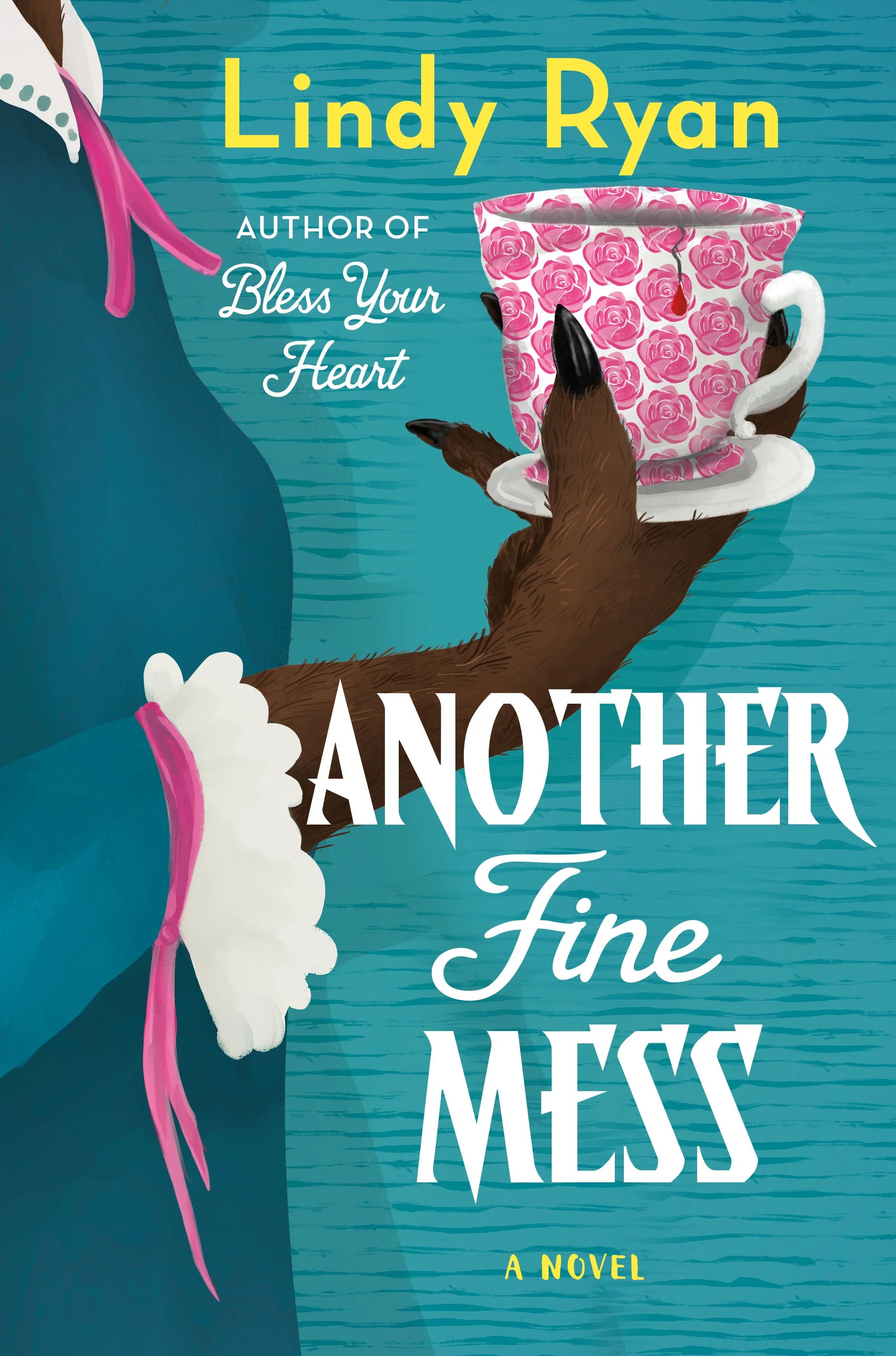
Spotlight: Another Fine Mess by Lindy Ryan

Making sure dead things stay buried is the family business...

For over a hundred years, the Evans women have kept the undead in their strange southeast Texas town from rising. But sometimes the dead rise too quick–and that’s what left Lenore Evans, and her granddaughter Luna, burying Luna’s mother, Grace, and Lenore’s mother, Ducey. Now the only two women left in the Evans family, Luna and Lenore are left rudderless in the wake of the most Godawful Mess to date.

But when the full moon finds another victim, it’s clear their trouble is far from over. Now Lenore, Luna, and the new sheriff—their biggest ally—must dig deep down into family lore to uncover what threatens everything they love most. The body count ticks up, the most unexpected dead will rise–forcing Lenore and Luna to face the possibility that the undead aren’t the only monsters preying on their small town.

Excerpt

Chapter 1

Sissy Broussard, September 1999

Sissy Broussard disliked a lot of things.

She disliked the kind of rain that came down in sheets, the scratch of a brush through her hair, the chalky pills Mother pushed down her throat every evening. Scents of citrus and mint and pepper. Loud noises. Cold. Sissy especially disliked the necklace Mother gifted her last birthday. She disliked the way it fit, too tight around her throat, how Mother insisted that she wear it, that it looked so pretty on her. She disliked the cool metal clasp that pulled at the hair at the nape of her neck, the glitter the necklace left along the edges of her vision, the silver charm that jangled loud enough to hurt her ears.

But most of all, Sissy disliked cigarettes.

Especially the ones in the green and white package, she thought and sneezed. The acid and peppermint made her nose itch and her lungs burn—which put Sissy in a predicament, because the mint cigarettes were Mother’s favorites.

Mother did her best to control the cigarette stink, but she could pump the air inside the house thick with all the Glade she wanted and it would still smell like burning menthol, but with the added fumes of Vanilla Breeze and Rainbow Potpourri. Sissy let the choker squeeze her throat, pull her hair, clink against her chest because Mother said it was important, but the curling acrid smoke that stunk up her beautiful coat and made her sneeze?

That she could not abide.

“Don’t you go sneakin’ out tonight,” Mother reminded her from behind the acidic fog, forever worried about cranky Mr. Gordon, who opened his front door and made sweet sounds whenever Sissy walked by. “Too many gone missing lately,” Mother said. “Don’t want nobody makin’ off with my pretty girl.”

Sometimes Sissy listened to Mother’s warnings and sometimes she didn’t, but the concern that she’d wander too close to the old man’s porch was wholly unnecessary.

Offensive, really, Sissy thought. She disliked Mr. Gordon, with his loud catcalls and coffee stink almost as bad as Mother’s cigarettes. His frizzy brown hair and frizzy brown eyebrows and frizzy brown beard. She only ever walked on his side of the road to get a better look at the birdbath on his front lawn, and even that she preferred to watch from the comfort of her favorite reading chair.

Aside from a little window shopping, birds were too much trouble for Sissy to bother with.

Too much, really, for Mr. Gordon to bother with. If he wanted to invite birds to his yard, he already had a perfectly good nest perched right on top of his head.

But Sissy disliked involving herself in anyone else’s business almost as much as she disliked anyone involving themselves in hers. And so, after a lazy Sunday spent lounging in her favorite reading chair, caught in a beam of warm September sunshine, she nibbled at the dinner her mother served, enjoyed the clack-clack-clack of the spinning wheel on her favorite game show, and then, when Mother retired to the back bedroom to smoke herself to sleep, Sissy pushed open the screen door and went out to get some fresh air.

The night’s warm breath pushed the cigarette odor out of her nose, tickling along her back as she padded down the center of the quiet residential street.

Daytime strolls were fun but when the sun went down, Mother went to bed, Mr. Gordon shut his door, and all the silly birds that flitted about the ugly concrete eyesore in his front yard hid themselves away for the night.

Everything else woke up.

Sissy knew every house on her street, every pet, every sound, all the way from the small house with the red shutters where she and Mother lived to the two-story at the opposite end of the block where a bratty Pomeranian yipped from behind the window every time Sissy strolled by. Now, from her viewpoint in the middle of the streetlamp-shadowed road, everything lay before her, spread out in every direction—the neat little houses all in a row, with their matching shutters and matching front doormats and closed garages. A few porch lights were on, but all of the windows dark. A tall trash bin punctuated the end of every driveway, lids closed to keep out the sort of nocturnal critters that dined on refuse and rubbish.

That don’t have mothers to lay out their meals for them.

Sissy disliked Mother’s habits as well as her gifts, but she quite liked her daily servings of cold fish and liver pâté.

Tomorrow morning the big green truck would make its way down the street, snatch up the plastic cans waiting at the end of each driveway, and gobble down their insides, just like they did every Monday morning—just like Sissy did when Mother served treats of chilled cream and crust in a special dish on the kitchen counter.

She listened to the sounds of night as she passed the tall can at the end of her driveway, the abandoned birdbath two doors down on the left, the square tubs the lady across the street always put out one night too early, on green trash night instead of blue recycling night. Sissy crept just outside where the streetlights touched, where the sparkles on her necklace didn’t glimmer in her peripheral vision. Her ears quirked at the tiny nicks of squirrel claws on bark, the scuttle of nocturnal critters as they skittered around, the crunch of dry leaves scattered against curb walls.

A possum hissed at her as she passed, but Sissy ignored it.

A squirrel chittered overhead, but she—

A flick of fur caught her eye.

Sissy froze. The stupid silver charm on her neck tinkled at the abrupt stop, then lay quiet against her chest. She stood stock still, the coldest thing in the warm autumn dark, not a wiggle of nose or twist of ear. Her eyes locked on the small tuft of what might be a tail, might be a paw, half-hidden behind one of the big green bins at the end of somebody’s driveway. She scented the air. Whiffs of moldy food scraps and drying leaves, a trace of Pomeranian scat on the downwind, but nothing that smelled like dinner.

Moonlight deepened the shadows around the trash can, outlining its edges with thick black borders. Even with her night vision, Sissy couldn’t make out the fine details of the brush of fur, but she lowered herself onto her haunches and listened.

A twig snapped. A mouse, maybe.

The brush of fur moved, became a ball of dark.

Raccoon, Sissy guessed as the fur swelled around the moon-shadowed edges of the can and she caught the scratch of nails against asphalt. Some little bandit, hoping it could wrench open the tall bin’s lid with its little humanlike claws, scavenge around in the filth within.

Electricity surged under Sissy’s skin. Dinners nibbled out of a tin were easy and cheap, but she’d trade every last puck of tuna and saucer of cream in Mother’s kitchen for the feel of a fresh catch between her teeth. A taste of raw meat.

A mouse would make for a delightful midnight snack, even if it would mean extra bathing tomorrow as Mother cleaned the blood from her fur.

Tomorrow Sissy would have all the daylight in the world to bathe, to snooze, to sneeze.

Now in the fresh air and wane of last night’s full moon, she’d hunt.

She crouched low enough that her small, lithe form might become nothing but a blur on the pavement, a smear as easy to overlook as an oil stain. As the snarl of dark hair that tried to hide in the can’s shadows.

Sissy’s ears twitched, her stomach rumbled, when the trash can growled. Definitely not a mouse, then. Not a raccoon, either.

Mr. Gordon?

Sissy’s ears flattened against her head. Her whiskers worked, her fur jumping up at the roots when an odor almost as acrid as Mother’s stupid cigarettes infiltrated her nostrils. The scent tore the hunger from her instantly, and a new instinct flooded through her. When Sissy pushed her body against the hot top now, it wasn’t so she could watch the creature behind the bin.

The ball of dark shifted, stretched, stood on all fours. The mass of fur and teeth atop its shoulders turned toward the street. Sissy stayed still as a statue while gleaming eyes cast out into the night, searching the shadows, scanning the dark—catching the sparkle of Mother’s necklace around Sissy’s neck.

The cat sprang to her feet and ran.

Another snap, another growl, and the predator behind the trash can gave chase.

The silver bell on Sissy’s collar screamed against the sound of the beast’s feet as they pounded behind her on the pavement—a ting, ting, ting, tracking her every step as she raced away from the thing behind her.

Her paws left asphalt, hit grass, slid over sidewalks, driveways, porches, as she fled, the neat little houses all in a row, their matching shutters and matching doormats and closed garages, all suddenly strange and unfamiliar.

She did not see Mr. Gordon’s house, his stupid birdbath.

Didn’t see the recycling tubs, set out a day early.

Didn’t see Mother’s house.

Sissy saw nothing but black. Smelled nothing but fear.

Heard nothing but the sound of her own collar, making it so easy for the monster to close in.

Buy on Amazon Kindle | Audible | Hardcover | Bookshop.org

About the Author

Lindy Ryan is an award-winning author, anthologist, and short-film director whose books and anthologies have received starred reviews from Publishers WeeklyBooklist and Library Journal. Several of her projects have been adapted for screen. Ryan is the current author-in-residence at Rue Morgue. Declared a “champion for women’s voices in horror” by Shelf Awareness, Ryan was named a Publishers Weekly Star Watch Honoree in 2020, and in 2022, was named one of horror's most masterful anthology curators. Her novel Bless This Mess is currently a finalist for the Bram Stoker Award. Born and raised in Southeast Texas, Ryan currently resides on the East Coast. She is a professor at Rutgers University. You can visit her online at lindyryanwrites.com.