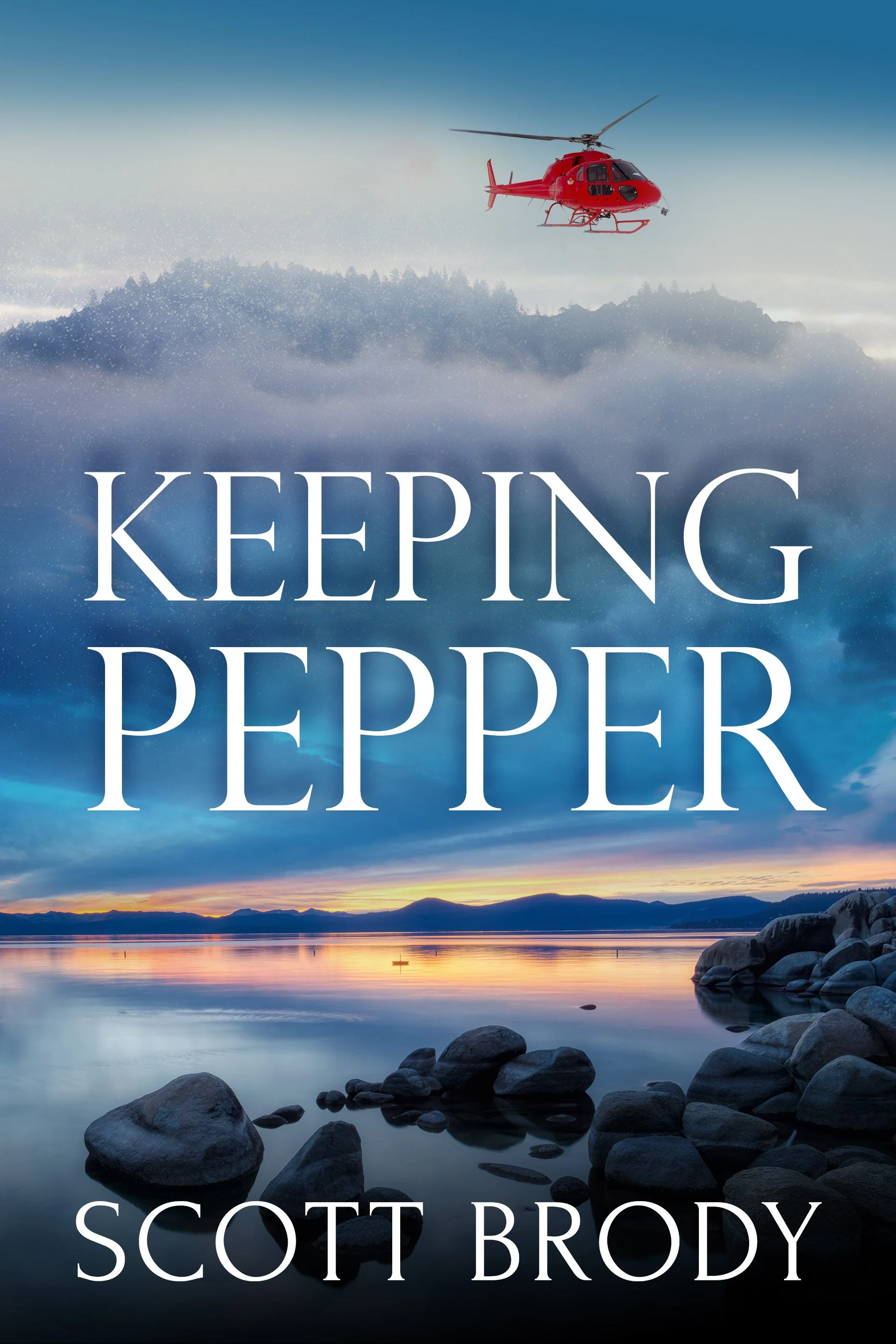
Beneath the weight of four long years in confinement, a story of liberation unfolds, igniting a whirlwind of love, fear, and even hope.
Ed and Stacey's departure from San Clemente at daybreak would prove to be much more than the start of a simple road trip.
The motorhome's tires kissed the asphalt of Orange County goodbye as they navigated towards the sprawling, glittery embrace of Las Vegas, and their friend Pepper.
That night, amidst the clinking of chips and shuffling of cards, Ed played at the $10 Blackjack table for hours, his thoughts swirling like the gin and tonic in his glass. His mind dances between the past and reconnecting with Pepper, a symphony of melancholy notes for the years gone by.
Their visit with Pepper the next day was supposed to be short. But his dementia had gotten much worse since being admitted, and Ed didn’t have the heart to leave him behind.
So Ed, Stacey, and Pepper embark on the next leg of their road trip together, to visit more old friends at Clear Lake near Santa Rosa.
At the reunion Pepper meets Sandy Martin, and sparks fly almost instantly, putting into motion a very different life than the hospital could offer him. Because facing the unknown together is better than being alone.
But when a local psychopath hears Pepper on a radio talk show and decides he wants Pepper to be his friend, things take a very dark turn.
Excerpt
Konocti
In the end, twelve of them decided to make the trip. Several others begged off, leery of the trails and opting to take the day at the farm. They took three vehicles. A car and two SUV’s, packed with lots of food, drinks and gear in addition to the people. It took them about twenty minutes to get to the bottom of the mountain. The road goes through the village of Kelseyville, down some residential blocks, then the road slopes up through a series of farm fields and orchards, followed by open rocky hillsides. As they rose up on the hill, the tableau took shape - Clear Lake at the foot of the mountain with towns and suburban blocks in the distance. Going higher, the view got bigger, and the lake got both deeper in color, and silvery where the sun reflected off it. They all stopped talking and watched the view changing and developing with some awe as they drove. As they got higher, they disappeared into a cloud bank, then the road popped out of the cloud, and they were in a thick stand of Maul Oaks in a notch between two peaks rising on either side of them. The oaks were tall, 40 to 60 feet, with big heavy curving branches that looked like trees out of an old Disney cartoon. They drove a bit further through the woods until they reached a clearing with parking spaces near a trailhead. They got out, still surrounded by trees.
“That didn’t take long,” Stacey said, stretching her legs.
Richie was organizing their stuff. He had divided them up into small packs so people could carry them easily on their backs. By giving them to a few people, he figured nobody would have too much weight to carry.
“They call it Mt. Konocti, but it’s really not much of a mountain,” he said. “Just about 2,200 feet above the lake.”
“Looked a lot higher coming up,” Hubert said. “Beautiful views on the way up. Can’t wait to see them from here.”
“Yeah, it gets better from here on.” Richie said. He turned to speak to the group. “Everybody ready? Everything good? Anyone need to pee or anything before we get started?” Nobody said anything. “Anybody wanting to take a nap yet?” He laughed, as did a few in the group.
“A nap?” Pepper asked Ed.
“It’s a joke, Pepper.”
“Ah.”
Pepper was standing with Ed, Stacey, Sandy, and Franny. They had decided to stay together as a group on the hike. They looked like an aging tribe in plaids and jeans, shaggy hair and caps in the cool morning. Bits of fog lingered and drifted through the trees around them, cooling the air and filtering the sun.
“OK, well then let’s get started,” Richie said to them all, turning to walk. “The trail-head is over here.” And they were off. They hit the trailhead and followed the path into the trees. After a few minutes, Richie started talking to them about where they were.
“This is what they call the Black Forest because it’s a very dense wood of Douglas Fir and Maul Oaks. It’s a bit of a mystery, since it’s located on the north face of the mountain where it never gets direct sunlight. Nobody really understands how it got started here or why it grows just here.”
“Kind of spooky in here actually,” Sandy said to Pepper, sliding her arm around his. Pepper thought that was nice, but he wondered if she was thinking he needed propping up. He decided not to worry about it.
“Yes,” he agreed with her. “Keep your eyes open for witches.”
Richie kept going. “Truth is Mount Kon is really pretty exceptional. It’s not so big, as I said before, but it is a special place - both the mountain and the lake. It’s an old volcano. Part of what they call the Clear Lake Volcanic Field. It has been quite active in its history. They say it last erupted around 10,000 years ago, which is pretty recently.”
He stopped to help a Cyn and Hubert over some rocks.
“I guess it was a fairly active volcano over the millennia, and through that time it created lots of caves and natural tunnels - old volcanic vents - into the interior of the mountain. Indians used to live here - lots of them. This was a large settlement of native Americans all around the lake. Mostly the Pomo tribe. They say thousands lived in the area in the 1800’s before white men came and started killing them off.”
“God Bless America,” Eddie said.
“But the Pomo explored the area more than anyone since. Their stories about the mountain told about a huge open cavern in the center of the mountain. Probably this would have been the central magma chamber from when the mountain was an active volcano. They said their
men used to crawl through the tunnels until they came to the edge of the openings, then they would drop things into the cavern to see how far they fell. Often, they never heard them land. Geologists mostly tend to believe these stories. They say this could be the tallest cavern in North
America. But the soil is very unstable and many of the vent tunnels have collapsed. So, it is dangerous to explore - nobody has ever been able to find the central cavern, if it still exists. But one thing they do know about Konocti - the mountain breathes. All the vents around the sides, and the open cavern in the center creates wind drafts and thermal currents. The changing pressures and different temperatures create its own air system. They say when the weather is changing on the outside and it gets windy, that’s when you can hear it the most, kind of whistling or wheezing. Feel it too, since the air on the inside is a constant temperature it feels either warmer or cooler than the air outside. So you get little blasts of the mountain’s breath walking around.”
He stopped and walked with them for a bit. Walking and talking got him out of breath.
“Lots of people have reported strange breezes blowing right out of holes in the side of the mountain. Sometimes they smell like old decaying soil, sometimes people say they blow warm wet air. It breathes. In storms, especially. And lots of people report finding openings into the side. Sometimes big enough to call caves. Other times just holes. This mountain -- it seems to have its own life, kind of. It’s unpredictable and kind of spiritual. One of the reasons I wanted to bring you all up here, just to see it and feel it. The Pomo felt it. This was a sacred place to them. They gave it the name Konocti which combined their two words for “mountain” and “woman.”
“Wow,” Sandy said. “You know, Richie - as long as I’ve lived in San Francisco, I never heard any of that before, and we’re so close. I’ve heard of Clear Lake, but never heard much about it. Never seemed to be anything that special.”
“I know, I don’t get that either, but people don’t seem to know much about it. I guess Napa steals our thunder, which I get. But this is a pretty amazing place. And really there’s much more. I haven’t even told you about the lake yet...”
And right on cue, as he said that they started to walk out of the trees into a more open section as they turned the corner to the eastern slope of the near peak they seemed to be heading towards, and the lake came back into view behind them. It was ringed by mountains. Now that they were near the top, they got the long view of the neighboring peaks and beyond.
“Killer view, man,” Ed said.
Richie was focusing on one spot on the lake, pointing. “Look, you see that patch on the surface of the lake over there?”
“I guess so,” Ed said. He didn’t see much, but he thought he could see some ripples around one area out in the center of the lake.
“There’s not much to see from here, I know. But it’s interesting. Of course, all this - this whole landscape - was created by volcanoes. It’s called the Clear Lake Volcanic Field, like I said, and it is still active. There’s some kind of magma pool underneath the lake. That patch in the water sits above a volcanic vent at the bottom of the lake. Lots of people have explored it. They call it a thermal spring. They say there are a bunch of vents under the lake, but that one is the biggest. Some divers explored it, but the water got too hot to go very deep. The magma is supposed to be pretty close to the surface there, less than 10 miles.
“The bubbling water from the volcanic vents gave the lake a reputation for healthy water, like mineral springs. Back in the day, maybe the early 1900’s I imagine, this area was full of
expensive resorts where people used to come to bathe in the waters. They say it was quite big back then.
“Here’s the other thing about Clear Lake - which by the way is not clear at all, very murky, nobody knows why they started calling it that - but Clear Lake is one of the oldest lakes in North America. It’s like half a million years old. Apparently, most lakes eventually get filled in with silt from runoff, but this one sits on some kind of plateau that has the ability to get pushed down as the weight from the silt increases. So, the bottom drops down as the silt comes in, which has kept the water in place all this time. Again, this is a function of the volcanic formation of the area. How cool is that?”
Everybody had to agree with that. Cool place. They kept walking. It was relatively level on the path. Still, Ed could feel himself getting a bit short of breath, not being used to the altitude. He had no doubt he was not the only one feeling it. He pushed on. He didn’t want to hold everybody up. The trail continued on now winding through the flat area and starting to slope up towards the nearest peak. They went through mostly shrubs and small trees now, as the side of the old volcano was strewn with sharp-edged black lava rock with plants growing around and through them. The path was relatively smooth and clear, but they all knew this would be a bad place to twist an ankle, (“God forbid”), so they watched carefully where they were walking. Between their exertion and their focus on the path in front of them, the conversation slowed to just an occasional comment. They walked in silence, just looking up from time to time to appreciate the incredible view all around them.
Richie felt like everything was going fine and according to plan. The trail was a loop trail of about two miles around, sloping up as they got closer to the peak, which was still some
distance in front of them. This wasn’t the main peak of the mountain, but a secondary one a bit lower. It wasn’t very hard to walk, but he figured they could always turn back if need be. His thought they’d stop on the rocks at the top and relax, take in the sun and admire the views, have a snack. Richie checked the time - it was almost 11AM. Everything was fine, but he was already stressed with the responsibility of the group. He hoped this was a good idea. There were some flat rocks nearby so he called a quick break and told everybody to relax. Nobody objected. Pepper sat with Sandy and Ed. Stacey was talking to Cyn.
“You both doing ok?” Ed asked them.
“Yeah, sure - feeling good,” Pepper said, with an energy that surprised Ed a little. “Well, good. That’s great, man. How about you Sandy?”
“I’m good. I’m pretty good about exercising. Nothing radical, but I stay in pretty good shape. So far this isn’t very challenging.” She pulled out half of a peanut butter and jelly sandwich and waved it. “A little protein, some carbs... tastes good up here!” She laughed. “How about you, Eddie, how are you doing?”
“No problem. I was feeling a little out of breath walking up here, but I’m OK. Great up here, I love it.”
“Yeah, nice,” Sandy agreed.
Ed was thinking how well Pepper seemed to be doing. He hadn’t been sure this hike was such a good idea for him, but now he decided maybe it was just the thing. Pepper seemed in clear mind and having fun. Ed didn’t know Sandy very well. He felt like he would like her well enough. She seemed nice. Certainly, she seemed to be good with Pepper. They seemed to be good together. She coaxed him to eat some of her sandwich, telling him he needed the boost for
the hike. Pepper said something to her that made her laugh again. Wait, he thought, looking at them again, how far has this already gone??
At that moment Pepper’s phone began to ring.
Pepper was clearly as surprised as anyone. He just managed to pull the phone out of a pocket and answer it before the call went off to voicemail.
“Hello? Yeah, it’s me.”
Ed was looking at him, curious. “It’s that guy from the radio station,” Pepper told him. Ed held out his hand. “Give me the phone,” he told Pepper.
“Eddie, it’s OK, I like talking to him. I don’t want to stop.”
Ed nodded. “I know, don’t worry. I just need to talk to him.”
Pepper gave him the phone, nervous, not knowing what Eddie was going to say. “Who’s this?” Ed asked.
“This is Will Shockley, from K-Talk Radio in Santa Rosa. I do the midday talk show here. Who is this?”
“Don’t worry about that right now. First - we’re not on the air now, right?” “No I’m not on ‘til later. Go ahead and turn on the station now if you have any doubts. Legally I actually have to get your approval for that anyway.”
“And you’re not taping this? Is anyone else listening?”
“No. You’ll have to take my word on that. But it’s just me calling Mike, that’s all.” “And you’re calling him, why?”
“Mike’s a trip, man. I like talking to him. Our audience loves him.”
Ed laughed in spite of himself. Pepper was a trip alright. Will heard the laugh and felt maybe he was breaking the ice. He waited.
“Alright look,” Ed said, “I get that, sort of. And I’m not trying to cut him off from you. I just need to be sure we can observe some rules, OK? I need to make sure to keep him safe. It’s easy to take advantage of him. You know what I’m talking about?”
“I don’t know,” said Will. “How am I taking advantage of him?”
“You haven’t yet. I just want to make sure that doesn’t happen, by you or anyone. Look, this is easy - don’t ask him his name, and don’t ask him questions about where he’s been the last few years. No specifics. OK?”
“I guess so.”
“That’s not good enough.”
Will hesitated but heard no give there. “OK, I can do that.”
“Good, there’s more,” Ed said. “We need to take this further. I need you to make sure nothing comes out. You run some kind of delay?”
“Sure.” Will said.
“OK, so I need to know if anything comes out, you’re going to stop it before it goes out.” “Wait, that’s really hard. We only delay 6 seconds, pretty hard to guarantee I can catch anything in that window.”
“That’s enough time, and you’re not getting this conversation,” Ed said. “This is not a negotiation. Look, I’m trying to work with you, for Mike’s sake, I’m prepared to trust you up to a point. But I’m not going to put him at any risk. If you can’t live with that, no problem. You just don’t talk to him.”
“OK...” Will was saying.
“We’re not done yet,” Ed said, “Don’t tell me what you can’t do, or why it’s hard. That’s your issue, and I don’t believe you anyway. Here’s what I want to hear, ok? Because if you and I
are on opposite sides of this, it’s not going to work. You need to be on my side of the table. Mike needs people looking out for him - I know you look at him as a potential ratings-booster, and that’s ok, but I expect you to also be on his side. Look out for him, protect him. Work with me. I don’t want to feel like you don’t give a shit and are looking for excuses to blow me off. I want the opposite - I want to trust that you’ll be thinking about him, and listening to what he’s saying, and making sure he doesn’t get close to that line. You see? I need to hear that from you. I need to hear it in your voice. Otherwise we’re done.”
Pepper was watching Ed, listening, straining to hear the phone. Ed stopped talking, waited for a response.
“Your turn to say something,” Ed said to Will. “Or not. Then I’m hanging up.” Will weighed his words. “OK. You’re right. People are trying to find out who he is. But I wouldn’t tell them. I hid your caller ID. I actually have been protecting Mike.” Ed hadn’t been expecting this, it scared him. “Who is looking for him? What happened?” “His first call here was really cool, but he mentioned splitting from some home or hospital or something. He didn’t give any details, but it was enough to set off warning bells for me. The cops called, my management was all over me. I told everyone there was no caller ID - which was a lie, of course. I kept the number and made sure it was deleted from the station phone system completely. After that, I made sure nothing was showing anywhere, and any calls I made to him were on my personal phone.”
Ed was impressed. “That’s good.”
“My instinct was to keep him away from everyone else. I mean, I will say straight up that part of why I wanted to protect him was so I could keep him on the show. He’s very interesting
and funny. Such a free spirit. You can’t believe how many calls and comments I get on him, people asking when he will be back on the show.”
“Really?”
“Yes, really. I’m sure he does help my ratings. Does he have dementia?” “They say so.”
“Yeah, that’s terrible. Yet, even that, the way he seems to deal with it - it’s so open and positive. People really respond to him, you’d be amazed.”
“Oh no, I know. We’ve been friends a very long time. I see that. He’s a rare soul.” “He is that,” Will said, “So yes, I want him on with me, but also I can see he has vulnerabilities. I want to keep those away from him. He needs to be safe, I’m good with that. I was calling him just now, mostly just to ask him how he was doing. I do worry about the old dude.” He stopped. Eddie was still thinking.
“We OK?” Will asked. What’s your name anyway?”
“Name’s Ed. I guess we’re ok, so far. I want to trust you, believe it or not. He does enjoy talking to you and I think it’s good for him. But I don’t have a very good impression of Talk Radio people in general. Maybe you’re different, I guess we’ll see. For his sake, don’t let us down, OK? I reserve the right to pull the plug on you anytime, and there will be no second chance. Clear?”
“Clear,” said Will.
Here...” He handed the phone to Pepper.
Pepper took the phone, aware that by now everybody was watching. “Yeah,” he said. It sounded to Ed like Will was just making small talk with him for a bit. No doubt because he
figured Ed was listening. Which he wasn’t much, actually, His knee had gotten stiff during the call with Will, so he walked a little and stretched it out.
Pepper must have told him they were up on the mountain because he was trying to convince Will they weren’t all crazy and everything was going to be fine. “We’re good, dude, don’t sweat it... It’s really nice up here...OK, sure I’ll let you know if we have a problem. Right, right.” He punched off the call, rolling his eyes. “Man, what a worrier.”
Everyone laughed at that. Stacey thought about explaining to Pepper why that wasn’t really so crazy but didn’t.
Richie felt like it was time to push on. He got them up and going. The path continued sloping up, heading generally towards the peak to their right. A taller peak watched over them to the left, but that one was definitely too much of a climb. The land sloped up much steeper in that direction. The weather was perfect, sunny and around 60 degrees. Several of them took off their coats. As the trail got closer to the peaks, there were smaller pine trees.
Pepper was in a good mood. Everything felt good to him. Here he was walking between Hubert and Sandy, holding Sandy’s hand. His body was working fine, he thought. Legs felt good, no problems. He couldn’t get over how beautiful everything looked and felt. There must be something perfect about the air up here, he thought; everything looked so incredibly clear, colors so brilliant, sunlight sparkling. He just kept looking all around, marveling at it. And the feel of the air - how could it be that good, that perfect? How could our bodies be in such synch with the environment? He had never thought about it that way. How many years of evolution had it taken to achieve that; thousands... millions? Brilliant miraculous harmony. And by the way, who had thought to create this fantastic little mountain they were walking around on?
Hubert must have seen Pepper looking around and appreciating everything. “Nice, right?”
“Amazing,” Pepper said. “I mean seriously, I’m just walking here, but I’m totally blown away at how incredible this all is.”
“Yeah, you forgot about all this, didn’t you? Back in Las Vegas.”
“Yes. I forgot the world could look like this.” Pepper turned and yelled up the line to Ed, walking 30 feet or so in front of them. “Hey Eddie!”
“What’s up, bro?” Ed yelled back.
“You rock, dude.”
“I know. What’d I do?”
“Saved my life. Brought me here. Walked me right out the front door of that miserable place. Put me in your fantastic bus and drove off, just like that. You know you’re out of your mind, right? You and Stacey both. No telling what kind of shit you’ll get into.
“I don’t know, man,” Ed said. “Probably you’re right. But… we couldn’t leave you in that box.”
“Bless you for that. Seriously, you can’t imagine.” He turned to Sandy as they walked together. “And you, you’re another little miracle that just appeared. Who knew I could even have sex anymore?”
“Pepper!!” Stacey yelled at him, but everyone was laughing too hard, Sandy included. She just shook her head.
“What?” he said to Stacey, “is that wrong to say? OK, sorry Stace.”
“Not me,” Stacey said, “apologize to Sandy.”
“Sorry Sandy. But really it was incredible, right honey?” He said to Sandy. “I mean, who would have thought?”
Sandy laughed at both of them and agreed with Pepper. “Yeah, who would have thought?”
Pepper turned back to Stacey. “There, you see?”
“I see,” she said, waiting for the conversation to move on.
“I did get confused.” He turned to Sandy. “Who did I think you were at one point?” “Carla.”
“Of course Carla. My first love and my first wife. You remember her, right Eddie?” “I do,” Ed said. “Why do I remember her so well?”
“It works that way,” Hubert joined the conversation. “Your long-term memory is much more stable than your short-term.”
“That was nice, but also sad,” Pepper said. “Like some ghost from far in the past. I’m glad I saw her. I see them a lot, those ghosts. Sometimes I don’t know who they are, although I’m sure I did know them. But the older the memories, like my grandparents, are blurry and tattered. Fading away, like an old picture losing its color.”
The rest of the group was quiet as they walked, listening to Pepper.
“That’s how our consciousness works,” Sandy said. “I read a book about it one time. They said consciousness is the constant blending of all the inputs to the brain. Seeing, hearing, touching, smelling, tasting. Somehow our brain assembles all those senses into a unified picture of the world around us, and poof… consciousness. And every micro-second it changes and updates. We file the memories away and compare them against other ones.”
“Right,” Pepper said, “I think that’s what I was getting at. I guess that memory thing is what’s failing me. You know, at the Lombard Center they gave us lectures to explain what was happening to us. They figure our memories are created by the different senses and are stored separately around our brain. Then when we go to call them up, our brain locates the files it had stored and re-assembles them. Sounds like some kind of hard drive, huh? Anyway, when you have dementia that filing system gets messed up. That’s why the older memories are easier to find than the newer ones. Because the newer ones don’t get filed right, so our brains can’t find the parts or put them back together right. The older ones were filed right, so those are still find able. Is that a word?”
“I think so,” said Richie. “I use it.”
“I’m not sure where I was going with that.”
“You were talking about how everything is connected,” Hubert said. “Which I think is right. We’re all perceiving the same things, but differently. We think different thoughts, make different associations. That’s our brains. It always amazed me that people talk about some ancient person performing relatively trivial things and calling them miracles, when we are confronted with the most astounding miracles every day. What could be more miraculous than our brains? I guess life itself is equally miraculous. And society takes them both for granted every day.
“Right on,” Richie said.
“I don’t know what creates our unique personalities,” Richie said. “But no doubt our accumulated memories have a big effect on who we are. That’s the difference between all of us being friends or strangers.”
“Yes, it’s true,” Pepper said. “I look at someone and feel like there ought to be memories there, but I can’t seem to pull them up. The brain can be a scary place. Sometimes it just won’t work the way you want it to. All those synapses and connections... Something starts firing wrong, nothing much we can do. I try not to be scared. I try to let it be, maybe to enjoy the old memories. I’m OK now, more or less. But I see the way you all look at me. I know. I don’t want to bring anybody down. I just want a little more time to have fun, see a few more things, do some things I never got to do. Or maybe do them again because I forgot I did them the first time.” That made him laugh. “I guess at some point I’ll have to go back to the Center, or someplace like that. I mean, I saw those people, I lived with them. I can see what the future is. Not pretty… not at all. But… I’m not there just yet, right?”
“No not yet,” Sandy said. “You’re OK. We’re OK.”
“There you go, Pepper,” said Ed. “Sandy says you’re OK. That’s really all you need, right?”
“Hell, yeah,” Pepper agreed.
It was almost time for Will to go on the air. He was punching buttons back and forth with a few callers off the air, finding out what was on their minds that day. Nothing much very exciting, it turned out. Jeannie was in the studio. She had stopped by to ask him what he was
going to do that day. He had a couple of ideas and was looking through the paper for more, but that was mostly for her benefit. He figured to basically wing it, as he usually did, and see where the callers took the conversation.
But Pepper was on his mind. He decided to talk to her about it.
“I talked to Mike earlier,” he said.
“Mike that older guy, with dementia?”
“Yeah, he’s up on Konocti today with a bunch of his friends. I’d really like to get him back on.”
“Wait,” Jeannie said, “He called you?”
“I called him,” Will said.
“Shit,” she said again. “OK. I agree. Get him on the show, I’ll run interference. Can you make it sound like he’s calling you? Frank is buddy-buddy with everybody in this town, so he’ll want to keep the local cops happy.
“You just stand up to him.”
He thinks I’m a lamebrain,” Jeannie said. “I never did figure out why he hired me.” Will didn’t see the big mystery. She took the job for $42k.
Will tried dialing Pepper back but got no answer. He left a voicemail but realized he’d need to find something else to talk about for the show. Back to the second-string callers blinking on hold.
Richie led the group up the path as it moved into the trees. They were approaching the peak he had picked as their goal for the day, and that peak was surrounded by a small wood. The trail got more shaded, and Richie had to warn everybody to watch the roots and rocks in the ground. He slowed down so the group could tighten up and everybody could take their time over the terrain. No broken ankles today, was his mantra for the climb. The trail wound along for several hundred yards. They came out on a small ridge, with another fabulous panorama of the hills, the land dropping off down to the lake below, and the bigger mountains beyond to the horizon. They all oohed and aahed as the view came into sight for them.
Next, the path came off the ridge and dropped into another stand of trees – mostly cedars and pines. Once again, they were in the trees. After another fifty yards or so, Richie stopped the group.
“What is it?” Cyn asked him.
“I just want to check the map. The trail splits here. I just want to make sure we go the right way. This is a loop trail, but I don’t think we’re at the loop split now. Too early.” He studied closely. He had a paper map in addition to the GPS. “The maps just don’t show this quite right. I think we go left here, but I’m not sure.” He looked down the trails in both directions where they split.
“Hubert, you’re doing fine, right?” Richie asked.
“Yes, fine,” Hubert said. “What do you need?”
“Just come with me down this trail a bit. Let’s take a look and make sure this is the right one.”
“Buddy system. Sure, let’s go,”
“OK.” And to Cyn, “Just keep everybody here. We’ll be right back – we’re not going far at all. Don’t worry.”
“Not far, right back, right?” she said. “Stick together - no getting lost. Richie, seriously, if we turn back now, everybody will have had an incredible day. If there’s any question about where to go, let’s forget it. We declare victory and go home”
“Right,” he said to her, “just a quick look up the trail. We won’t be out of earshot, promise.”
And off they went, Richie and Hubert, taking the trail to the right. Richie was serious, of course, he had no plans to take it very far. It snaked around a bit, and maybe 30 yards down, came to an outcropping of rock. Richie was saying this was what he expected – the trail was about to end. This was not the way to the peak. He was about ready to turn around. He just wanted to walk out on the crag a bit where the visibility was better to get a look around. Hubert told him to be careful and hurry up off that rock.
“I know, just a minute,” Richie said. But the rock was tricky. Since Konocti was a volcano, the rock around them was mostly volcanic, which was hard like any granite, only black, very uneven, and full of sharp points and edges. And since the lava cooled in place, there were cracks and holes randomly everywhere. A warm breeze seemed to be blowing around his feet, which struck him as odd. Richie very carefully picked his way up on the rock. Then he twisted around to see where they were.
Bad idea. He could feel himself losing his balance as he twisted. He realized his ankle was wedged in a crack in the rock and he knew he was beyond being able to catch himself – he was going to fall. It all happened in slow motion. He stumbled backwards over the rock, his ankle pulling free as the weight of his body pulled him down. The level of the rock was lower
behind him, so he dropped maybe two feet further as he fell back. He was in free-fall for an instant that seemed to last forever, he looked at the sky as he fell back – knowing the rock was coming next.
The pain was blinding.
He crashed down on the rock below. He hit his head, his ribs, his legs. But it was his back that bore the weight of the impact. The pain, unlike anything he had ever felt, radiated from his lower back like a tsunami ricocheting and pulsing around his body. The sky went black. He thought he heard Hubert calling him, but the ringing in his head drowned everything out. Including his own screaming – if that was coming from him, he really didn’t know. His body was on fire. And his lungs – something wrong there – he didn’t seem to be able to get much air. It seared him to breathe.
Then he passed out.
Above him, Hubert was in a panic. He also had seen it playing out as if in slow motion, watching Richie twist, lose his footing, stumble, then sail down backwards landing on the volcanic rock behind him. Even before Richie saw it coming, Hubert knew this was going to be bad. But the sound of Richie landing bone on rock almost made Hubert throw up. He started screaming for help right away. Now Richie was lying motionless below him. Hubert’s mind locked in horror. He didn’t know whether to run back or stay with Richie. All he could do was to scream to for help.
Back up the trail, the group was relaxing quietly when they heard a terrified sounding screaming coming from where the two had gone down the path. Cyn and Eddie jumped up. They couldn’t tell who was screaming at that point, but obviously something was very wrong. Cyn took off ahead of Ed.
“You stay here with everybody,” was all she said to him as she started running down the path.
Ed realized that was probably right but felt like Cyn would need help. “Stacey,” he said to her, “you better go. That sounds bad.”
Cyn reached them quickly. She ran past Hubert, who was still screaming. She saw Richie on the rocks and scrambled down to him. She fought to control the rising panic in her as she tried to see how badly hurt he was and start to take care of him. Gently, she took his head and started running her hands over his body feeling for wounds or breaks. She knew she was crying since she had to keep wiping her eyes.
Stacey was right behind her, trying to take it in. She climbed down to be with Cyn. “Did he break anything?” she asked Cyn.
Cyn didn’t answer, she couldn’t take her eyes off Richie. Stacey spoke to her evenly and directly, trying to get her to focus. “Cyn, where is he hurt? What did he break?” Richie was starting to move now, moaning but breathing and struggling to regain consciousness. His eyes fluttered, looking glassy.
“Richie, can you hear me?” she asked him.
“Aaah, aah” was all he said, but Stacey could see him looking and trying to focus on her. “OK stay with us now,” Stacey said. “Just relax, you’re going to be ok. Cyn, talk to me. Now!”
Cyn blinked at her, still crying. “Yes, what?” she said. “He’s really hurt. Oh my God, Stacey.”
“OK listen to me, honey,” Stacey said, “we need help here for him. Right now. I’m going to go back and tell Eddie. He’ll get it done. But we can’t lose any time. OK? So I need you to
stay with Richie. Try to keep him awake and warm. Make him comfortable if you can, but don’t move him. We don’t know what’s really broken. You got that, ok?” Cyn nodded. “I need you to look at me and tell me you’ll do that,” Stacey said. Cyn did. “OK,” Stacey said, “I’ll be right back.”
She climbed back up to Hubert, who had calmed down some.
“I can’t believe this happened,” he said.
“I know. But are you ok now Hubert? I need to get back to the group and get help.” Hubert couldn’t seem to focus on her. “He hit so hard, that was so terrible. That noise… I think he hit his head on the rocks. That was too loud. I never heard anything like that before.” He looked at her now for the first time. “I hope this wasn’t my fault.” He seemed to be questioning this.
She did her best to reassure him, but this new info made her even more frightened for Richie. She wanted to tell Eddie. “I really have to go, Hubert. You just stay here.” “Yes, I’m ok now. You go, I’ll stay here with Cyn. Go.”
Stacey hurried back up the trail until she got back to the group “It’s Richie – he took a very bad fall.” Then she turned to Ed.
“He fell on his back on the rocks. I can’t tell what he may have broken, but he’s barely conscious. Hubert says he cracked his head pretty good. You need to get us help up here like right now. It’s bad – I’m scared.”
She saw Ed taking out his cell “Do we have bars up here?”
“Yes,” he said, dialing 911. “Thank God we’re high up. You have your phone, right?” She nodded.
“OK, you go back. Take some water with you. I’ll let you know what I find out.”
Stacey went back down the trail, telling everybody else to just stay there, don’t wander off.
The phone was being answered, so he turned his focus to that. Ed really didn’t have that much to tell the 911 operator. They were hiking on Mt. Konocti, near one of the peaks. One of his friends had taken a bad fall and needs medical help right away. No, he can’t walk – he’s barely conscious. That was really all he knew. Stacey hadn’t been able to give him any more specific info. The operator peppered Ed with questions - Did he get a concussion? Probably. Broken any bones? Don’t know. Is he breathing ok? How is his heart rate? Is he bleeding? But Ed couldn’t answer any of them. Thinking about what Stacey had said, she hadn’t mentioned any serious bleeding, so he said he didn’t think so to that question. He felt frustrated – like maybe he wasn’t making her understand the urgency of the situation.
“Look, please! We’re not doctors here, I don’t know what may be broken or hurt. But we need help – you have to get him out of here and to a hospital,” Ed was almost shouting at the phone.
“Yes sir, we’re working on that. Just stay with me on this phone please. Is the battery on your cell ok?”
Ed stopped to look. “Yes, it’s good.’
OK,” the voice on the line was level, sounding in control. She was trying to calm him. “We’re talking to Medevac now.”
“Thank you,” was all Eddie could say.
She was back thirty seconds later. “We have a helicopter coming out of Ukiah for your friend. They are lifting off in a few minutes. That’s about 35 air miles away from your location. They should be there in about fifteen minutes. Is there a clearing somewhere near you?”
Things started moving very fast. Ed went back down the path, watching for the helicopter and trying to tell the 911 folks where they were. Another EMT talked to Stacey about how Richie was doing, concerned that he was going into shock. After a while Ed heard the familiar whirring of chopper blades – at first very faint, then louder and louder until the helicopter filled the sky and the powerful downdraft blew up a cloud of dirt and dust all around them. He couldn’t remember ever hearing a more welcome sound.
Then the EMT’s were on the ground and running up the trail. They got Richie strapped in the gurney and back to the helicopter with Cyn, and then they were wheels up and on their way to Santa Rosa.
Once it was gone, a drafty silence returned to the mountainside, the group in stunned silence. The local police had also been called by EMS and a couple of cars showed up with lights flashing.
Buy on Amazon
About the Author