Q&A with Simon Tolkien, The Room Of Lost Steps
/
Why is your novel called The Room of Lost Steps?
Because I got lucky!
In the summer of 2019, I spent a week in Barcelona doing research. I had a series of sites to see, but changed my schedule on the last day because my tour guide happened to mention that Antoni Gaudí’s architectural masterpiece, the Güell Palace, had been used as a communist prison or cheka during the Civil War.
As I passed through the wrought iron entrance archway and entered the cavernous lamplit vestibule, I felt a sense that I had left the world behind and that the palace was magical, turned in on itself, alive and watchful, in a way I had never experienced in any building before. And as I walked through the beautiful halls with their thick walls clad in ebony and rosewood, iron and stone, I felt a dawning certainty that this was where the climax to my book would play out. As if my characters already existed there, their footsteps echoing on the marble stairs just like mine.
Finally, I came to a sumptuously decorated rectangular room with an elaborately coffered oak ceiling and snake-like ornaments, separated by three marble columns from a narrow gallery overlooking the street below. I looked in my guidebook and saw that this was the room of lost steps, so called because it was where supplicants waited to be admitted to the great hall beyond, walking up and down, thinking of what might lie ahead. Lost steps trod on the threshold of success or despair. But I knew that for my hero, Theo, this would be where his story would end; this would be the room where Esmond, his schoolfriend turned communist secret policeman, would interrogate high value anarchist prisoners brought up from the basement stables turned dungeons down below. Prisoners that would include the girl that Theo loved.
All the rest of that day, I took measurements and made notes, filled with a sense of gratitude and wonder. I felt as if the palace and the room of lost steps had been waiting for me, even though that of course made no sense, because I had stumbled on them by virtue of a chance remark.
Back in America, the feeling stayed with me, and years later, when a friend read my book and suggested that The Room of Lost Steps should be its title, I knew immediately that she was right. Because it was the room where everything ended, and because of its mysterious name, and because it suggested the theme of loss and disillusionment that lies at the heart of Theo Sterling’s journey from boy to man.
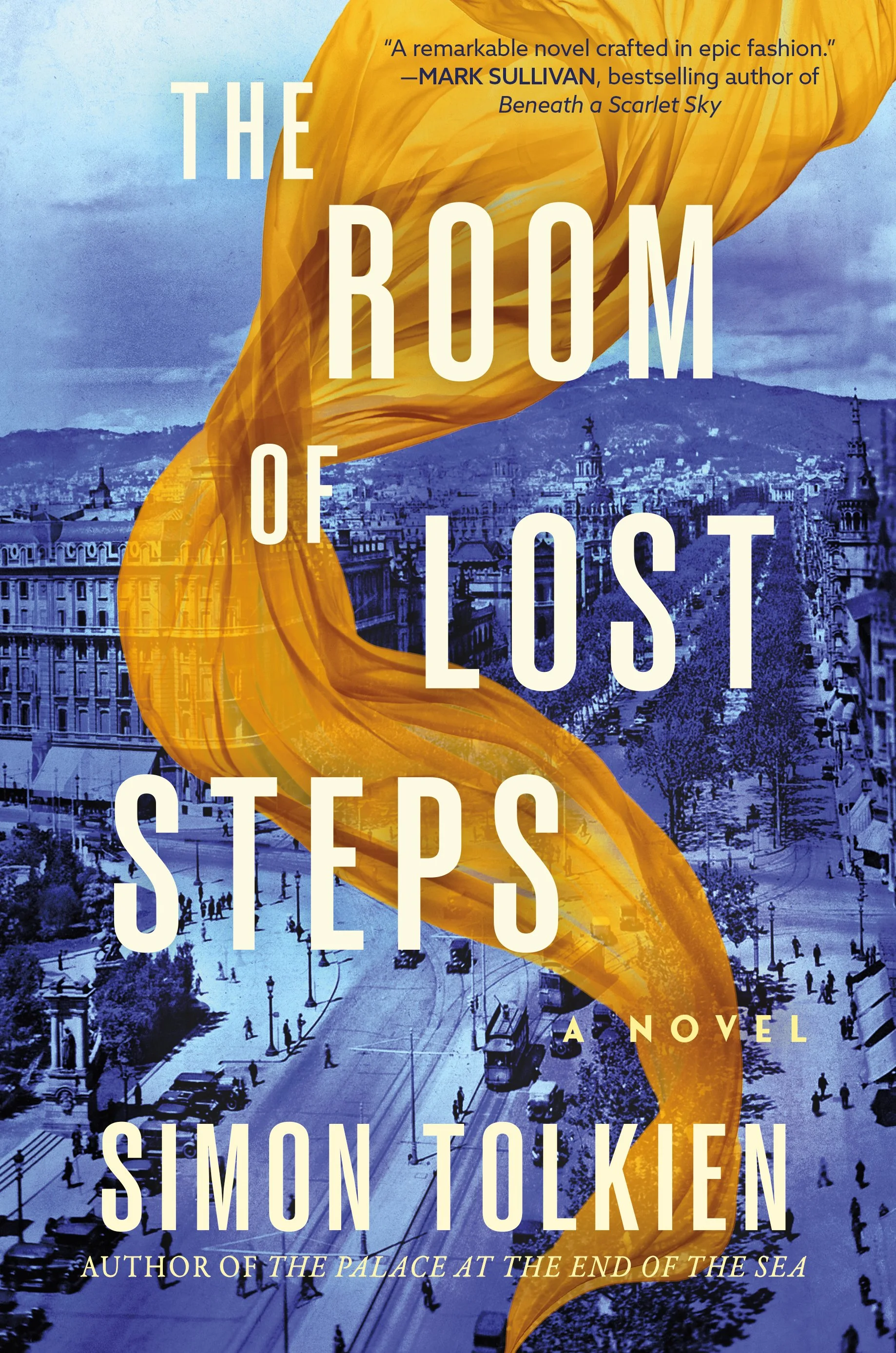
What is the significance of the photograph on the cover of The Room of Lost Steps?
The photograph of Barcelona from the 1930s was taken, looking across Plaça de Catalunya to the Passeig de Gràcia. On the left, at the corner of the square, stands the imposing Hotel Colón, which was demolished in 1940 and replaced with a bank. The luxury hotel plays a vital part in my novel and the rapid changes that occurred there in 1936 -7 are central to the hero, Theo Sterling’s experience.
Theo visits Barcelona for the first time in the summer of 1936, and stays in the hotel with his mother and stepfather, looking down from the windows of his room at crowds of well-dressed people walking among the statues and fountains. But his excitement turns to horror when he sees the terrible carnage in the square following the fighting for control of the city between the army rebels and the anarchist workers on July 19th.
In the evening, he witnesses the bravery of the Civil Guard commander who succeeds in negotiating a ceasefire, enabling the besieged soldiers holed up in the hotel to be evacuated; and afterward, he spends the happiest days of his life with Maria, the anarchist girl he loves, staying in the same room, now pockmarked with bullet holes.
They experience together the heady first days of the anarchist revolution in the city, walking up the Passeig de Gràcia to the Ritz Hotel which has been turned into a meal kitchen for the poor, who are eating off monogrammed plates under sparking chandeliers. For a moment, Theo believes that the meek have inherited the earth, until he is forced to flee Barcelona, hunted by anarchist enemies using their new power to settle old scores.
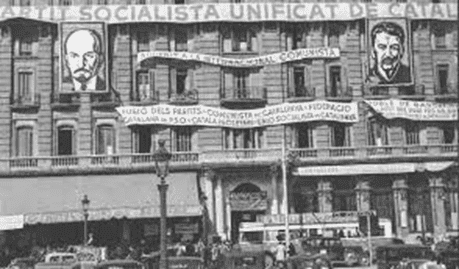
He returns to the city the next year as an International Brigade soldier, only to find that the hotel has become the headquarters of his new master, the Communist party. A huge portrait of Stalin hangs down over the room where he was once so happy, and he has no answer to give when Maria tells him that “they take everything. Even you.”
Ninety years later, the Plaça de Catalunya is at the beating heart of the modern city of Barcelona, but many of those walking among the statues and fountains are unaware of the extraordinary events that once took place there, and which I have tried to bring to life in my novel.
In the preface to the Room of Lost Steps, you wrote that the novel “is a fiction set withing real history,” What does that mean?
I have always believed that a historical fiction writer can add to history, but that he or she must not change it, because that would be to deceive the reader. But then, when I visited Barcelona to research this book, I realized that I had a unique opportunity to go further than addition, because the locations and timelines of the street fighting between the anarchists and the rebel soldiers on July 19, 1936 could provide a natural itinerary for my hero, Theo, to follow, thus enabling the reader to viscerally experience with him the principal events of the day through fiction wedded to history: a combination far more powerful than when the two just operate side by side.
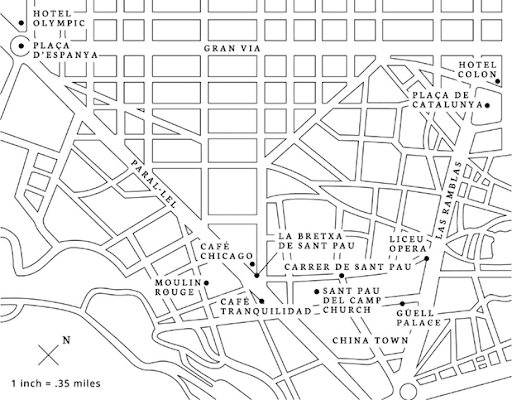
In the book, I provide this map (Barcelona, Events of July 19, 1936) to enable the reader to follow Theo’s itinerary, and I’ve attached a copy to illustrate how it works. He is awoken at dawn by gunfire outside the Olympic Hotel where he is staying – (see the top left of the map). Outside, in the Plaça D’Espanya, he witnesses the horror of army cannons being fired down a crowded street causing “a scene of carnage that nothing in his life up to that moment could have prepared him for … severed arms and legs and other nameless chunks and strips of flesh hanging in the leafy branches …” He flees down the Paral-lel boulevard to a huge barricade at the Café Chicago built by the anarchists to stop the soldiers linking with other military units to the south and east. There, he participates in the heroic resistance to the army’s attacks and sees how it ultimately fails when the soldiers use a human shield of women and children to advance; and then, hours later, he meets more anarchist fighters and assists in the retaking of the barricade, before he is sent on as a messenger to bring news of the victory to the charismatic anarchist commander, Buenaventura Durruti, in the Ramblas. This encounter affects Theo profoundly and convinces him that he is “touching history”: the same reaction that I am hoping my readers will experience.
Inspired by the Barcelona chapters, I took the same approach of welding fiction and history together, when writing the war chapters in Part 2 of the novel. A group of volunteers did arrive at the front on the night before the Battle of Jarama without any military training, and Theo becomes one of them. His role as a runner messenger allows the reader to see first-hand the insanity of the orders that led to the unnecessary deaths of hundreds of Americans the next day, and a mutiny and court martial did occur after the battle just as described in the book …
Thus, history in The Room of Lost Steps becomes not just a framework for fictional events, but fuses with the fiction in the events themselves, allowing readers to share the experience of the men and women who lived through those extraordinary times. Their story is often shocking and distressing, but as I say in the Preface, “that is how it was”, and sometimes “history can appear stranger than fiction.”
What effect does the Spanish Civil War have on the hero of the novel, Theo Sterling?
Theo joins the International Brigades half way through the novel for a number of reasons. He fell in love with Spain and with the firebrand anarchist girl, Maria, during the summers he spent in an Andalusian village before the War, and he wants to return to fight to prove himself worthy of her, and because his highly developed sense of social justice makes it impossible for him to stand aside while the Spanish Fascists seek to overthrow the democratically elected government, so as to preserve their power and wealth and keep the poor from escaping a condition of semi-serfdom that has prevailed for centuries. Theo’s life experience up to this point has led him to believe that a man can ‘touch history’ and make a difference to the world, and he is determined to put this to the test.
At home, Theo’s stepfather tries to dissuade him from volunteering by describing his experience of the horrors of trench warfare in the First World War. But Theo won’t listen. Love and anger and belief drive him forward, and the second part of the book tells the story of what happens to these emotions when they are tested in the furnace of mechanized war.
Theo’s ideals help him to make a perilous crossing of the Pyrenees at night and his assignment to the Lincoln Battalion makes him feel that he has rediscovered his American identity. But thereafter the process of disillusionment quickly begins. He receives no training whatsoever before the incompetent Communist Brigade leadership throw the battalion into a suicidal attack in which they suffer 66% casualties without getting anywhere near the Fascist line. And after the battle, the survivors are kept as virtual prisoners in the trenches, so that they won’t be able to tell their stories to the new recruits.
Another battle follows, and Theo experiences the full terror of modern warfare. As he shelters from the ceaseless shelling, parched and starving, he comes to understand that his stepfather was right. Flesh is no match for bullets and bombs, and courage does not win battles. Might will defeat right because the Spanish Republicans cannot match the Fascists as long as they are supported by Nazi Germany and Mussolini’s Italy, and the western democracies refuse to intervene. One soldier and his rifle have no significance in such equations, and in the end, all that Theo has left as he stumbles in retreat across the desert landscape is the need to save his wounded friend.
The Room of Lost Steps is a story of belief and disillusionment, of hope and loss, and what is left of a man when his ideals are stripped away.
Grab your copy of the book on Amazon | Bookshop.org