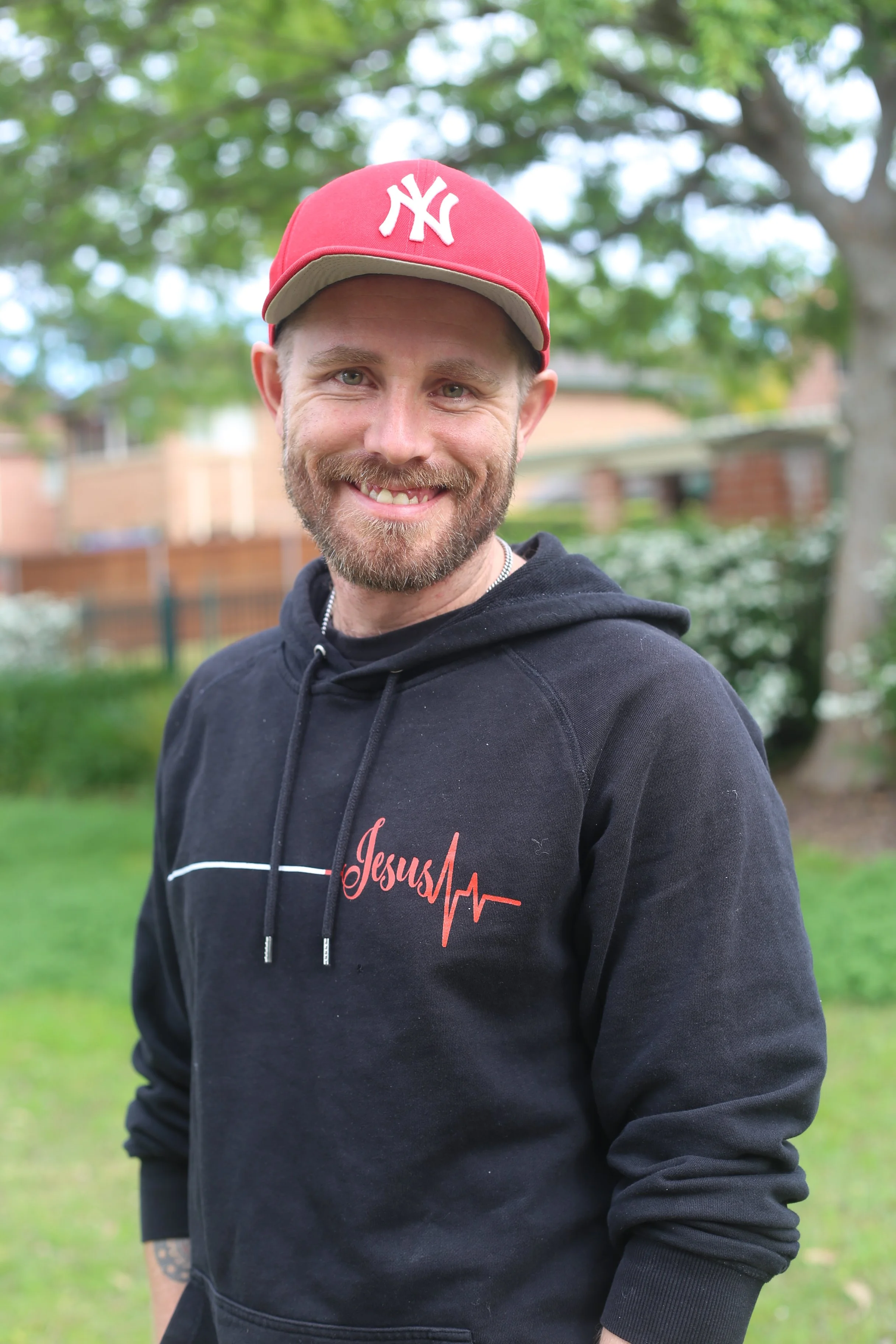
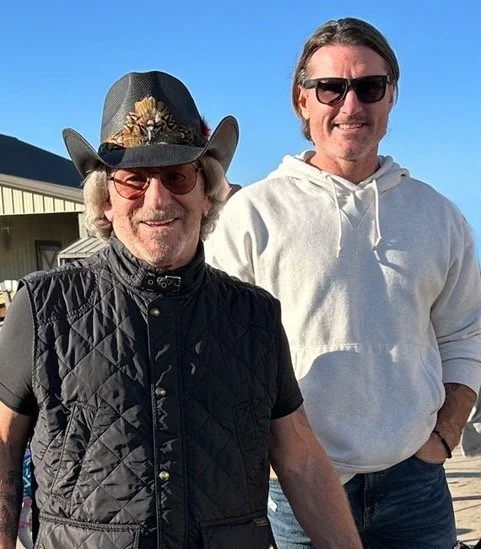
Q&A with Tom Hruby and James Pomerantz, The Breacher's Playbook
/
The Breacher’s Playbook asks a powerful question: What happens when the skills that kept you alive in war are no longer welcome in everyday life? What inspired you and Tom to explore that theme in such a personal and intense way?
JAMES: Transitioning from military life to civilian life is a struggle for so many veterans, especially those from Special Operations. When training for more than a decade appears to be for skills no longer needed, questions inevitably arise surrounding, what next? Tom and I talked extensively about how the book’s main character (retied SEAL Deklan Novak) struggling with his transition into civilian life would react if he suddenly found himself in a position to put those military skills to use again. What is someone capable of doing if unspeakable harm is done to a family member or friend? Is this the most revealing character examination that a man can be confronted with?
TOM: The truth is that most of us spend a decade after service trying to recreate ourselves and transition into something acceptable by modern society. Most special forces guys are warriors at the core long before they attend BUD/s or the like. Given years of training and experience we become masters of our craft – guaranteed only for the wars to end and the need for our skills on the battlefield to wane.
Guys like me get bored if not effectively used and decide to move on. Of course we are unprepared for how dissatisfying life in the regular world can feel. We desire to make great impact, but the reality is that the skills of a legitimate warrior do not carry over easily.
I consider myself a highly trained warrior fortunate to be able to just sit back and enjoy the regular world while it is still here. Personally, it has given me a great sense of peace about how my life experience is not wasted nor irrelevant. For me, it would be impossible to tell my story without exploring this transitioning theme. The entire story is about the journey of a man finding peace, purpose, and balance between power and restraint in a bold new world. It is a story of rediscovery, reconciliation, and redemption.
Deklan Novak’s journey touches on grief, reinvention, and moral complexity. How much of his story is drawn from Tom’s real experiences—and how did the two of you choose which elements to fictionalize?
JAMES: Deklan’s journey is all drawn from Tom’s real-life experiences until Deklan is recruited by the FBI, joins their Quantico training facility, and is sworn in as a Special Agent assigned to a Violent Crimes Against Children squad. The elements we chose to fictionalize, fall in line with Tom’s remarkable achievements. He is in his early forties and his life is far from complete. Deklan Novak became the fictional vehicle for imagining what’s next. Tom never believed the bar was ever set too high.
TOM: Declan feels like me. He thinks like me. He is complex like me. Deklan wrestles with ambiguity every step of the way. And he knows it. Or at least, he is increasing his awareness of life’s ambiguities. At the same time, he is a damaged, traumatized man as we all are. He is dealing with his personal grief while confronting the grief of the outside world. We get to watch Deklan bounce back and forth as he molds his new understanding of the world.
The novel unfolds in nonlinear chapters over two decades. Why did you choose this structure, and how does it reflect Deklan’s internal transformation?
JAMES: Nonlinear structures allow authors to immerse the reader right away in what the character is made of. Many times, as a reader, I am tempted to skip all the early biographical details in a novel to get to the meat of the story. A nonlinear structure eliminates the temptation to skip ahead.
TOM: I have always loved nonlinear story telling. It provides an immediate richness to the story and characters that are unattainable with other formats. It also allows great freedom in adding variation to the back story. I feel that once you get it right it opens up vast opportunity to color the story in almost any way that you like. I am also simply drawn to the fact that it is complex and difficult to do well. This structure alone is artful.
From combat missions to courtroom testimony to college football, the novel spans vastly different worlds. What was the biggest challenge in weaving those threads together?
JAMES: By choosing a nonlinear structure and traveling from combat to the courtroom to the football field, the biggest challenge was what every author must confront which is preventing the reader from putting the book down. The subjects help. The interest level provided by combat experiences, playing Division-1 football and the intricate inequities in our legal system regarding abused children begin at the highest level. Our only goal from that point on was not to disappoint the readers with a predictable script. A great novel based on a true story feels real from page one.
TOM: There is so much story that was removed from the original manuscript. We hope to tell those stories in subsequent books. It was difficult deciding what we would remove from the original manuscript of over 600 pages. I felt like the integrity of the characters and total story would suffer greatly as we cut story after story. Fortunately, I think that James is rather a genius and the book is actually better cut nearly in half. I am not quite sure how James did it. He somehow has the ability to see the whole story in his mind.
Deklan is both a warrior and a witness—a character shaped by trauma, loyalty, and a deep moral code. How did the two of you approach writing a character who is both emotionally guarded and deeply empathetic?
JAMES: As a co-author but not the subject material, I only had to look inside Tom Hruby to find the morality inside of Deklan Novak. My father didn’t have to pat me on the back or reward me for acting the way I was supposed to act. I was expected to follow his lead. Tom didn’t have to explain to me what he was all about. I followed his lead.
TOM: Deklan is an enigma, even to himself. He is discovering himself, piece by piece. As readers, we see this happen. We get to see why he behaves a certain way before he even knows why. We see why he is guarded emotionally and watch him confront his unconscious traumas in real time. I think that is a fun part of the story, how readers can anticipate the way in which Deklan will confront his own thinking and decision making. I think our structure is remarkable in how layered a character and environment we created.
Kaley’s storyline is haunting and painfully real. Why did you decide to place Deklan in a position where he must navigate emotional and legal gray areas so far removed from combat?
JAMES: Again, this falls back on what is the purest form of character examination. Deklan, as a Navy SEAL, is paid to protect the nation and is the wall that our enemies must get over if they want to defeat the nation. An abused child is defenseless, much like the public in wartime. SEALs do not endure hell for a paycheck. SEALs endure hell for a lifetime of respect. That doesn’t end with retirement from the Navy.
Tom, as a Navy SEAL and former Division I athlete, and James, as a seasoned novelist how did your collaboration begin? What was the writing process like between such different life experiences?
JAMES: I met Tom at Northwestern football summer camp in 2014. I was working on another novel about an older college football player. Head Coach Pat Fitzgerald was a friend and allowed me to be a guest at training camp. There, Pat introduced me to Tom Hruby. Tom and I became friends but did not begin work on The Breacher’s Playbook until 2023. Writing with Tom is a breeze. He did all the hard stuff!
TOM: We met at Northwestern Kenosha summer football camp in 2014. We became friends discussing several projects over nearly ten years. Our lives got in the way of this project until 2024. I always knew that I wanted to work with James and when it turned out that we both were still interested and motivated it was easy. Surface level James and I appear different but we are very much the same character. We are both explorers, truthtellers, adventurers, teachers, and men of integrity. When men like this come together, it is pretty easy.
The book pulls back the curtain on elite military training, college athletics, and child protection investigations. What kind of research went into making each of those worlds feel so vivid and true to life?
JAMES: Tom’s grueling experiences at BUD/s and as a D-1 football player came to life on the page quickly. I traveled to Quantico and the FBI Academy for an unprecedented access visit to a secure military base. The FBI Academy is on the Marine Base at Quantico, Virginia. Tom’s SEAL background opened doors that normally never opened at the FBI Academy. The lead instructor at the Academy was a former Navy SEAL and knew Tom. He gave us hours at the base to show us every step of training that an FBI agent endured throughout his time in the academy.
TOM: I have experienced them first hand. We also had unprecedented access to experts and facilities.
If the book were adapted for the screen, who would you want playing Deklan—and what tone would you want the adaptation to strike.
JAMES: Tom and I have discussed this question at length. I was leaning towards Tom Hardy as Deklan, but age and similar roles may creep into the boundaries. Timothy Chalamet is a great actor but would have to bulk up for the role. Chris Pine, Chris Pratt and Jake Gyllenhaal are all possible candidates, but a similar role tag may come into play. The tone of the movie must be thriller laced with the testosterone humor associated with SEAL teams, football teams and law enforcement.
TOM: My sons think that I should play Deklan.
The Breacher’s Playbook is the first in a planned trilogy. The book ends with Deklan joining the FBI. What can you tell us about where Deklan’s story goes next?
JAMES: Deklan grows frustrated with the legal handcuffs associated with a federal agency and law enforcement in general, where it seems like more rights are given to criminals than the victims. Deklan will explore outside opportunities to use his skill set more effectively through a privately funded police force made up of Special Operations veterans.
TOM: Deklan does not stay with the Feds for very long. He grows increasingly disillusioned with the bureaucracy and impotency of government agencies. Deklan is lured away from governmental institutions to something far more versatile, dynamic, funded, and functional.
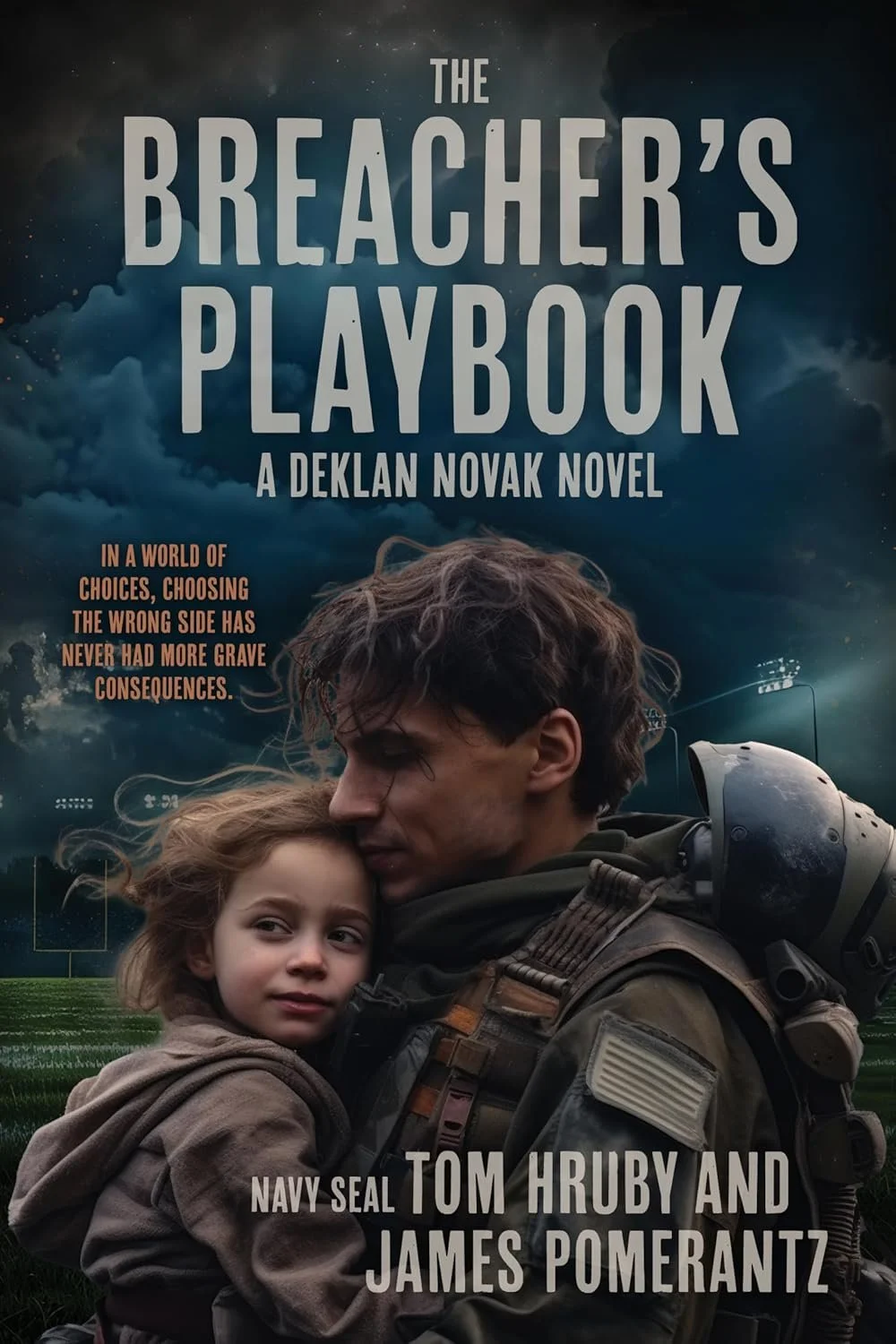
About The Playbook:
Deklan fought his demons in the combat zones of Iraq and Afghanistan as a Navy SEAL breacher and now in Chicago as a special agent for the FBI’s Violent Crimes Against Children squad.
That grit will be what he leans on in his new role as a tough FBI agent tasked with unraveling the disappearance of two children from a daycare center owned by his mother in this first installment.
This debut narrative, the first in a planned three-book series, is a fictional account based on Hruby’s real-life story.
The mystery thriller lays the groundwork for what the authors describe as a recurring character who is hard, fast, and mean as a razor wire. Deklan’s life path is one of determination and sacrifice in the face of defeat. That grit will be what he leans on in his new role as a tough FBI agent tasked with unraveling the disappearance of two children from a daycare center owned by his mother in this first installment.
Get your copy on Amazon | Bookshop.org