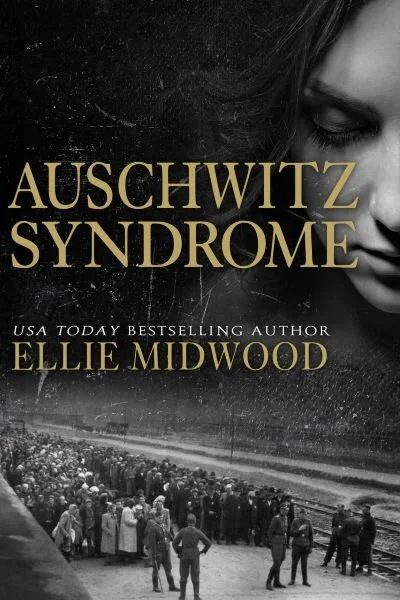
Spotlight: Auschwitz Syndrome by Ellie Midwood
/
Germany, 1947.
A strange case scheduled for the Denazification Court lands on the desk of an American psychiatrist currently serving in Germany, Dr. Hoffman.
A former Auschwitz guard, Franz Dahler, is set to appear in court, and he has requested to bring the most unexpected witness to testify in his defense – one of his former inmates and current wife, Helena.
As soon as one of the newly emerging Nazi hunters and former Auschwitz inmate, Andrej Novák, recognizes the officer’s name, he demands a full investigation of Dahler’s crimes, claiming that the former SS man was not only abusing Helena in the camp but is also using her as a ploy to escape prosecution.
Silent, subdued, and seemingly dependent on her husband’s every word, Helena appears to be a classic victim of abuse, and possibly more of an aid to the prosecution instead of the defense.
As she begins giving her testimony, Dr. Hoffman finds himself more and more confused at the picture that gradually emerges before his eyes; a perpetrator is claimed to be the savior and the accuser, the criminal.
The better Dr. Hoffman gets to know each participant, the more he begins to question himself; whether he’s facing a most unimaginable love story, or a new and still-nameless psychological disorder affecting the very manner in which Helena sees the events of the past.
Partially based on a true story, this deeply psychological, haunting novel will take you back in time to the heart of Auschwitz and post-war Germany, and will keep you guessing the true motive of each side.
Excerpt
Momentarily, she grabbed my elbow and pulled me, still wrapped in the colorful blanket, towards the door of the barrack. She shoved it open and pushed me into the snow-shrouded outside. A gust of wind hit me in the face, along with her words.
“I have not the right?! Look!” She pressed my jaw into her vice-like grip, directing my face toward the crematorium. “Look at the chimney, you idiot! People are being burned there as we speak. People are being burned there daily, our own people, our own families and you tell me that I have no right?! You wish to celebrate it by dancing and singing! You wish to thank the good Herr Kommandant for his kind treatment of us! You wish to thank the SS for being so considerate!”
“It has gotten better under Kommandant Liebehenschel’s command,” I muttered stubbornly in my defense. “You were not here before, when Höss was in charge. You have not the faintest idea of how bad it was then. If there’s anything we can do to keep in Kommandant Liebehenschel’s good graces—”
“Just like you keep in Dahler’s good graces?” She stepped in front of me. Shadows played on her face, provided by the light of the stove, lit inside the barrack, distorting it and twisting it into a grotesque mask.
I did not say anything to that. I had not anything to say to that.
“You say I have no right! No, I say, it’s you who has no right. You have no right to call yourself a Jew after what you did. You’re a disgrace to our ancestors who suffered but endured in the name of God. You’re a disgrace to our history. You’re nothing but a dirty tramp who sold herself to the SS.” Her face almost touched mine. She repeated, articulating every syllable, “Dirty. Tramp.” The words stung more than the back of her hand with which she’d hit me across my mouth. I sensed it coming and didn’t turn away, didn’t try to dodge it.
She was right. I was a dirty tramp and I deserved it.
Elza was long gone and I still stood in-between the darkness and light, between the madness and sanity, between the life of the barrack and death of the chimney, belching reddish clouds of smoke towards the indigo, indifferent sky. It was December, yet no one shouted for me to shut the door like they ordinarily would have. It was Róžínka who took me by my shoulders and brought me inside to the suddenly-quiet barrack and whispered in my ear the only consolation she could offer me, “she has no right to tell you how to survive. She’s mad at you for having me around, is all. Don’t take it to heart.”
Buy on Amazon | Barnes and Noble
About the Author
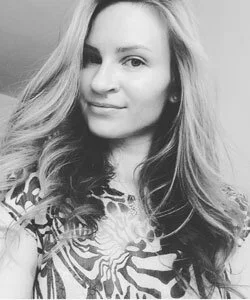
Ellie Midwood is a USA Today bestselling and award-winning historical fiction author. She owes her interest in the history of the Second World War to her grandfather, Junior Sergeant in the 2nd Guards Tank Army of the First Belorussian Front, who began telling her about his experiences on the frontline when she was a young girl. Growing up, her interest in history only deepened and transformed from reading about the war to writing about it. After obtaining her BA in Linguistics, Ellie decided to make writing her full-time career and began working on her first full-length historical novel, “The Girl from Berlin.” Ellie is continuously enriching her library with new research material and feeds her passion for WWII and Holocaust history by collecting rare memorabilia and documents.
In her free time, Ellie is a health-obsessed yoga enthusiast, neat freak, adventurer, Nazi Germany history expert, polyglot, philosopher, a proud Jew, and a doggie mama. Ellie lives in New York with her fiancé and their Chihuahua named Shark Bait.
For more information on Ellie and her novels, please visit her website. You can also find her on Facebook, Amazon, and Goodreads.
Giveaway
During the Blog Tour, we are giving away a paperback copy of Auschwitz Syndrome! To enter, please use the Gleam form below.
Giveaway Rules
– Giveaway ends at 11:59 pm EST on November 8th. You must be 18 or older to enter.
– Giveaway is open to US residents only.
– Only one entry per household.
– All giveaway entrants agree to be honest and not cheat the systems; any suspicion of fraud will be decided upon by blog/site owner and the sponsor, and entrants may be disqualified at our discretion.
– The winner has 48 hours to claim prize or a new winner is chosen.