Spotlight: Karl Marx and the Lost California Manifesto by Scott D Carlson
/
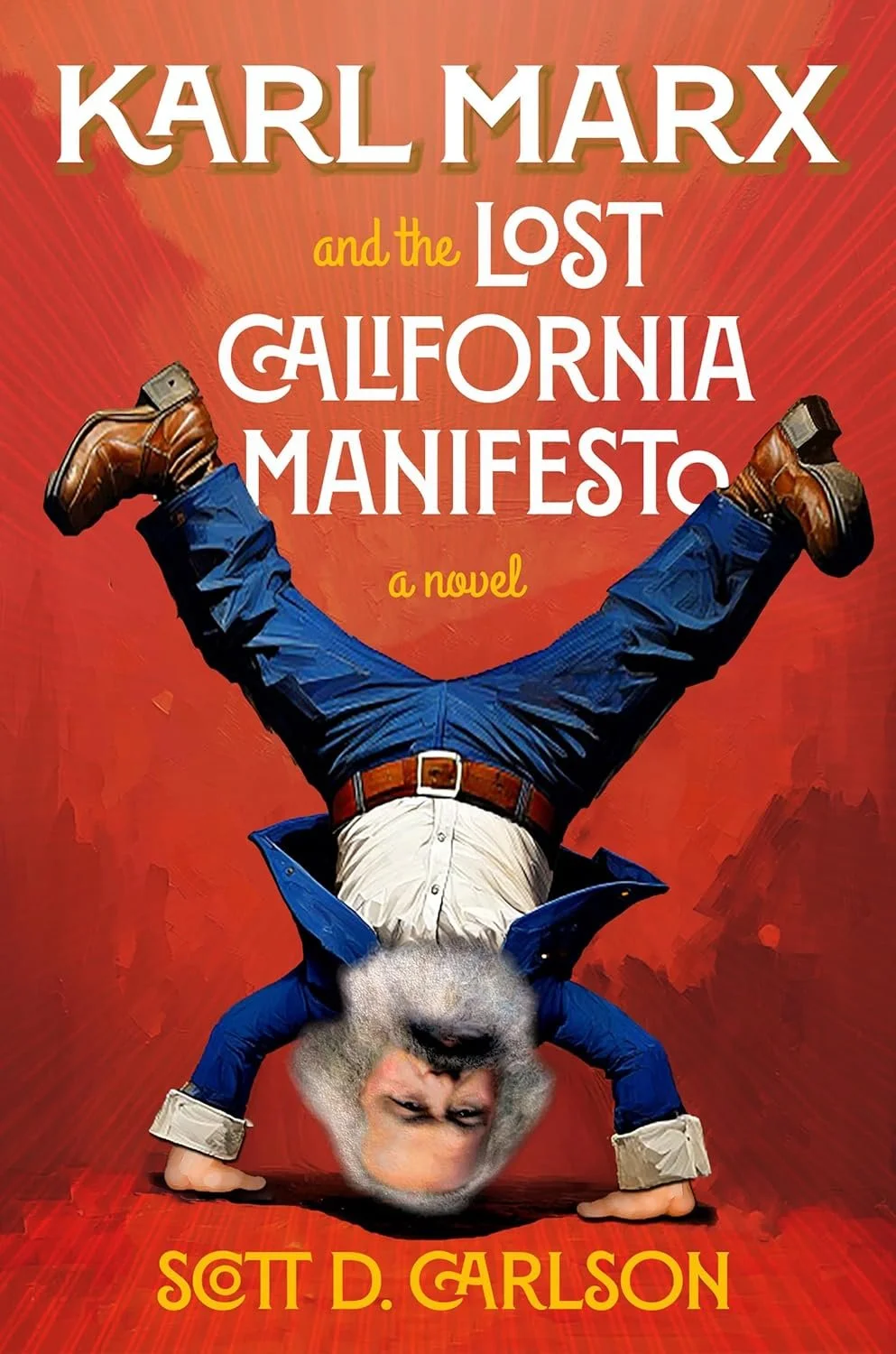
Part adventure, part satire, and wholly original, Karl Marx and the Lost California Manifesto by Scott D. Carlson explores the Gold Rush through the eyes of one of history’s most unlikely dreamers.
Facing financial ruin and imprisonment in London, Karl Marx makes a desperate leap westward in 1849, bound for California’s gold fields. There he meets Sixto, a resourceful teenager raised by padres in a mission, whose quick wit and courage earn Marx’s respect. Together they head into the Sierra Nevada in search of gold, pursued by bumbling Prussian agents determined to retrieve Marx’s lost Manifesto. Along the way, they encounter fortune seekers, Miwok villagers, and the infamous outlaw Joaquin Murrieta. As they navigate greed, prejudice, and absurdity, Marx begins to see how the communal spirit of California’s frontier challenges his own revolutionary ideals. Through Sixto’s warm and sardonic voice, the story unfolds as both a picaresque romp and a meditation on belonging and belief.
Excerpt
From Lt. Junger and Lt. Fischel to King Frederick William IV
May 14, 1849
To: His Excellency King of Prussia Frederick William IV
Re: Herr Karl Marx
To our most high King, the greatest sovereign in all of Europe—Ja in all the world! Your servants have cleverly followed, if we do humbly say so ourselves, Herr Marx and his Junge companion to this settlement called Sacramento, in the hinterland of California. It is a place even more remote and Scheiß-ridden than San Francisco. A flood came and turned the entire settlement into one great cesspool of Scheiß, mud, offal, garbage, and dead beasts. There are no wonderful water closets here like those your Majesty has at Sanssouci—in fact, there are no water closets at all. Always the whole settlement smells like the hind end of a peasant horse.
Expertly disguised as miners from Chili, we left San Francisco on the same steamboat as did Marx, the Junge, and their donkey. Because of our Chilian dress, we met on the boat the hostility of some drunken Americans, who insisted we must keep first to the aft, then to the forward part of the boat. This conformed perfectly with our plan, as we could then stay close to Marx and his accomplice.
In the morning, we witnessed Herr Marx engage in argument with some of the passengers and then, as seems to be his habit, with the boat captain. Marx cannot tolerate anyone other than himself being the “captain.” As is also his habit of late, he came out on the losing end. He then ordered the boat captain to deliver him and the Junge to the bank of the river. The captain resisted but finally gave in, no doubt thinking it best just to be rid of Marx, and abruptly deposited them on a spit of sand in the river channel.
Soon after, we asked the captain to bank the boat and we disembarked. After fighting our way through the bulrushes, we came out at a point from which we saw Marx and the Junge setting off overland. On the boat, Marx had been engaging in some very odd gymnastics, and he continued these as they set off toward the east. They, and we, did not know that they were headed in the direction of a native village, which they eventually entered.
From a distance we waited as the subversives conducted in the village what we believe to be benign business with an American woodsman. After seeing them leave, we entered the village. Through the woodsman there, we learned that the natives had been entertained by Marx, and that they expected us to perform for them too. Wanting to please, your servants proudly represented the Prussian nation by performing a very creditable Lauschaer Galopp, for which we received a standing ovation. The woodsman also revealed to us Marx’s probable ultimate destination in the mountains beyond Sacramento. As much as we then wanted to continue with our surveillance, our native hosts said we must, before leaving, eat a local dish of mashed boiled acorns garnished with bits of tuberous material. We acceded, unfortunately, as almost immediately we were both befallen with, we are sorry to offend your Excellency, explosiver Durchfall, which disabled us for the rest of the day and that night.
However, the next day, we were able to muster the strength to set off for this sorry settlement that makes a Latvian hamlet seem like Baden-Baden. Here ensued some temporary trouble from which we will soon extricate ourselves and again be hot on the trail of Herr Marx, to wit: We eventually located Marx and the Junge in one of the several houses of drink and gambling—an establishment charmingly referred to locally as a “café chantant.” This house also featured music provided by a French woman and an American piano player who had to be, we are sure, working together for the first time. The music was not to our taste, nor was the very bad beer—how we greatly miss the beloved brews of home! The French woman was an apparent lady of the night posing as a mumbling chanteuse. The American played in the style of a Lutheran church organist, and the mismatch resulted in loud catcalls from the surly patrons.
We followed Marx and companion to a gambling table with the intent that we might be able to bankrupt him, but quickly discovered that the table, run by a Mexican card dealer, was exclusively for speakers of Spanish. The confusion caused by this language obstacle was compounded by the unfamiliar game being played, and further so by having to endure the awful music. Oh how we miss the strain of accordions playing the Hohenfriedberger Marsch in a Biergarten! In short, we have been unusually frugal with your Excellency’s money, but we risked an imprudently large bet in the game and lost. Conversely, Marx, aided by the Spanish-speaking Junge, bet against long odds with what we believe was one of his last coins—and won.
Apparently feeling flush, Herr Marx proceeded to drink several glasses of the lousy beer. Then, in a break in the chanteuse’s “music,” and presumably inspired by her nationality, Marx stood upon a table and began singing the revolutionary Marseillaise anthem. We were alert that this might be a signal or coded message to other revolutionaries in and around the “chantant,” but the catcalls grew very loud and Herr Marx was struck by bottles thrown by a table of Australians. One of the Australians then turned his attention to us. He wanted to know “what the hell you’re gawkin’ at” and wrongly accused us of Sodomitic desires. His compatriots soon joined in abusing us. We could not speak openly without giving away our identities to Marx. And we are not French puffs “de crème.” One thing led to another, and we found ourselves outside in a fistfight with the Australians. We fought bravely but were outnumbered and were pitched into a mudhole caused by the recent flooding. To add insult to injury, the Australians exposed us to several lewd gestures which were of a nature unlike any we have ever seen, even in a Prussian enlisted men’s barracks. However, the Australians received a comeuppance of sorts as they—and we, too, unfortunately—were arrested by constables and arraigned by the local justice of the peace, who apparently makes his living by taxing foreigners with outrageous fines, nonpayment of which results in confinement. We had only a small sum left after the gambling table and thus are enduring an unpleasant stay in the “hoosegow” with the Australians but expect to be released shortly.
Your Excellency may be assured that despite losing Herr Marx’s trail for a short time, we are confident we will be able to find him, as we know of his intended destination. However, we regret to report that we are very short of funds. Our accidental gambling loss has drained our “treasury,” so to speak—please send money, your Highness! You may send it to Sacramento, in care of our cover names, “Hozay and Horhay the Chilians.”
We thank you profusely and remain deeply dedicated to your service.
Your servants,
Lt. Ernst Junger
Lt. Franz Fischel
Buy on Amazon | Bookshop.org

About the Author
Scott D. Carlson writes with humor, irony, and compassion. His varied background—as lawyer, teacher, cook, and storyteller—brings authenticity and depth to his work. He holds an MA in Creative Writing from New York University and lives in the San Francisco Bay Area, where California’s layered history continues to spark his imagination. Learn more on his website.