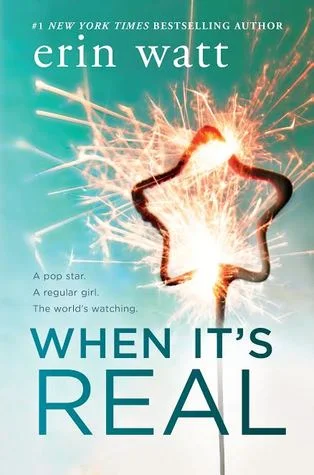
Review: When It’s Real by Erin Watt

This book has potential to be loved. It’s a sweet YA love story featuring an average girl, Vaughn, and a famous rock star, Oakley. And it has fake dating; everyone loves the fake dating trope. Vaughn is recruited to help Oakley’s image, and somewhere down the line they begin to fall in love.

The story is unoriginal, but never seems to feel old. It was always entertaining. I especially loved how the author incorporated the fandom life. Throughout the novel, tweets from fans of Oakley were showed in the narrative. Sometimes they were quite funny.

I must say that the PR campaign was a little weak and unrealistic. How did no one speculate that the relationship was fake at first?

Although, I didn’t love it; I could see how others would enjoy it. It is mostly angst free and is definitely a no commitment, quick summer read. The characters are somewhat likeable. They definitely are not perfect and most of the time act with their emotions instead of their head.

The book does a great job diving into the insane lifestyle of a celebrity, and how the fear of being irrelevant and forgotten impacts them.

There is sort of a love triangle. Vaughn is in a relationship when tasked with the job. I felt like the story could have done without it. As for the romance between Vaughn and Oakley? The chemistry was not there entirely.

The sparks were missing. And I think I felt that way because of Oakley’s behavior towards Vaughn most of the book. Oakley was a brat most of the book, and at times was rude for no reason. Vaughn and Oakley do share a couple of cute moments but they aren’t defining or memorable.

Final Analysis

When It’s Real is a quick summer read that is definitely aimed at a younger target market. The characters tend to be somewhat likable and the story is the dream life of some. Who wouldn’t want to date their favorite celebrity?  

Review: The Foxe & The Hound by R.S. Grey

Buy on Amazon

Buy on Amazon

R.S. Grey’s books tend to all follow the same formula. The romantic leads tend to lean more towards enemies than friends during the first half, and then events or coincidences (i.e. running into each other a lot, working at the same doctor’s office, etc.…) cause the two individuals to see each other in a new light.

There is a lot of sexual tension, banter, and even a sprinkle of sex in an unconventional place thrown in. The book ends with a nicely tied red bow and sometimes even features a time jump with a glimpse of the lead’s new life together. Spoiler Alert: they are still super in love and there might even be wedding talk.

Although this book was entertaining, it definitely followed the R.S. Grey’s book writing formula. The characters had different occupations; however, too many things felt familiar. The familiarity was both a blessing and a curse.

On one hand, I enjoyed the book because she does the enemies-to-lovers trope very well and she writes excellent banter. It was funny, and the romance was actually super cute. It’s a quick read, and it is almost entirely angst free.

However, on the other hand, it would be nice to experience something fresh from this author. Her books are beginning to blend together and her main characters are starting to feel unoriginal. It makes it hard to want to continue to read because you already know how the story is going to turn out.

Characters

There is not really much to discuss about the characters. They’re a little unforgettable and seem too familiar. It is worth mentioning that they are likeable characters.

I will say that Madeleine’s background was seriously lacking. I don’t think it was ever truly explained why she is a Real Estate agent. She said she enjoyed her job, but it was never fully explained why she graduated college and chose that specific career when I don’t believe that was her beginning goal.

Final Analysis

The Foxe & the Hound is a good book, but it’s a book that R.S. Grey has written many times before. It does have a good romance and nice humor, but is frustrating because of the lack of unoriginality, and it isn’t something that truly stands out.

Review: Paid Companion by Nia Forrester

Buy on Amazon

Buy on Amazon

This wasn’t what I thought it would be. I thought it would be an entirely fun and simple read; random family secrets were not figured into my equation. Nevertheless, it was not a bad book. This book depends on coincidence and suspension of disbelief. It does try to highlight family and the challenges that can come with it. Also, there are a couple of funny moments.

It definitely dragged on, and many scenes did not contribute to or move the overall plot. The scenes that should have been featured took place off screen.

Characters would start to reveal a secret and then the chapter would end before the words even left their mouth. The next chapter would start sometime after the reveal, and pages later the audience would finally find out what was revealed. It was frustrating because that happened a lot.

Also, there was a lot of telling instead of showing. For example, the book started at an awkward place. The main character was getting ready to leave for her job. It would have been more interesting to have seen her acquire that job instead of telling her friend how she got it. The dialogue felt unnatural and too much at times.

Characters

Overall, the characters were likeable and decent. There was minimum backstory for Lia. I would have liked to get to know her more. For example, why is she working at a model agency? What about her art?

Because the Morgan family are portrayed as this wealthy and high class family, Lia was supposed to sort of be relatable to the common people. At certain points in the book she was relatable, but at other places she was not.

Out of all the characters, Kevin might have been the most developed. In addition to getting a prominent backstory, he felt the most real.

I was scared that this book was going to have a love triangle. It doesn’t and I’m extremely thankful for it. Paid Companion is only around 200 pages and the main romance lacked important development. If there was a love triangle, it would have felt rushed and unnecessary.

Like mentioned earlier, the main romance is a little under developed at this point in the story. The couple is cute together, and do have the potential to be great, however, with the material given there needs to be a little more development.

They got together within 5 days of knowing one another. It’s a good start to their relationship; but I would have liked to have seen more emotional conversations and them spending time (together) alone and actually bonding. The fact that important conversations between the romantic leads took place off screen was a disadvantage to this couple.

Final Analysis

Paid Companion is a relatively short book that does manage to drag on. It is not completely dissatisfying. There are some funny moments, and it does have a romance that has the potential to be great.

Review: Tired of Apologizing for a Church I Don't Belong To by Lillian Daniel

About the Book

WHEN LILLIAN DANIEL APOLOGIZED to a total stranger for every bad thing that had ever been said or done in the name of Christianity, he was surprised that she was responsible for all that. "The Inquisition? Don't even raise it, I'm way ahead of you. I was mad about it before you even heard of it, that's how open-minded I am. Salem witch trials? I know! So embarrassing. Can I hang out with you anyway? You're too kind." "Religion is responsible for all the wars in history," they would say, and I'd respond, "You're so right. Don't forget imperialism, capitalism, and racism. Religion invented those problems too. You can tell that because religious people can be found at all their meetings." In this book, Daniel argues that it's time for Christians to stop apologizing and realize that how we talk about Christian community matters. With disarming candor laced with just the right amount of humor, Daniel urges open-minded Christians to explore ways to talk about their faith journeys that are reasonable, rigorous, and real.

AFTER THE PUBLICATION of the much talked about When Spiritual But Not Religious Is Not Enough: Seeing God In Surprising Places, Even the Church, Lillian Daniel heard from many SBNRs as well as practicing Christians. It was the Christians who scolded her for her forthright, unapologetic stand as one who believes that religious community matters.

The Christians ranted that Christians, by definition, tend to be judgmental, condemning hypocrites, which is why people hate them. By saying religion matters, she was judging those who disagree, they said, proving the stereotype of Christians. Better to acknowledge all that's wrong with Christianity and its history, then apologize.

In this book, Daniel shows why it matters how we talk about Christian community while urging open-minded Christians to learn better ways to talk about their faith.

Review

Well, judging the book based solely on it's title, I thought the book was going to go in another direction. In that regard, I had different expections but it definitely ignited many thoughts that have left me wanting to chat about. The book definitely touched on thought provoking areas of potential discussion that I find the believer, as she describes the “spiritual but not religious” and the non believer can really have some constructive dialogue. There is certain aspects that I didn't agree with but really appreciate her open mindedness to embracing the positive and the negative towards perceptions of those who believe and those who don't. 

There were two thoughts that defined her commentary in the book that I absolutely loved. She based it upon “spirituality without stereotypes” and “religion without ranting.” Depending on which side of the belief situation you fall into, there is such a large spectrum of where Christianity falls into and how so fitting those two thoughts embrace many of the problems that lie with the perceptions and actions of it. The breakdown of the Nones, really gets to the heart of where the rooted divisiveness in perception comes from. This book was honest, real and touched upon all the problems churches face today as well as the struggles of those who were given voice that have made to feel unheard or accepted. Her candid openmindness is one that many will find refreshing and hopefully open dialogue for Christians to be more open minded about communicating their faith.

Review: Can't Fight This Feeling by Miranda Liasson

I'm always on the edge of my seat when I finish reading the start of a series that I absolutely love, anticipating the second book, just hoping to meet my high expectations. Well, I'm so excited that Can't Stop This Feeling, the second book in Miranda Liasson's Spikonos series kept that awesomeness going with us diving more in the quirky Maggie and that delicious Drew.

I'm on the fence with telling you that this could be a stand alone. I guess it could but you wouldn't get everything you need that would appreciate it as much as you would've had you read the first book. For those of you who are new to the series, Maggie is definitely a one of a kind personality. As much as Maggie says she wants to move on, the one person that truly will always make her heart skip a beat is her late husband, who tragically died. She is making it through life with her young son but definitely could use a little love to brighten her days. There hasn't been anyone that came close to even igniting a spark until that rugged billionaire Drew came to town and changed her outlook from single lady to potential future.

Drew has had his share of heart break. First his brother gets involved with his girlfriend and then his father convinces him for the sake of business to get involved with a gal that wasn't right for him, he goes AWOL and ends up laying low trying to piece his life together. Seeing Maggie as only a friend, by the way who is also friends with his brother and his wife, needs a date to his brother's wedding. This is the brother who is getting married to his former love. So, you know that will be definitely awkward. Seeing that she has a calming way about her, invites her to an opportunity to be sort of mediator/date to keep the family calm. Maggie, being a psychologist, has a great way of putting people at ease which to Drew's surprise has an effect on him.

As the family drama unravels, Maggie and Drew find their broken hearts bonding in ways that neither one of them would've thought of. Drew doesn't exactly trust women and Maggie well, wants love but is afraid to jump in too deep. They say some people come into your life for a reason, will this two mend each other's broken hearts? I know the answer but I will let you enjoy the journal to find out.

Overall, Can't Fight This Feeling is just simply awesome. Miranda is such an awesome author who knows how to tell a story well. For this book in particular, I love second chance romances but both these characters had deep rooted pain that their journey was so compelling to follow. I love how she gets to their core but more important have struggles that will resonate with her readers. I love how these two were paired together because they both had stories that needed to be told. 

We always see women getting cheated on but here's a guy who got his heart broken that left him unable to trust. We see his pain and  his walls come down to not let their fear get in the way of trying to love. Maggie, who has a child and lost her husband, not seeing that there there is so much more of life to live and true love is possible, a second time around. She'd rather find someone that she can't really love because it is too painful but seeing her break down her walls to see her pain dissipate is something many women can connect with. The guilt of letting go and letting love in, really makes you find excited for her life transition.

I love how there is an authenticity to their relationships and find them to easy to connect with. You can't help but fall in love with them and want to know what's going to happen next. I have to say towards the end I thought the book was going to go another way but was very satisfied with the hea. I can't help raving about Miranda and this book. I'm excited to see what comes next. I definitely recommend if you haven't read the first book, grab it and then read this one. 

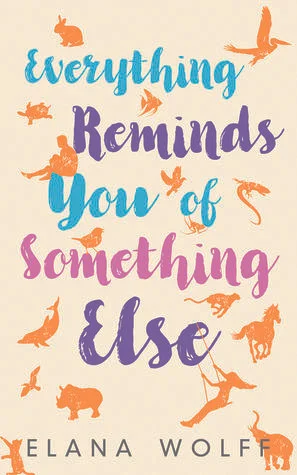
Review: Everything Reminds You of Something Else by Elana Wolff

Meta Power: Metamorphosis and Metaphor in Wolff’s Poetic World

Elana Wolff’s Everything Reminds You of Something Else invites us to enter a poetic world where every word is heavy with meaning. Every poem in the collection moves us to pause and think critically about our lives. In particular, as we open the door of this world, come in, and close it softly behind us, we may realize that our key to finding our way is through connections. Every poem we read pushes us to forge powerful connections and draw lines even if they are just lines in the sand. What is interesting is that the book helps us grasp the value and power of metaphor. Suddenly, the simplest ideas become absolutely essential for us both to understand and evaluate. In our modern-day reality, staying connected may seem absolutely vital for us. We must make connections between ideas. Wolf’s poetry collection revives our interest in ideas that we might have forgotten about. In fact, I believe that the value of this book lies precisely in its focus on connections. The book opens with a series of quotes one of which is from Kafka’s The Trial. The quotation comes at the end of the novel where K. is speaking to the chaplain. The chaplain tells him, “Your anxiety … I see in it a lack of necessary faith” (ix). Every poem in the book pushes us to realize the miraculous power of faith without which we are simply not alive, not in the fullest sense of the word. Essentially, every poem offers commentary on the power of faith.

One of the themes that some of the poems emphasize is the healing influence of prayer. The poems help us realize that prayer has more power than we may think. We get the sense that it could help us find a voice, an outlet for the pain inside. In “A Panegyric,” we realize that no matter how sincerely we plead and ask to be healed, our prayers could only end up torturing us. The act of praying can potentially free us from slavery but, for that, we need to find a way to escape our oppressors. The poem’s message also lies precisely in its focus on the strength of the prayer. In addition, the silent prayer in our hearts cannot fail to finally find an outlet for self-expression.Wolff writes that “[t]he pursuers withdraw to the citadel, / relieve their arms of upward gesture / Dusk descends / they lower their heads as well” (ix). In these lines, we sense that the pursuers are looking for peace, a chance to raise their arms in prayer and heal the pain inside. As we read, we may feel the urge to find healing, to finally get comforted. What this poem and many others seem to be telling us is that prayer has the power to do just that — to heal our pain and to help us find hope in the end.

In addition, some of the other poems in the book call on us to question what is real and unreal for us. One of the poems suggests that reality could actually not be material, after all. According to the poem “Air,” “Most of what is real is immaterial” (25). Consequently, we must look beyond our material reality in order to understand what is real. What the poem does not do is help us find a solution, a way to mitigate the pain. The speaker suggests that “[i]f you can accept air, you can accept beings of air; / you can accept the shadow / air holds in its nothingness and its light” (25). She places an enormous responsibility on our shoulders. We must try to look beyond our material reality and experience the world around us through more than just our senses. The speaker goes even further to suggest that we can and probably should accept both air and shadow as well as the inhabitants of both realms. The poem urges us to stop clinging blindly to our material reality and focus on seeing with our mind’s eye, Wordsworth’s “inward eye / which is the bliss of solitude.” Even though the airy realm in the poem may be difficult for us to relate to, we must try to accept both beings of light and shadow.  

Some of the poems discuss the theme of metamorphosis. It is one of the central themes that they share. One of the poems specifically addresses metamorphosis, especially the process of slowly becoming human. In the poem “Metamorphoses,” the speaker argues that “[s]ome are born human, most have to humanize slowly, / I want to say I’m on my way > at this point, pelican; / in time, perhaps, writer” (8). These lines might really surprise us, since the idea of working on becoming human might sound completely disorienting. It even seems incongruous that we must work on becoming human when we are supposed to have been born that way. The idea of metamorphosis, however, implies that as we grow and educate ourselves, we gradually become human. In other words, the central message seems to be that we should keep working on ourselves. Eventually, if we work hard enough, we might become human. While this idea may disorient us, its merit lies precisely in how hard the individual works in order to become an intelligent human and not just a mammal who is trying to survive. In the speaker’s case, she says that she slowly acquires human form as she metamorphoses from pelican to writer. The only issue is that the poem does not explain why some of us are born human, while others have to humanize.

The poetry collection motivates us to stretch our minds so we can see connections between our own experiences and the themes in these poems. We take our humanity for granted. We do not imagine that we have to actually work on becoming human. The poems, however, push us to realize that this process is as important as being alive. Not only must we work on humanizing. We could even attempt to see life like in a dream and strive hard to realize that “The great thing is the no thing that is not” (9). In other words, greatness is something we have not attained yet and have not been able to so far — not just yet. Nonetheless, the possibility exists for us and we could get closer to it by making connections. Metaphor is our key. We must give our imagination free reign. Perhaps, in the end, we still may attain clarity.